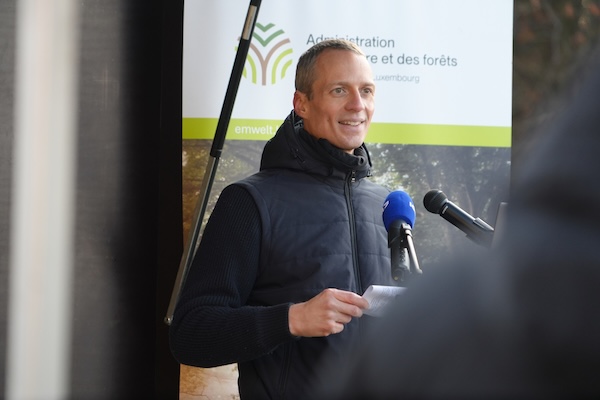
 Serge Wilmes, Luxembourg's Minister of the Environment, Climate and Biodiversity;
Credit: MECB
On Friday 27 November 2026, Luxembourg’s Minister of the Environment, Climate and Biodiversity, Serge Wilmes, and Director of the Nature and Forest Agency (ANF), Michel Leytem, presented the results of the 2026 forest health inventory, revealing a continued deterioration in the health of Luxembourg’s forests.
The inventory, conducted regularly since the 1980s, monitors the health of Luxembourg’s forests and helps to adapt forest management practices and identify measures to strengthen the resilience of forest ecosystems.
According to the ANF, in 2026, the inventory examined 1,176 trees across 51 observation plots, assessing criteria such as foliage loss and discolouration of leaves or needles as indicators of tree health.
The results showed that only 12% of the trees examined displayed no signs of damage, while 30% showed minor damage and 58% showed moderate or severe damage.
Certain tree species were particularly affected. In oak coppices, 91% of the trees examined showed moderate or severe damage or were dead, while only 1% of beech trees were in good health. Among oaks and other broadleaved trees, 73% showed moderate or severe damage.
In response to these findings, ANF representatives stressed the importance of continuing efforts to strengthen forest resilience and protect forest ecosystems through close-to-nature forest management practices.
These measures include selecting tree species suited to local conditions, promoting species and genetic diversity, encouraging natural regeneration, retaining deadwood and improving water retention through the restoration of forest wetlands. Maintaining permanent forest cover and managing wildlife populations also form part of this approach.
The government supports private forest owners through the Klimabonus Bësch subsidy, which encourages sustainable forestry practices that contribute to carbon storage, biodiversity protection, soil preservation, sustainable timber production and the provision of clean water and fresh air.
Municipalities are also encouraged to implement local measures through the Nature Pact, which supports biodiversity, ecosystem resilience, habitat connectivity and carbon sequestration.
Furthermore, the national forest and hunting roundtable “Bësch- a Juegddësch”, initiated by Minister Wilmes, brought together stakeholders to develop measures supporting natural forest regeneration and strengthening the capacity of Luxembourg’s forests to adapt to climate change.