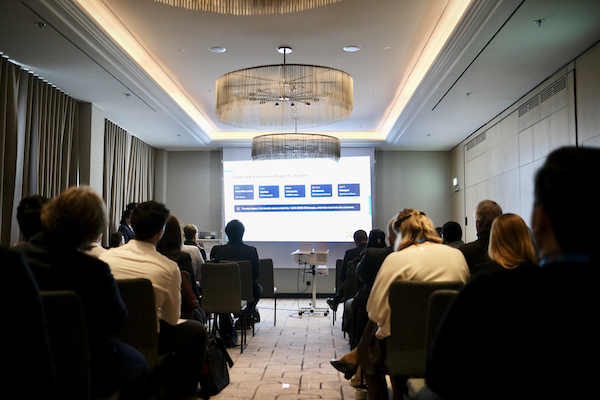
 Cybersecurity breakfast conference at the Marriot Hotel Alfa in Luxembourg Gare;
Credit: StevenMiller, Chronicle.lu
Cybersecurity breakfast conference at the Marriot Hotel Alfa in Luxembourg Gare;
Credit: StevenMiller, Chronicle.lu
On the morning of Tuesday 13 October 2026, the Luxembourg AI Factory and Luxembourg Cybersecurity Factory (LCSF) hosted a cybersecurity breakfast conference at the Marriot Hotel Alfa in Luxembourg Gare.
This session, titled “Cyber Data Unlocked: Building Luxembourg’s Cyber Commons”, welcomed around 90 guests for a series of discussions and workshopping sessions on the intersection of cybersecurity, artificial intelligence (AI) and data sharing technologies.
The opening session, led by Emilia Tantar, Chief Artificial Intelligence Officer and Head of Luxembourg Cybersecurity Factory, focused on updates regarding LCSF’s Data Space initiative. Launched in May 2026, the Cybersecurity Data Space is the first cybersecurity data space in Europe, offering curated, open-access datasets to the broader security and AI community. The data space, accessible at cybersecurity-factory.lu, currently offers datasets spanning vulnerability intelligence, network security, dark web information, operational incident statistics and market data.
Emilia Tantar noted that cybersecurity is mainly a closed data, software, hardware, and standardisation economy but it is burdened by proprietary threat solutions, which are vendor-locked and have high licence costs. She said: “We believe that we need to change the paradigm… We believe that open-source is the beginning, and having data, having software, having assets, which are verified, makes them trusted.”
Emilia Tantar went on to detail the relationship between LCSF and the work of the Luxembourg AI Factory, LuxInnovation and LuxData, the Luxembourg-based data analytics and business intelligence company, and how these partnerships help to create a secure and complementary infrastructure.
On the cybersecurity data space, she detailed: “It is a federated environment where you have organisations who share cybersecurity data on the common rules. You remain the owner of your data and each of the organisations keeps control over who uses its data and for what. What we do not do, it is not a central database, a federal database… Data stays with its holder and is exchanged peer-to-peer.”
She added: “We have trust and governance. We have a common rule book. We have verified participants' usage policies. It is interoperable. We have shared standards, and we are following the data space support building blocks, meaning in terms of technology, legal, governance.”
Eric Gray, Data and Community Commons Specialist at the Luxembourg House of Cybersecurity (LHC), then gave an overview of the Cybersecurity Factory website in which he showed the data catalogue, its categories, assets and the associated metadata, which can be harnessed, for example, to extract training data for AI systems.
He said: “What we do today is we provide the large portion of data in the data space. This is an opportunity for organisations to be a part of the community and share data that we can use within not only Luxembourg but within the European Union as well. We create the data space and our focus is really on trust. Creating an open data space where you can publish information, control the information that you publish and manage it and share it with the community.”
When questioned on what kind of companies are currently sharing data within the Cybersecurity Data Space, Emilia Tantar clarified: “Any company. We are open to any company, public or private. We believe in democratisation and the usage of cybersecurity data. And for that reason, we open it to all organisations. We are here to support mainly, of course, SMEs to build business out of the data that we are making available and also to support the sustainability of the Luxembourgish ecosystem and their business by building sustainable data.”
Daniel Grigorovich, co-founder of Luxembourg security and compliance platform CloudSource, then gave a presentation which gave an overview of how the company has been utilising data from the Cybersecurity Data Space to assist its clients on issues such as regulation and security.
Mika Lauhde, Project Developer at the Luxembourg House of Cybersecurity, followed with a presentation on another of the “engines” of the Luxembourg Cybersecurity Factory: the Cyber Commons Office.
Supported by Luxembourg’s Ministry of Economy, the purpose of the Cyber Commons Office is to strengthen cybersecurity, digital resilience and technological independence by promoting shared, open digital resources, such as open-source software, open data, open hardware and community collaboration.
On the subject of how the Cyber Commons Office will provide ongoing, long-term support, Mika Lauhde emphasised: “All those tools that we are now providing here with the open source and through our cybersecurity and the Cyber Commons Office, we are giving a kind of ‘sustainability guarantee’. As long as the Ministry of Economy is there and is supporting us, we have been giving a promise that all those tools what we are providing for this ecosystem will be kept updated.”
The event then continued with a series of five workshop sessions, split by stakeholder type, in which the participants were questioned on their data requirements, support and training needs and various technical issues, in an effort to gather consensus for the type of improvements which could be made to the Cybersecurity Data Space which would be beneficial for new and current users of the system. These were then presented to all attendees at the end of the event.
More information about the Cybersecurity Data Space can be found at https://www.cybersecurity-factory.lu/?factory=data-space.