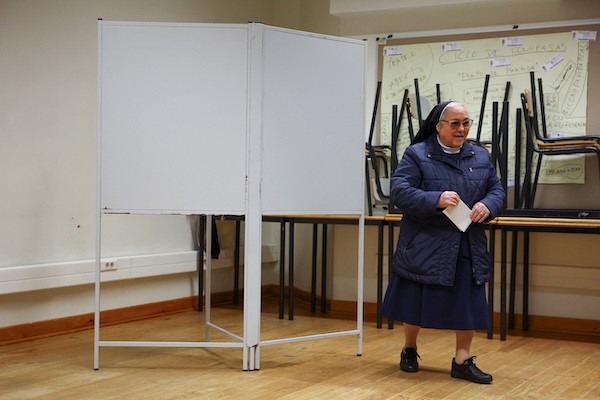
 A nun walks from a voting booth during the presidential election in Lisbon, Portugal, Sunday 18 January 2026;
Credit: REUTERS/Pedro Nunes
A nun walks from a voting booth during the presidential election in Lisbon, Portugal, Sunday 18 January 2026;
Credit: REUTERS/Pedro Nunes
LISBON (Reuters) - Moderate Socialist Antonio Jose Seguro came out on top in the first round of Portugal's presidential election on Sunday 18 January 2026, followed by the far-right leader Andre Ventura and the two will face off a runoff on Sunday 8 February.
In the five decades since Portugal threw off its fascist dictatorship, a presidential election has only once before - in 1986 - required a runoff, highlighting how fragmented the political landscape has become with the rise of the far right and voter disenchantment with mainstream parties.
The presidency is a largely ceremonial role in Portugal but wields some key powers, including in some circumstances to dissolve parliament, to call a snap parliamentary election and to veto legislation.
With all the votes in Portugal counted, Seguro garnered 31.1%. Ventura was at 23.5%.
Joao Cotrim de Figueiredo of the right-wing, pro-business Liberal Initiative party came third among a total of eleven contenders, winning around 16%.
Ventura seeks to unite the Right
In May 2025, the anti-establishment, anti-immigration Chega, founded just about seven years ago, became the main opposition party in a parliamentary election, winning 22.8% of the vote. As in much of Europe, the rise of the far right has swayed government policies, particularly on immigration, towards a more restrictive stance.
However, all recent opinion polls have shown Ventura, a former sports TV commentator, losing the runoff due to his high rejection rate of more than 60% of voters. Analysts often describe Chega as Ventura's "one-man show", a view corroborated by the fact that Ventura is running for president after stating on many occasions that he wants to be prime minister.
But Ventura sounded combative as he left a Catholic mass he had attended in downtown Lisbon: "Now we need to unite the entire right wing ... I will fight day by day, minute by minute, second by second so that there won't be a Socialist president. We will win," he said.
"The country has woken up after these 40 years of no runoffs," he told supporters later.
Prime Minister Luis Montenegro said his centre-right Social Democrats, whose candidate Luis Marques Mendes came fifth at 11.3%, would not support any of the runoff contenders. Cotrim de Figueiredo has said he does not want Ventura as president.
In a recent note, the Economist Intelligence Unit wrote that a Seguro-Ventura runoff "would be more straightforward given his (Ventura's) limited appeal beyond his core base".
"While the presidency is largely symbolic, Ventura is the only candidate signalling a more interventionist approach, though EIU sees this as unlikely to translate into victory," it said.
Other contenders included retired Admiral Henrique Gouveia e Melo, who led the country's COVID-19 vaccination campaign, with 12.3% and even comedian Manuel Joao Vieira, who had just over 1% of the vote, according to partial results, on a promise of a Ferrari sports car for every Portuguese and wine on tap in every home.