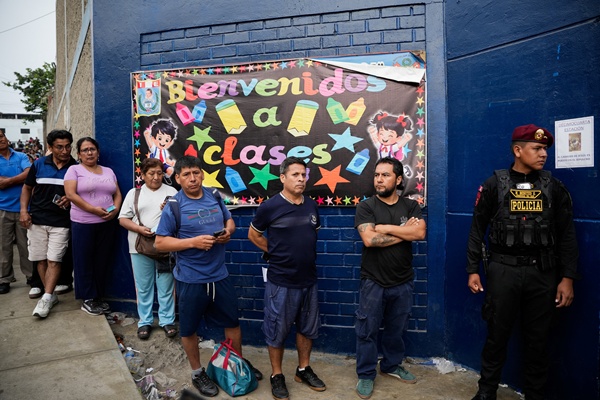
 People queue to vote at a polling station after Peru's general election was extended to a second day in some precincts of the capital due to the late setup of voting tables and the absence of citizens assigned to receive voters, Lima, Peru, 13 April 2026;
Credit: Reuters/Angela Ponce
People queue to vote at a polling station after Peru's general election was extended to a second day in some precincts of the capital due to the late setup of voting tables and the absence of citizens assigned to receive voters, Lima, Peru, 13 April 2026;
Credit: Reuters/Angela Ponce
LIMA (Reuters) - Peru’s presidential race remained wide open on Monday 13 April 2026, with roughly half the ballots still uncounted after a second day of extended voting, leaving conservative Keiko Fujimori in the lead but no clear challenger for a likely June runoff.
A tight race for Fujimori's second-place challenger started to take shape, with right‑wing former Lima Mayor Rafael Lopez Aliaga, center‑left candidate Jorge Nieto, and outsider Ricardo Belmont clustered within a narrow band. Each was polling between 10-14%, with just under 60% of ballots counted.
Long lines persisted outside polling stations in parts of Lima during the day as voters returned to cast votes for president and a new bicameral Congress after widespread delays hampered the general election on Sunday 12 April 2026.
With none of the leading candidates anywhere near the 50% required to win outright, a 7 June runoff appeared highly likely, prolonging political uncertainty in the world's third‑largest copper producer amid rising crime levels and intensifying geopolitical competition between the United States and China.
Results published by electoral authority ONPE showed former congresswoman Fujimori – the daughter of former President Alberto Fujimori, who was imprisoned for human rights abuses – leading with about 17% of the vote. Lopez Aliaga and Nieto were trailing close behind, with nearly 14% and 13%, respectively. Belmont had secured just below 10%, with 58% of the votes counted.
Authorities extended voting hours for a second day until 18:00 local time on Monday (01:00 CEST) for more than 50,000 people who were unable to cast ballots on Sunday, after logistical failures that delayed the opening of some voting stations in the capital. Electoral authority ONPE said the problems stemmed from a failure to deliver voting materials on time.
Jose Samame, ONPE’s managing director, resigned after taking responsibility for the delays and was later detained by police as part of a formal investigation launched on Monday into the failures.
At a polling station in the Lima's San Juan de Miraflores district, Angela Rios returned to another day of long lines.
“This is an injustice," she said while waiting to cast her ballot. "Yesterday we waited in line, and today we all have to work. No one is going to compensate us for our day."
The electoral authority had expected to have 60% of results by midnight on Sunday, a level that has yet to be reached, leaving open the possibility of a late surge, or technical tie for second place as votes from the interior of the country are counted.
Ballots from Lima, which typically arrive first, account for about a third of the electorate, where both Fujimori and Lopez Aliaga command strong bases of support.
With margins so tight and any of four candidates still with a chance of reaching a runoff, the logistical failures risk fuelling fraud allegations, said Nicholas Watson at consultancy Teneo.
"Any candidate who narrowly misses out on second place will be able to argue that they missed out on a berth in the runoff because of the ONPE’s incompetence," Watson said.
Fujimori said there was still "a lot of ground to cover" and a great deal of disillusionment as the country approaches a second round, addressing journalists from her car on Monday en route to meet her daughters.
Lopez Aliaga, the face of the Popular Renewal party, said he would not allow a “brutal fraud,” arguing that most of the polling stations that failed to operate were in Lima, where his support has traditionally been strongest.
Political instability
Years of political turmoil in the Andean nation have eroded confidence in institutions and left many voters deeply disillusioned.
Since 2018, Peru has had eight presidents, fueling skepticism that any incoming administration will last a full five‑year term amid repeated impeachments, corruption scandals and fragile governing coalitions.
Several business associations expressed concern over the election uncertainty.
“These incidents affect not only the presidential election, but also the Senate race and elections for other authorities,” the main business association representing Peru’s private sector, CONFIEP, said in a statement on Monday.