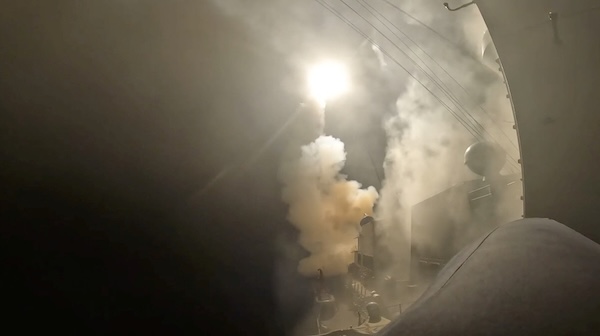
 A screengrab from a video obtained from social media on Tuesday 1 September 2026, shows a missile launch on the day US Central Command (CENTCOM) said US forces carried out strikes on Iranian military target.;
Credit: REUTERS/US Central Command
A screengrab from a video obtained from social media on Tuesday 1 September 2026, shows a missile launch on the day US Central Command (CENTCOM) said US forces carried out strikes on Iranian military target.;
Credit: REUTERS/US Central Command
WASHINGTON/CAIRO (Reuters) - The US and Iran found themselves back in a war footing on Wednesday 2 September 2026, after the most significant exchange in weeks, with Washington threatening even more devastating strikes while Iran protested an attack that it said killed five and wounded dozens of civilians at a wedding.
The US military's Central Command said it completed a wave of strikes against Islamic Revolutionary Guard Corps targets on Tuesday 1 September including air defence sites, radar systems, maritime assets and facilities, mine-laying capabilities, and communications sites.
Iranian media reported attacks on multiple targets around the country on Tuesday, many near the Strait of Hormuz, where Iran has been threatening oil tankers that dare transit the narrow waterway without authorisation.
Iran in turn said it struck US assets in Jordan and Iraq, according to official statements, while Iranian media reports said it also attacked Bahrain. Although the IRGC said it killed a large number of US forces in Jordan, two US officials told Reuters there had not been any casualties, according to initial assessments.
Jordan's armed forces said its air defence systems dealt with thirteen ballistic missiles that entered the kingdom's airspace, ten of which were intercepted and three fell in remote areas. Bahrain said Iranian drones were intercepted and destroyed.
The IRGC also said its ground forces carried out combined missile and drone attacks on US bases in Erbil in northern Iraq, killing several US personnel. Neither Iraq nor the US had confirmed the attack.
The exchange of fire marked the first serious combat since July, ending a period in which the warring parties withheld fire but also showed little interest in returning to negotiations.
The lull came as the conflict appeared to be draining both sides. Iran's already ailing economy has been battered by war and its conventional military forces have been degraded. Meanwhile, with US President Donald Trump confronting higher fuel prices ahead of November congressional elections, the US Army has used up much of its global stockpile of highly accurate long-range missiles, Reuters reported last month, raising concerns about the military's readiness for future conflicts.
Nonetheless, the renewal of hostilities produced another exchange of defiant statements.
"I like our position now much better, with almost total control of the Hormuz Strait, and their economy totally collapsing," Trump said.
"They are just playing out the inevitable. When are the Iranian people going to rise up and fight?"
Iran threatened the US and its allies.
"We warn that the continuation of American evil in the region will be met with heavier, more widespread, and devastating responses, and any country that cooperates with the aggressive American army must accept its dangerous consequences," Iran's joint military command said in a statement.
Five killed at wedding
In what could be one of the more significant cases of civilian casualties in the war, five people were killed and 50 wounded at a wedding near Sirik, a coastal area on the Strait of Hormuz, the Iranian Red Crescent reported. The Mehr news agency said a four-year-old child was among those killed, while the IRNA news agency, citing a provincial official, put the number of wounded at 68.
US officials have yet to comment on the incident.
"This cruelty cannot be separated from the chain of atrocities that preceded it," Iran's foreign ministry spokesperson said in a statement, citing incidents including the blast at a school in Minab that killed 160 people at a girls' school on the first day of the war.
The Pentagon has yet to issue an official finding on the Minab strike, but it may have been the result of US use of outdated targeting data, two sources familiar with the matter told Reuters.
The foreign ministry statement pledged that Iran would respond to "these savage crimes with firmness."
"Those governments and international institutions that remain silent in the face of such barbarism, or seek to justify such acts, must understand that their silence is not neutrality," Iran said. "Those who remain silent today will not be immune to its consequences tomorrow."