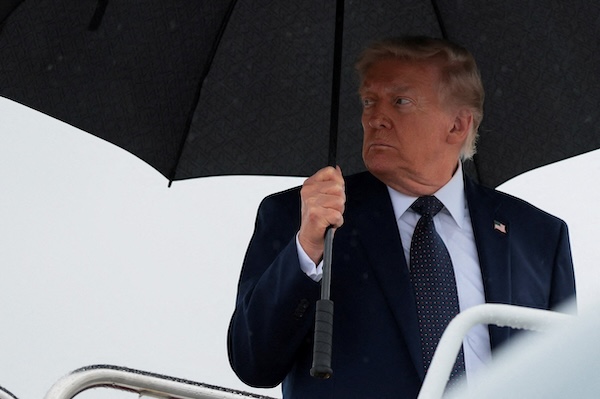
 US President Donald Trump looks on as he boards Air Force One en route to Morristown Airport in Morristown, New Jersey, at Joint Base Andrews, Maryland, US, 22 May 2026;
Credit: REUTERS/Kylie Cooper
US President Donald Trump looks on as he boards Air Force One en route to Morristown Airport in Morristown, New Jersey, at Joint Base Andrews, Maryland, US, 22 May 2026;
Credit: REUTERS/Kylie Cooper
WASHINGTON (Reuters) - On Thursday 3 September 2026, US President Donald Trump said he would ask European nations to pay back the United States for military aid and munitions previously sent to Ukraine amid the ongoing war with Russia and appeared to signal a halt in sales to allied nations.
In a social media post, Trump also slammed reports of heavily depleted US munition stockpiles amid the separate war in Iran, while adding that the United States was ramping up production and stockpiling munitions.
"We are taking them for ourselves, the USA., rather than selling them to others, but the sales to Allies will soon again, begin," Trump wrote.
"Hundreds of Billions of Dollars was given to Ukraine and NATO, free of charge, that Europe would have paid for — If they were only asked, but we will be asking for that money, though somewhat belatedly!" he added, blaming the administration of his Democratic predecessor Joe Biden.
Last year, the United States and NATO developed the Prioritized Ukraine Requirements List initiative, under which European countries pay to supply Ukraine with US weapons.
Reuters reported last month that the US Army has used up much of its stockpile of highly accurate long-range missiles during the Iran war, raising concerns about the military's readiness for future conflicts.
Both the wars in Ukraine and Iran — and their economic shocks — could impact whether Trump's fellow Republicans maintain control of both chambers of the US Congress next year.
On Thursday, oil prices hit fresh six-week highs as the latest US strikes on Iran and renewed Israeli threats against Tehran revived concerns about disruptions to Middle East supplies as vessels remain throttled in the Strait of Hormuz.
US Treasury Secretary Scott Bessent on Wednesday sought to partly blame Kyiv's recent strikes against Russian energy targets for rising oil and gas prices.
"We are going through an energy shock right now due to both the war in Ukraine - because, you know, Ukraine has decided that they want to blow up Russian energy assets and refined products, so that is creating upward price pressure on a global basis - and then the conflict in Iran," he told Fox News in an interview.