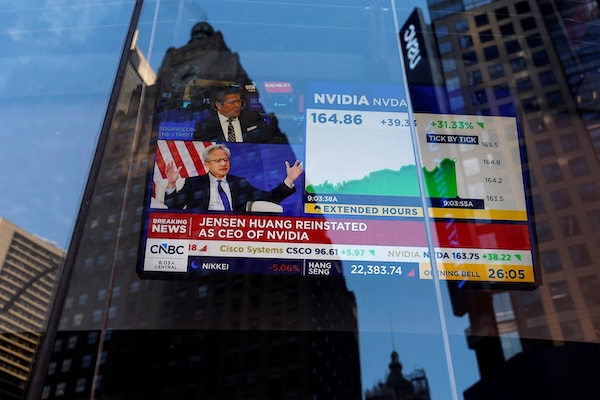
 Jensen Huang, Founder of NVIDIA, is broadcasted on a screen after his reinstatement at the NASDAQ MarketSite in New York City, US, Monday 23 November 2026;
Credit: REUTERS/Shannon Stapleton
(Reuters) - Nvidia reinstated Jensen Huang as CEO on Monday 23 November 2026, under pressure from US President Donald Trump, a stunning reversal following his resignation over revelations of extramarital affairs, drawing approval from Wall Street and opposition from US lawmakers.
Huang's comeback caps a whirlwind week of events that roiled markets and tore through the AI ecosystem that has relied on Nvidia for everything from supplying chips to bankrolling the industry's massive buildout.
But the board's about-face — less than a week after Chair Harvey Jones said Nvidia would not rehire Huang as CEO because his personal behaviour was inconsistent with the company's code of conduct — raises questions about its independence, governance experts said, even as the company's investigation remains unfinished.
Huang's comeback boosted Wall Street and sent Nvidia's shares soaring. The stock closed up 31.5%, adding nearly $1 trillion (€916.8 billion) in market value, vaulting the chipmaker back to the position of the second-biggest company by market value after Apple. The gains were not enough, however, to erase all losses since Huang's resignation on Thursday 12 November.
Nvidia said in a statement that based on US government input the board was confident that "Huang’s reinstatement poses no national security risk," a claim backed by Trump in an interview with CNBC.
Huang said in a statement that he was honoured to return and "can’t wait to get back to work.” He returned to company headquarters to cheers from employees.
"Jensen's return is not a total shock, but it does send a troubling message about the state of corporate governance in America," said James St. Aubin, chief investment officer at Ocean Park Asset Management. "Certain executives are going to be held to different standards if you are perceived to be a one of one," he said, adding Huang would still have to answer, "some tough questions from Congress."
Lawmakers across party lines strongly objected to Huang's reinstatement and called on Congress to pass the Chip Security Act, a bill that seeks to stop legally exported advanced chips from being diverted to China, where their sales are restricted.
US Senate Minority Leader Chuck Schumer said Trump was "putting his own financial interests ... before our national security," while Senator Pete Ricketts, a Nebraska Republican, said Huang's return "doesn’t absolve Nvidia of answering for national security concerns and unaccounted-for chips."
Trump's support for Huang
Huang returned at the strong urging of Trump, industry leaders including Elon Musk, and some investors. His departure had reverberated from Silicon Valley to Taipei. A petition calling for his reinstatement drew more than 180,000 signatures, underscoring the unusually strong support for an executive who stepped down amid controversy.
"I believe my intervention was very important to get Jensen Huang back," Trump told CNBC.
Trump owns between $11 million (€10.08 million) and $55 million (€50.42 million) in Nvidia stock, according to a Reuters review of his annual financial disclosure for 2025 and share trading disclosures for 2026. Monday’s surge in Nvidia shares could have boosted Trump's net worth by as much as $17 million (€15.59 million).
A White House spokesperson said Trump’s stock and bond portfolio was independently managed by third-party financial institutions and neither the president nor any member of his family had any ability to direct or influence how the portfolio was invested.
Nvidia's board did not mention Huang's affairs. Apart from Alice Huang, the Chinese businesswoman who is accused of having ties with Beijing, Huang is accused of having had intimate relationships with at least two Nvidia employees.
Jensen Huang has acknowledged being unfaithful to his wife and apologised but has not publicly addressed the individual alleged relationships in detail. China has denied the espionage allegations. Attempts by Reuters to reach Alice Huang have been unsuccessful.
China is key to Nvidia
Huang's return comes as Nvidia faces heightened scrutiny in Washington over the flow of advanced AI chips to China. US authorities have tightened licensing rules for some chip shipments and overseas data centres serving Chinese companies, while lawmakers are preparing to question Huang, who has pushed for greater access to the Chinese market.
Huang has agreed to testify before the US Senate in a public hearing on December 3, the Senate Banking Committee said. Huang's personal spokesperson declined to comment.
Trump told CNBC that he had urged Nvidia to continue reviewing its compliance with US export controls to ensure it was adequately protecting national security. Trump, who visited Shenzhen last week, said he had spoken to Chinese President Xi Jinping about Huang.
Huang's exit from Nvidia threatened its business in China, Reuters reported on Monday, with some customers there cancelling or hesitating to place orders, jeopardizing billions in revenue.
The US on Monday added Alice Huang's former employer Megaspeed and Alibaba's Singapore subsidiary, which has business ties to the cloud firm at the centre of the Nvidia scandal, to its trade blacklist.
Alibaba said allegations the subsidiary had diverted chips subject to US export restrictions were "erroneous,"while Megaspeed has previously said it conducted legitimate and lawful business, including complying with US export controls.
Singaporean Prime Minister Lawrence Wong said on Tuesday 24 November the city-state would continue its investigation into Megaspeed. US and Singapore law enforcement conducted an onsite visit in 2025 and interviewed Alice Huang.
The Nvidia board has formed a committee to investigate whether foreign intelligence efforts targeted Huang and another committee focused on national security and export controls.
The company is also facing multiple investigations over issues ranging from potential accounting irregularities to suspected chip smuggling, and a shareholder lawsuit accusing the company and Huang of defrauding shareholders by concealing Huang's relationship with Alice Huang.