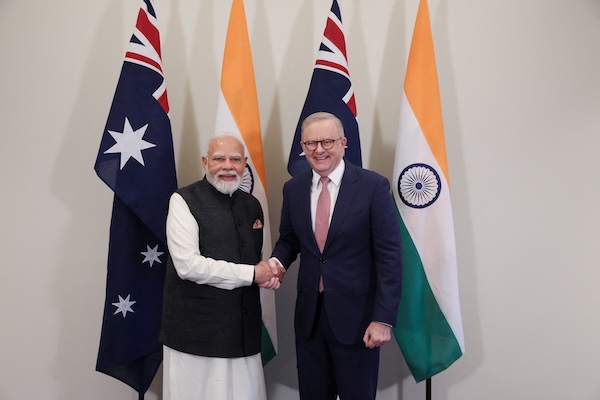
 Australian Prime Minister Anthony Albanese and Indian Prime Minister Narendra Modi shake hands ahead of the CEO Forum and Economic Roadmap Business Reception in Melbourne, Australia, Thursday 9 July 2026;
Credit: REUTERS/Hollie Adams
Australian Prime Minister Anthony Albanese and Indian Prime Minister Narendra Modi shake hands ahead of the CEO Forum and Economic Roadmap Business Reception in Melbourne, Australia, Thursday 9 July 2026;
Credit: REUTERS/Hollie Adams
MELBOURNE/NEW DELHI (Reuters) - Australia and India reached a deal on Thursday 9 July 2026 to export Australian uranium to India for use in the nuclear energy industry, while agreeing to deepen cooperation in renewables, critical minerals and green hydrogen.
India has long eyed Australia's uranium reserves to help meet a target of 100 gigawatts of nuclear energy capacity by 2047, while Australia is looking to diversify trade beyond its reliance on China, its top partner.
"Australia and India are close partners and even closer friends," Australian Prime Minister Anthony Albanese told reporters in Melbourne on Thursday, after finalising the deal with visiting Indian Prime Minister Narendra Modi.
"The arrangement facilitates Australian uranium exports to India to help increase the share of non-fossil fuel power capacity, providing an additional market for the Australian resources sector."
Though both nations agreed to a nuclear cooperation pact in 2014, uranium exports have been limited over concerns about ensuring nuclear fuel is used solely for peaceful purposes, such as energy generation.
Modi said on Thursday India's relationship with Australia presented "historic opportunities" for both countries to cooperate across several areas.
Australia's technology, capital and resources could help accelerate India's energy transition, Modi said. He also signalled possible cooperation in low-carbon aluminium projects.
"We have historic opportunities to cooperate in this field," Modi said, as he urged Australia's business community to invest long-term in India's road, port, rail and urban infrastructure projects.
"India provides a safe, stable and sustainable growth option for your funds," he said.
Australia's largest pension fund, AustralianSuper, said on Thursday it would invest a further A$500 million (€303.4 million) in India's National Investment and Infrastructure Fund.
‘Living bridge'
After meeting Modi at the business event, Albanese called the Indian leader a "living bridge" between Australia and India, saying Modi's vision had helped reshape the roadmap for Australia's economic engagement with India.
India is Australia's fifth-largest trading partner after China, Japan, the US and South Korea, while around 1 million people in Australia claim Indian ancestry, out of a population of 28 million.
Modi, who previously visited Australia in 2023, is expected to meet thousands of expatriate Indians at an event in one of the biggest stadiums in Melbourne on Thursday evening.
The Indian leader has staged large-scale events during his overseas trips and has addressed packed stadiums in the United Kingdom, the United States and other countries that have large expatriate Indian populations.
Thousands of supporters thronged one of Sydney's biggest indoor stadiums during his last visit three years ago.
Modi arrived in Australia after visiting Indonesia, where he signed a raft of deals on agriculture and defence, including for the BrahMos cruise missile system. He will leave for New Zealand on Friday afternoon before returning to India.