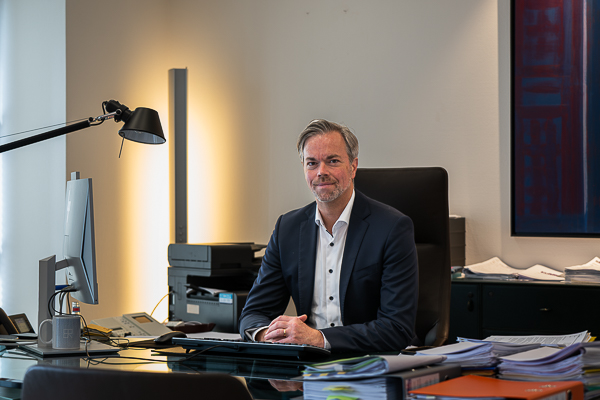
 Luc Feller, Mayor of Mamer;
Credit: Ali Sahib, Chronicle.lu
Luc Feller, Mayor of Mamer;
Credit: Ali Sahib, Chronicle.lu
The Grand Duchy of Luxembourg consists of twelve cantons made up of 100 municipalities. Each municipal council is elected directly by its residents in municipal elections held every six years. The municipality’s mayor is then appointed from among the elected members of the municipal council.
In this series, Chronicle.lu spoke to a selection of the country’s mayors to discuss the challenges within their municipality, their daily activities, how projects are prioritised and how they communicate with residents.
The seventh in this series features Mayor Luc Feller, who represents the municipality of Mamer.
Chronicle.lu: What is the size of your municipality, in population and number of nationalities?
Luc Feller: Mamer has around 11,500 inhabitants. Our municipality is home to 106 different nationalities.
This diversity is one of the defining features of Mamer. It reflects both our proximity to Luxembourg City and the presence of international institutions and the European School in and around our municipality.
Chronicle.lu: What are the main challenges currently facing the municipality and how is the administration working to address them?
Luc Feller: Like many municipalities in Luxembourg, Mamer is confronted every day with new challenges. One of the most important ones is demographic growth, particularly linked to new residential developments and the creation of affordable housing.
As a result, we are expanding our school and childcare infrastructure. By the end of the current municipal term, we expect to have around 1,300 childcare places for children living in our municipality.
Another key challenge is integration. Over the past years, many young families from many different countries have moved to Mamer. We want people to feel at home here, to spend part of their free time in the municipality and to meet other residents.
We work towards this goal through a broad range of activities organised by the municipal administration, our consultative commissions and local associations. We also create forums where citizens can express their views and contribute ideas. We recently did this in the areas of environment and inclusion. Our participatory budget is another important tool: it allows residents to propose projects themselves, which can then be analysed and implemented.
In this sense, our objective is not only to manage growth, but to organise it in a way that strengthens social cohesion, quality of life and the feeling of belonging to a shared local community.
Chronicle.lu: Please describe the daily activities undertaken by you, as mayor of the municipality of Mamer, and how you work in conjunction with the other members of your administration.
Luc Feller: My daily work consists mainly of moving municipal projects forward. This involves many phone calls, meetings, discussions and constant coordination with the municipal administration, the aldermen and the municipal council.
It also means staying close to residents. I try to keep an open ear for citizens who ask for a meeting, raise a concern or want to share an idea.
A large part of the role is therefore about coordination: bringing together political priorities, administrative expertise, technical constraints and the expectations of residents. As mayor, I see my task as ensuring that projects do not remain ideas on paper but become concrete improvements in people’s daily lives.
Chronicle.lu: Please describe the challenges of being mayor of Mamer and what makes your municipality unique in Luxembourg.
Luc Feller: I believe the challenges faced by mayors are broadly similar in many municipalities. One has to deal with a wide range of topics, be reactive and remain present and accessible.
Mamer is a municipality that has experienced significant growth over recent years. At the same time, it has managed to preserve a high quality of life. In the centres of Mamer and Capellen, we have attractive recreational areas with many leisure opportunities for children and families.
The municipality is also surrounded by forests, which means that residents can move very quickly from an urban environment into nature.
This combination makes Mamer special: it is close to Luxembourg City, dynamic and international, but at the same time it remains green, family-friendly and strongly rooted in local life.
Chronicle.lu: As mayor, how do you select and prioritise which projects the municipality will undertake?
Luc Feller: The mayor does not decide this alone. Priorities are set together with the other members of the college of aldermen and the municipal council.
We place particular emphasis on modern infrastructure for families, successful integration, a strong sense of community among residents, and climate and nature protection.
We also take into account the long-term development of the municipality: population growth, school and childcare needs, mobility, water and wastewater infrastructure, sports and cultural facilities, and the financial sustainability of each project.
Chronicle.lu: What are the key projects, developments and upcoming events that will shape life in Mamer over the coming months and years?
Luc Feller: Over the coming years, we will complete two school buildings and two Maison Relais childcare facilities. In addition, we are creating further space for our administrative services and an inclusive café managed by our Maison citoyenne (community centre).
We will continue to invest in our water and wastewater networks. Once these projects have been implemented, we will also focus on expanding and modernising our sports infrastructure.
The aim is clear: to prepare the municipality for future growth while maintaining the character, attractiveness and quality of life that residents value today.
Chronicle.lu: How does the municipality communicate with residents and encourage them to become involved in local life and decision-making? Do you use English in such communications?
Luc Feller: Our communication is generally multilingual, and English is naturally part of it. With residents from 106 nationalities living in our municipality, English plays an important role in everyday communication.
We communicate widely about the activities taking place in Mamer through different channels, so that residents know what is happening in the municipality. Our many activities encourage people to spend their free time here and to take part in local life.
Workshops organised by the Maison citoyenne allow residents to express their opinions directly on different municipal topics. The participatory budget also gives citizens the opportunity to propose and support concrete projects.
In addition, digital tools such as the CityApp and other information channels help us reach residents quickly and make it easier for them to interact with the municipality. Our goal is to make participation as accessible as possible, including for people who are new to Mamer or who do not yet speak Luxembourgish fluently.