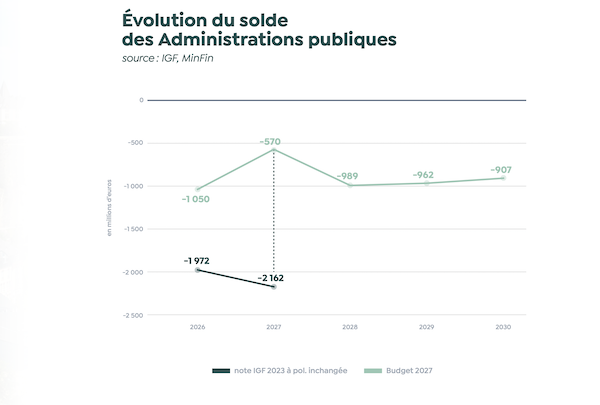
 Evolution of the General Government Balance;
Credit: IGF, MinFin
Evolution of the General Government Balance;
Credit: IGF, MinFin
On Wednesday 7 October 2026, Luxembourg’s Minister of Finance Gilles Roth presented the draft 2027 State Budget to the Chamber of Deputies with more than €4.5 billion in public investment, equivalent to 4.4% of GDP.
According to Luxembourg’s Ministry of Finance, the draft was presented under the motto “Fir d’Leit. Fir Opschwong” (For the People. For Growth.). The 2027 budget focuses on purchasing power, social cohesion and well-being, while supporting growth, competitiveness and investment. The ministry further said that the budget invests in citizens, the economy, infrastructure and the country’s future, while maintaining sustainable public finances.
Minister Roth commented: “Fir d’Leit. Fir Opschwong. Our priority is clear: investing in citizens for sustainable and inclusive growth in the country. This budget strengthens our Luxembourg model, supports the purchasing power of our households, protects our social cohesion and preserves sound public finances. In these uncertain times, we are offering new prospects and paving the way for tax reform introducing a single tax class.”
The ministry stated that the central government revenue is expected to reach €33.9 billion, compared with expenditure of €35.8 billion in 2027. The deficit would therefore stand at around €1.9 billion.
At the general government level, the deficit is expected to amount to €570 million, or 0.6% of GDP, compared with an estimated 1.1% of GDP in 2026. Social Security is expected to record a surplus of €920 million and local government a surplus of €459 million.
Public debt will remain below 30% of GDP and is expected to decrease from 29.3% at the end of 2026 to 28.6% in 2030, noted the ministry.
Against a backdrop of moderate growth, the government plans more than €4.5 billion in public investment in 2027. The draft budget also provides an additional €400 million per year for the National Action Plan against Poverty, €206 million more for the Employment Fund and an additional €168 million for pension insurance.
Expenditure linked to the government's "well-being GDP" approach will reach €6 billion, equivalent to 6% of GDP and 24% more than in 2026. This includes €4.3 billion aimed at combating the risk of poverty, €654 million to reduce housing costs and €630 million to support employment.
Social transfers will account for 47% of the budget, while the "Resilienzpak" tripartite agreement represents around €450 million in support for households and the economy. The social minimum wage will increase by 3.8% on 1 January 2027. Together with an increase in the related tax credit, affected employees are expected to receive an additional €180 net from January and €200 net from July 2027.
The overall amount allocated to family allowances will increase by €152 million, while expenditure by the Children's Future Fund will reach almost €1.8 billion.
The government also plans a new cost-of-living supplement for around 106,000 people and a specific supplement for more than 32,000 children. Education and childcare will receive €5.2 billion, including almost €1 billion for childcare facilities, while the Employment Fund will reach almost €1.5 billion.
In housing, the "Bëllegen Akt" tax credit will increase to €45,000 per person, while the government plans to invest €2.5 billion in affordable housing between 2027 and 2030, complemented by a €250 million Housing Bond. Mobility investment will include €825 million through the Rail Fund, €66 million for the tram network and €532 million for road infrastructure.
According to the draft, furthermore, the government plans €1.4 billion in digitalisation expenditure between 2027 and 2030. Hospital Fund expenditure is set to rise from €234 million in 2026 to €471 million in 2030.
For businesses, corporate income tax will decrease from 16% to 15% for large companies and from 14% to 13% for small and medium-sized enterprises. The tax credit for investments linked to the digital and energy transitions will rise from 18% to 21%. The budget also provides €284 million for artificial intelligence (AI) projects and €2.2 billion for public research centres and the University of Luxembourg (Uni.lu).
The National Energy and Climate Plan will receive €14.4 billion over four years, including €3.2 billion in 2027. The government will extend Klimabonus Wunnen until 2035 and, from 2027, pre-finance heat pumps and energy renovation work. Klimabonus Mobilitéit will remain in place until 2030, with €69 million allocated to electric cars and €14.5 million to social leasing.
The police budget will reach around €600 million, with 160 new positions planned for 2027, while the Grand Ducal Fire and Rescue Service (CGDIS) will receive almost €186 million. Defence spending will reach 2.1% of gross national income, or almost €1.4 billion. Luxembourg will also allocate 1% of gross national income to official development assistance, corresponding to €898 million.