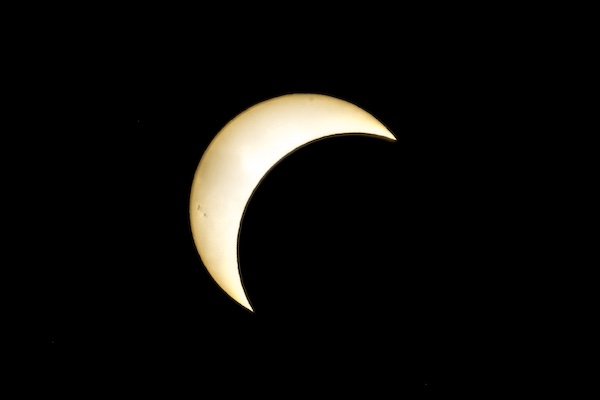
 On Wednesday 12 August 2026, Luxembourg will experience its most significant solar eclipse in 27 years;
Credit: Pixabay/Jason Gillman
On Wednesday 12 August 2026, Luxembourg will experience its most significant solar eclipse in 27 years;
Credit: Pixabay/Jason Gillman
On Wednesday 12 August 2026, Luxembourg will experience its most significant solar eclipse in 27 years.
From around 19:00 on Wednesday, Luxembourg will enter what is referred to as the path of occultation and will experience around 90% of the total eclipse’s shadow as the moon moves across the sun, blocking its light towards the Earth.
This solar eclipse represents the most significant to pass over continental Europe since March 2015, and will see parts of Iceland, northern Portugal and Spain experiencing full totality. It will also be the most significant eclipse in Luxembourg since 1999, when a total eclipse was experienced on 11 August, albeit under cloudy skies.
A partial solar eclipse did occur above Luxembourg on 20 March 2015 but only reached 76% obscuration.
The science behind the shadow
Solar eclipses occur when the moon’s orbit aligns with the position of the sun relative to a point on the Earth’s surface. The zone of “totality” - where the moon obscures 100% of the sun’s surface - is ordinarily between 100km to 280km wide and variances occur depending on the Earth’s distance to the sun and the moon’s distance to the Earth (both of which operate on elliptical orbits), as well as the moon’s orbital position, which is not perfectly aligned to the Earth’s orbital plane relative to the sun. Another contributing factor is the curvature of the Earth’s surface, which changes the width of the shadow as it travels across the planet’s surface.
The umbra - the moon's shadow that blocks out the sun - will race across 8,260 km in around 90 minutes, most of it over empty Atlantic waters. Beginning in northern Russia, full totality will be visible from parts of Iceland, northern Portugal and Spain. Beyond Europe, a partial eclipse will be visible from Alaska, Siberia, Canada, parts of the northern United States and West Africa. For most in the path of totality, the sun will be fully eclipsed for just under two minutes.
The view from Luxembourg
In Luxembourg, peak occultation of around 90% coverage of the sun will occur at approximately 20:15 with the sun close to the horizon. Unfortunately, this timing and position means that features of the local landscape (hills, forests, buildings etc.) have the potential to block one’s view of the eclipse.
With less than 100% coverage, and, again because of the sun’s low position, there is not expected to be a substantial decrease in the sun’s brightness as the moon passes over it. However, those equipped with suitable eyewear will be able to see the moon’s movement across the path of the sun. The partial eclipse will finish in Luxembourg at around 21:00.
A clear evening with little to no cloud cover is expected.
Scientific opportunity
During the event, scientists across the zone of totality will have all eyes on the eclipse as it presents the opportunity for them to study the innermost part of the sun’s outer atmosphere, the corona, which can only be seen from Earth during a total solar eclipse.
Research teams will also be launching dozens of high-altitude balloons from Spain and Iceland to study the Earth's atmosphere and other changes during the eclipse, when the temperature will momentarily drop.
In Ettelbruck, Luxembourg-based astronomy night-sky organisation, Nightwise, will host the Solar Eclipse Day 2026 event at the Hall du Deich. The family-focused science event will offer eclipse-related activities and events throughout the day and the locally visible phase of the eclipse will be observed safely on site. Free solar glasses will be distributed at the event so that visitors can enjoy the eclipse safely.
Safety first
Safety is the most important thing to consider during any solar eclipse. The only safe way to look directly at the eclipse is through special-purpose solar filters, such as solar glasses or hand-held solar viewers. Homemade filters or sunglasses, even very dark ones, are not regarded as safe for looking at the sun and should not be used. Viewing through a camera, binoculars or a telescope, even when wearing special eclipse glasses, is dangerous due to such device’s lenses concentrating the light and should not be undertaken.
Further information about the Solar Eclipse Day 2026 event, along with additional safety advice for viewing the eclipse can be found at: https://nightwise.lu/solar-eclipse-2026/