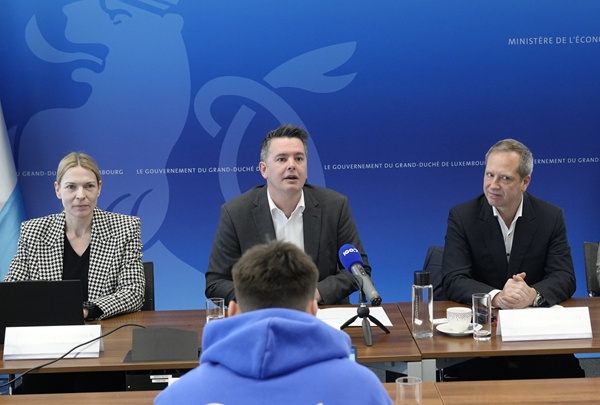
 (L-R) Françoise Gaasch, Ministry of the Economy; Lex Delles, Luxembourg's Minister of the Economy, SMEs, Energy and Tourism; Fabrice Marcotty, Managing Director at Amer-Sil;
Credit: MECO
(L-R) Françoise Gaasch, Ministry of the Economy; Lex Delles, Luxembourg's Minister of the Economy, SMEs, Energy and Tourism; Fabrice Marcotty, Managing Director at Amer-Sil;
Credit: MECO
On Wednesday 25 March 2026, Luxembourg's Minister of the Economy, SMEs, Energy and Tourism, Lex Delles, presented the results of the call for tenders launched in 2025 to support the decarbonisation of the manufacturing industry in Luxembourg.
To illustrate concretely how decarbonisation can be implemented through innovative and sustainable industrial investments, two of the six selected projects were also presented by Fabrice Marcotty, Managing Director, and Ihsan Goksu, Head of Growth at Amer-Sil, as well as Adrien Villani, Director of Digital Transformation and Lean Sigma at Avery Dennison.
This initiative is part of the Ministry of the Economy's strategy to provide concrete support to industrial companies in their energy transition, particularly through the electrification of production processes and the reduction of greenhouse gas emissions.
This call for tenders was part of the temporary European framework established following Russian aggression against Ukraine, with the aim of strengthening the resilience of businesses and reducing dependence on fossil fuels. It thus addressed a dual objective: to support the decarbonisation of Luxembourg's industry and to contribute to reducing the consumption of imported gas.
Open from 22 August 2025 to 31 October 2025, the call for tenders was aimed at companies established in Luxembourg and active in the manufacturing sector. Eligible projects had to achieve a reduction of at least 40% in direct greenhouse gas emissions, compared to the reference years 2020 to 2024, through the electrification of industrial processes. This criterion will be monitored annually, according to the ministry. The total budget allocated to this measure was €132.25 million, in the form of grants intended to cover the funding gap for projects over a ten-year period. Projects were ranked and selected according to competitive criteria, notably based on the amount of aid requested per tonne of CO₂ avoided over ten years.
Seven projects were submitted, six of which were selected to receive financial support. In total, these six projects are expected to reduce direct greenhouse gas emissions by 271,107 tonnes of CO₂ over a ten-year period, representing an average annual reduction of 27,110.7 tonnes. This is roughly equivalent to 150,000 to 200,000 flights between Luxembourg and Paris, noted the ministry. The total amount of state subsidies allocated over ten years is €102,217,515.72, which corresponds to an average cost of €377.04 per tonne of CO₂ avoided.
The six selected projects involve the following companies: Amer-Sil SA, Avery Dennison Luxembourg, ArcelorMittal Bissen & Bettembourg, Goodyear Operations SA – Colmar-Berg Plant, Goodyear Operations SA – Dudelange Plant and Tarkett GDL SA.
According to the ministry, the selected projects concretely illustrate the ongoing transformation in Luxembourg's manufacturing industry. At ArcelorMittal Bissen & Bettembourg, the galvanising process for wires used in products such as fencing and agribusiness products will be carried out by a machine powered exclusively by electricity rather than natural gas.
At Amer-Sil, a manufacturer of high-quality microporous polymer/ silica separators for industrial batteries, the steam required for the process will now be produced using a hybrid electric/ gas boiler, reducing reliance on natural gas. Avery Dennison, a producer of labels and packaging materials, will invest in the partial electrification of the drying process for a silicone and adhesive coating line currently powered by gas, in order to reduce the energy footprint of its process.
At Goodyear, both in Colmar-Berg and Dudelange, part of the process steam production required for tyre manufacturing will be supplied by electric boilers, thus reducing dependence on natural gas. At Tarkett GDL, some of the heat used in the production of plastic flooring will also be generated by an electric boiler.
Minister Delles stated: "Decarbonising our industry means giving it the means to remain competitive, modernise its processes and strengthen its resilience in the context of an accelerated energy, climate and technological transition. By supporting these investments, we are acting simultaneously for the climate, for the competitiveness of our economy and for Luxembourg’s industrial base. Maintaining and modernising our industrial base also means strengthening our strategic autonomy and securing the jobs of tomorrow."
The selected companies have a maximum of three years to implement the project implement their projects. Support will be reduced if the projects are not completed within the allotted timeframe. According to the ministry, this requirement reflects the government's commitment to linking public aid to concrete, rapid and measurable results.
The Ministry of the Economy has reaffirmed its commitment to continuing and strengthening its support for the decarbonisation efforts of Luxembourg companies. The European Commission has published a new framework, the Clean Industrial Deal State Aid Framework (CISAF), the implementation of which, designed to best meet the needs of businesses, is currently underway.
The government also intends to support the entire economic fabric in this transition, including SMEs, through other calls for projects and targeted programs. Among the measures currently in progress are calls for projects related to photovoltaic installations from 30 kW to 200 kW, as well as AC charging stations, truck charging points and zero-emission trucks. In addition to this, there are other forms of assistance, including specific schemes such as SME Packages, to support companies in their energy and technological transition.