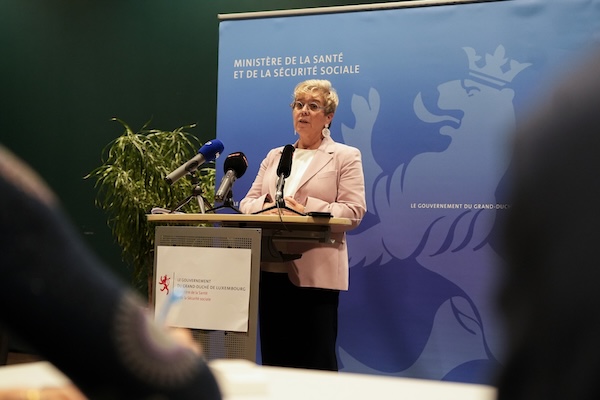
 Martine Deprez, Luxembourg's Minister of Health and Social Security;
Credit: M3S
Luxembourg's Ministry of Health and Social Security has provided an update on the financial situation of the health and maternity insurance scheme and the measures proposed to improve its efficiency.
The quadripartite committee met on Wednesday 21 October 2026 at the Opderschmelz cultural centre in Dudelange, chaired by Luxembourg's Minister of Health and Social Security, Martine Deprez, in close collaboration with Minister of Finance Gilles Roth.
Provided for under Article 80 of Luxembourg's Social Security Code, the annual quadripartite committee brings together the ministers responsible for social security, health and finance, representatives of the most representative employee and employer organisations, as well as representatives of professional groups designated by law. The committee reviews trends in health-related revenue and expenditure and may propose legal, regulatory, contractual or statutory measures relating to health insurance, alongside broader measures aimed at improving the efficiency of the healthcare system.
Financial situation
According to the ministry, the deteriorating financial trend of the health and maternity insurance scheme is continuing and is expected to intensify in 2027.
For the 2026 financial year, the balance of current operations of health and maternity insurance is expected to record a negative operating result of €133.3 million.
For 2027, current expenditure is projected to increase by 7.0% to €5.57 billion (€5,572.9 million), while current revenue is expected to rise by only 6.0% to €5.38 billion (€5,383.3 million), resulting in a projected deficit of €189.6 million.
Previous multi-year projections appear to be confirmed. The financial situation of health and maternity insurance and the forecasts for 2027 indicate that the ratio of total reserves to current expenditure is expected to stand at 9.2% in 2027, falling below the legal minimum threshold of 10.0% established by Article 28 of the Social Security Code.
The break-even contribution rate calculated for healthcare for the 2027 financial year is 5.85%. Compared with the current contribution rate of 5.6%, an increase of 0.25 percentage points would bring the result for 2027 to zero and therefore achieve a balanced budget.
Under Article 30 of the Social Security Code, the contribution rate is reset by the Board of Directors of the National Health Fund (CNS), with effect from 1 January of the year for which the budget indicates that the level of reserves falls outside the prescribed limits. If the Board of Directors has not reset the rate by 1 December, it is determined by the minister responsible for social security.
Proposals of the strategic committee
Working groups coordinated by a strategic committee, bringing together in particular the professional groups referred to in Article 80 of the Social Security Code, presented a set of measures during an interim review in spring 2026 aimed at improving the efficiency of health and maternity insurance. These measures are expected to generate savings and increase revenue by a total of €95 million, a target that will be achieved gradually.
At Wednesday's meeting, the quadripartite committee endorsed the strategic committee's proposed efficiency measures aimed at restoring a sound and sustainable financial position for health and maternity insurance. Following their presentation during the interim review, the measures underwent additional work within thematic groups under the coordination of the strategic committee. The measures with the greatest financial impact concern medicines, the management of medical practices, hospital care and the fight against abuse and fraud. These measures will now be translated into concrete actions:
-
Medicines: For several years, pharmaceutical expenditure has been increasing particularly rapidly, a trend that cannot be explained solely by growth in the insured population. The introduction of expensive innovative medicines and the expansion of therapeutic indications for certain treatments are also contributing factors. In response to this increase in pharmaceutical expenditure, the establishment of a legal framework and the development of models aimed primarily at determining contributions from the pharmaceutical industry are proposed.
-
Management of medical practices: In the area of managing medical practices, awareness-raising letters are to be sent to healthcare professionals in the fields of medicines, medical biology and physiotherapy. The aim is to encourage appropriate prescribing and care practices while contributing to the efficient use of health and maternity insurance resources.
-
Hospital care: Regarding hospital care, the three main measures are accounting-based control of hospital expenditure; reducing the average length of hospital stays where the patient's medical condition permits, in order to improve the use of hospital capacity; and pooling hospital laboratories, with the aim of consolidating certain resources and activities to avoid duplication and improve the efficiency of medical analyses. The overall budget allocation for hospital sector expenditure (EBG) granted by the government for 2027 and 2028 takes into account these efficiency measures discussed within the strategic committee.
-
Fight against abuse and fraud: Finally, the fight against abuse and fraud will involve, in particular, a review of the current systems for monitoring and supervising healthcare providers.