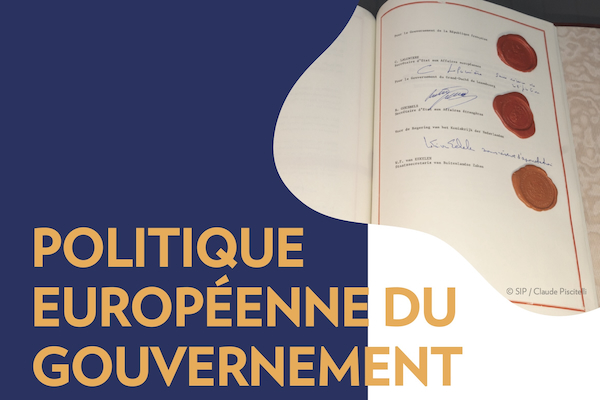
 Credit: © SIP / Claude Piscitelli
On Tuesday 9 June 2026, Luxembourg’s Ministry of Foreign and European Affairs, Defence, Development Cooperation and Foreign Trade announced the publication of the nineteenth edition of the annual report on Luxembourg’s European policy.
According to the ministry, the report provides a concise overview of the European issues that were of particular importance to Luxembourg in 2025 and covers the main issues handled by the various Council formations, coordination at national level and the implementation of European Union law.
The ministry highlighted that as Russia’s war of aggression against Ukraine entered its fourth year, the report outlines how solidarity with Ukraine remained at the centre of discussions within the European Union. Luxembourg supported all nineteen packages of sanctions against Russia in 2025, as it had done previously. Luxembourg also continued to honour its commitments by providing political, humanitarian, military and financial support to Ukraine.
Another area of high importance for the ministry remained the future of the Middle East, with this key region for the European Union’s neighbourhood policy also the subject of extensive discussions. The report explains how the European Union remained engaged throughout 2025 in efforts to stabilise the region and describes how Luxembourg worked to promote dialogue while never losing sight of the seriousness of the humanitarian situation.
In the report, the geoeconomic context was characterised by an increase in unfair trade practices and protectionist trends. In 2025, Luxembourg supported the European Union’s accelerated efforts to diversify its trade relations while protecting sensitive sectors, particularly in the agricultural field, as outlined in the report.
The report also noted one of the guiding principles of European policy during 2025 - the simplification of the European Union’s regulatory framework. The ministry noted that this is regarded as an essential tool for sustainably strengthening competitiveness within the internal market. The report highlights progress made throughout the year and Luxembourg’s commitment to this ambitious and proactive policy aimed at stimulating economic growth across Europe.
Moreover, 2025 was marked by the celebration on Saturday 14 June 2025 of the 40th anniversary of the signing of the Schengen Agreement. The ministry highlighted that freedom of movement continues to be regarded by citizens as one of the most tangible achievements of the European integration process. Nevertheless, internal border controls continued throughout 2025. Luxembourg consistently worked at all levels to defend the established rules while also seeking practical solutions to reduce the impact of these controls, as the report demonstrates.
The ministry emphasised that the preparation of the European Policy Report forms part of the aide-mémoire agreed between the Chamber of Deputies and the Government concerning cooperation on European policy matters.
In the report’s preface, Luxembourg’s Deputy Prime Minister and Minister for Foreign and European Affairs, Xavier Bettel, remarked: “In these uncertain times, marked by growing tensions and increasingly complex challenges, the European Union and the values upon which it is founded remain our compass.”
He added: “Cooperation, dialogue, openness and respect for international law form the backbone of the European Union and are the cornerstone of its resilience. I hope that this report on the Government’s European policy highlights Luxembourg’s efforts to ensure that the European Union, strengthened by the values it embodies, can continue to serve as a beacon in a global landscape characterised by unpredictability and fragmentation.”