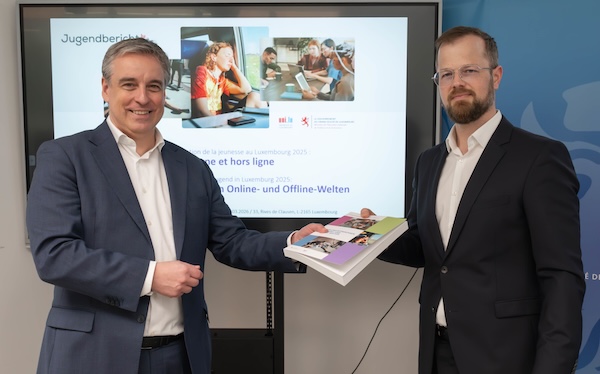
 (L-R) Claude Meisch, Luxembourg's Minister of Education, Children and Youth; Dr Robin Samuel, Professor of Sociology and Youth Research and Director of the Centre for Childhood and Youth Research (CCY) at the University of Luxembourg;
Credit: MENEJ
(L-R) Claude Meisch, Luxembourg's Minister of Education, Children and Youth; Dr Robin Samuel, Professor of Sociology and Youth Research and Director of the Centre for Childhood and Youth Research (CCY) at the University of Luxembourg;
Credit: MENEJ
On Monday 9 March 2026, Luxembourg's Minister of Education, Children and Youth, Claude Meisch, and Prof. Dr Robin Samuel of the University of Luxembourg presented the fourth National Report on the Situation of Youth in Luxembourg at a press conference.
The report, entitled “Leben und Aufwachsen in Online- und Offline-Welten” (“Living and Growing Up Online and Offline”), is published every five years and provides an overview of the living conditions and daily realities of young people aged twelve to 29.
According to Luxembourg's Ministry of Education, Children and Youth, the report provides an in-depth and up-to-date analysis of young people’s living conditions and daily realities in the country. As with the previous editions published in 2010, 2015 and 2020, the research for the 2025 report was carried out by the Centre for Childhood and Youth Research (CCY) at the University of Luxembourg.
“Social networks and smartphones have a direct impact on the lives and well-being of our young people. The National Report on the Situation of Youth in Luxembourg confirms that reducing smartphone use at school as part of a healthy screen-life balance was the right decision. At the same time, we must also create spaces and opportunities outside school for young people to meet, exchange and share meaningful experiences. The report also clearly shows that access to social media needs to be better regulated,” said Minister Meisch.
Since the publication of the last national report in 2020, the global context has undergone significant changes. Successive crises and rapid technological developments have considerably altered the expectations, perspectives and responsibilities of young people. Given the central role of media and digital technologies in the daily lives of young people and their influence on behaviour, the ministry also tasked the University of Luxembourg with placing particular focus on the digital practices of young people in order to inform future reflections and strategic orientations.
During the press conference, the minister highlighted several key findings of the report and explained the responses provided through youth policy, the ministry noted.
The Influence of Smartphones and Social Media
The report shows that the digital world has become an integral part of young people’s daily lives. Some 68.5% of young people use social media on at least 20 days per month, and 80% spend at least two hours per day on social networks. Digital technologies influence family life, school, social interactions and leisure activities. They also play a central role in identity formation, opinion building and social relationships, which now take place both online and offline.
This omnipresence of screens is accompanied by an acceleration of the pace of life and a feeling of lost time, particularly linked to social media and digital content consumption. Many young people find it difficult to detach themselves from their smartphones, often out of fear of missing out (FOMO). Young people aged twelve to fifteen appear particularly vulnerable, as their digital skills and self-regulation capacities are still developing, according to the report.
These findings confirm the relevance of the measures introduced by the ministry in 2025/2026 to ban or restrict smartphone use in primary schools, maisons relais and secondary schools. They also confirm the importance of awareness campaigns targeting young people and families within the framework of the Screen-Life-Balance campaign, the ministry noted.
The Need to Meet and Share Experiences
Since the 2020 report, the daily lives of many young people have changed significantly. Face-to-face meetings have become less frequent, and young people engage in fewer leisure activities. Opportunities for spontaneous exchanges and shared in-person experiences have declined noticeably: only 13.3% of young people aged twelve to 29 meet their friends at least 20 days per month, the report states.
At the same time, overall well-being among young people has declined since 2019, with around one quarter reporting feeling worse. This is accompanied by increasing societal concerns.
These developments highlight the growing need for support, proximity and real-life encounters. They confirm the importance of measures implemented through the campaign “Manner Ecran – méi beweegen, entdecken, erliewen”, which aims to develop more screen-free activities for young people, giving them more opportunities to practise sport, be creative, participate in cultural activities or simply meet one another. A recent example is the MoVe initiative by the National Youth Service (SNJ), which offers sports activities for young people mainly during school holidays.
Rising Feelings of Anxiety
Since 2019, feelings of anxiety among young people aged sixteen to 29 have increased. In 2024, fear of a war in Europe was the main concern for 80.6% of young people, followed by fear of serious illness (78.9%), environmental pollution (77.3%) and climate change (74.5%). Concerns related to the economic situation and personal security have also increased, the report notes.
It is essential to remain attentive to young people and to create spaces where they can express their concerns and participate in societal debates. School psychosocial support services (SEPAS) and youth centres already provide such support. In addition, the ministry plans to increase initiatives enabling young people to actively engage in issues that concern them, such as climate change or the responsible use of media and new technologies. By participating in projects and exchanges on these topics, young people strengthen their sense of personal effectiveness and confidence in their ability to act and have an impact, the ministry said.
A Broad Consultation Process Towards the Jugendpakt
The report is an important element in the political reflection process leading to a new national youth policy action plan by the end of 2026 (Jugendpakt). It forms part of a broad consultation process already launched with actors in the youth sector and other relevant stakeholders.
The process began in 2024, notably with the first Assises of the youth sector. In 2025, a ministerial tour under the theme “Wou dréckt de Schong?” (“Where does it hurt?”) enabled exchanges with more than 200 young people in four regions of the country and helped identify several priority areas for the future Jugendpakt. To deepen this consultation, a series of focus groups will be organised to explore certain themes highlighted by the report in greater detail.
Consultations with youth organisations and youth services will take place through existing cooperation platforms. All contributions will be integrated into the preparation of the Jugendpakt to ensure that the action plan is based on scientific evidence, direct dialogue with young people and close cooperation with actors in the field.
The new youth pact will continue the reorientation of the youth sector, placing greater emphasis on developing activity opportunities for young people, the ministry also noted.
The full version of the National Report on the Situation of Youth in Luxembourg is available in French and German at https://2025.jugendbericht.lu.