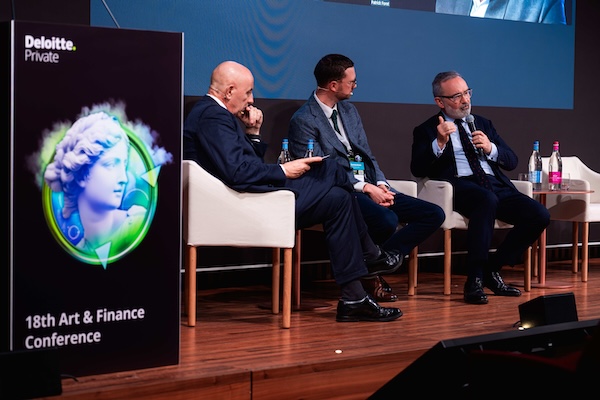
 (L-R) Ernesto Lanzillo; Paul Burtenshaw; Jean Gazançon;
Credit: Deloitte Luxembourg
On Wednesday 28 October 2026, Deloitte Luxembourg announced that, together with Deloitte Italy, it had organised the eighteenth Deloitte Private Art & Finance Conference, which took place on Tuesday 27 October 2026 at Procuratie Vecchie in Venice, Italy.
Held under the theme "Tomorrow's Cultural Cities: From Patronage to Portfolio", the conference explored how private capital can support cultural institutions, heritage preservation and the development of cultural cities. The event brought together representatives from business, finance, government and the cultural sector, both in person and via livestream.
The discussions took place against a backdrop of growing interest in art and collectibles within wealth management. According to Deloitte's 2025 Art & Finance Report, 51% of surveyed wealth managers offered art-related services, compared with approximately 25% in 2011.
Simone Venturini, Mayor of Venice, highlighted the significance of hosting the conference ahead of the 60th anniversary of the Aqua Granda flood of 4 November 1966, which prompted international efforts to preserve the city's cultural heritage.
He emphasised the need for new forms of public-private cooperation that combine heritage protection with financial sustainability and cultural development. He also pointed to Venice's potential to attract investment in research, industry, technology and advanced services, supporting innovation and employment.
Adriano Picinati di Torcello, Global Art & Finance Coordinator at Deloitte Luxembourg, said: "Private capital can bring continuity, flexibility and innovation to cultural ecosystems, but it needs to remain closely aligned with institutional missions and community needs. That is how financial support can translate into lasting cultural value."
Ernesto Lanzillo, Chair of the Board of Directors of Deloitte & Touche SpA and Deloitte Private Leader for Central Mediterranean, also highlighted the shift from traditional patronage towards financial models combining private investment, long-term stewardship and measurable impact.
The conference also examined the economic importance of cultural and creative industries in Venice and the surrounding Veneto region.
According to the “Io sono Cultura 2026” (I am culture 2026) report, prepared by Fondazione Symbola, Unioncamere, the Guglielmo Tagliacarne Study Centre of the Italian Chambers of Commerce and Deloitte, Veneto's cultural and creative sector generated €10.2 billion in value added in 2025, representing 5.6% of the regional economy.
The sector employed 141,773 people, accounting for 6.0% of the region's workforce. By comparison, the Italian national average stood at 5.7% for both economic value added and employment.
In the province of Venice, cultural activities accounted for 5.7% of value added and 6.3% of employment.
A central focus of the conference was the transition from traditional philanthropy and patronage towards more structured approaches to cultural financing.
Participants discussed models including blended finance, impact investment and public-private collaboration, examining how these approaches could support cultural institutions and heritage preservation while improving long-term financial sustainability.
The discussions also addressed the role of art collections and cultural assets in family governance, succession planning and wealth transfer, including the involvement of younger generations in managing and preserving cultural heritage.
These subjects built on previous editions of the conference. The 2024 event examined cultural and creative industries, impact investing and social impact, while the 2025 edition explored art investment, wealth transfer, philanthropy and new technologies.
Participants also considered methods for measuring the impact of cultural projects, alongside questions of governance, rights and long-term preservation.
The conference forms part of Deloitte Private's Art & Finance initiative, launched in 2008 to explore the relationship between finance, culture and business. It also contributes to Deloitte's Arts and Culture programme, which promotes exchanges between cultural institutions, businesses and public and private financial organisations.