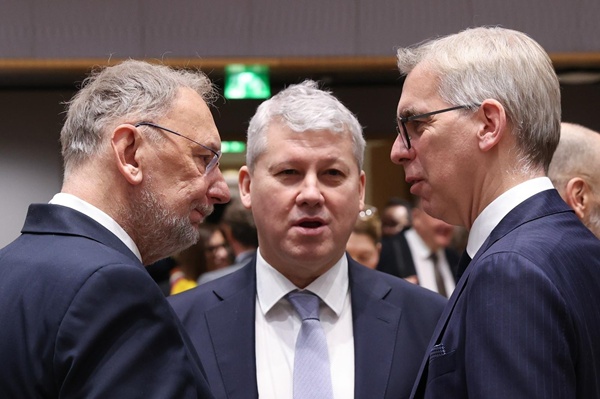
 (L-R) Davor Božinović, Croatia's Minister of the Interior; Marian-Cătălin Predoiu, Romania's Minister of Internal Affairs; Léon Gloden, Luxembourg's Minister for Home Affairs;
Credit: European Union
(L-R) Davor Božinović, Croatia's Minister of the Interior; Marian-Cătălin Predoiu, Romania's Minister of Internal Affairs; Léon Gloden, Luxembourg's Minister for Home Affairs;
Credit: European Union
Luxembourg's Minister for Home Affairs, Léon Gloden, participated in the European Union (EU) Justice and Home Affairs (JHA) Council held on Thursday 5 March 2026 in Brussels, Belgium.
During the Schengen Council meeting, Magnus Brunner, European Commissioner for Internal Affairs and Migration, presented the Schengen Barometer. Minister Gloden reported that asylum applications in Luxembourg had decreased by 12.5% for 2024/2025. According to the minister, "internal border controls are one of the main weaknesses of the Schengen Area, with extensions for more than ten years. External border controls must be strengthened, but internal border controls should not be implemented." He also expressed support for the recent European visa strategy aimed at preventing abuse and attracting talent to Europe.
According to Luxembourg's Ministry of Home Affairs, EU ministers then discussed improvements to voluntary return procedures. Minister Gloden explained that "Luxembourg was a pioneer in reforming its return system with a new concept of voluntary return that emphasises personalised support for return at each stage of the international protection procedure and tailored reintegration support. Member States confirmed that, without the prospect of voluntary return, forced return is necessary."
Ministers also exchanged views on the external dimension of migration, notably in relation to the situations in Lebanon and Libya.
They further discussed the future of Europol, in light of announcements by European Commission President Ursula von der Leyen, who has called for strengthening the agency's mandate as well as its human and budgetary resources. Minister Gloden reaffirmed the importance of Europol and the added value it provides, particularly in terms of data sharing for national investigations. His ministry added that Europol plays a key role in the EU's joint framework for combating organised crime and terrorism.
In this context, Minister Gloden said that strengthening Europol would also serve as a compensatory measure for the cumbersome and static controls at internal borders within the Schengen Area. He advocated for an agency with a robust mandate, particularly in the area of analytical capabilities, enabling it to process large amounts of data and identify links between different cases. The minister reiterated Luxembourg's position that greater synergies should be created while respecting the area of expertise of each actor: the role of Frontex should remain limited to protecting external borders, while Europol should retain jurisdiction over police cooperation.
The ministers' working lunch focused on the impact of the current geopolitical context on the EU's internal security, with particular emphasis on the situation in Syria and the Gulf region. Ministers stressed that the priority is the interests of the Iranian people and emphasised the importance of closely monitoring the situation.
Ministers also formally adopted conclusions on the EU Strategic Framework on Drugs, reflecting the Council's position on the EU Drug Strategy and the specific action plan presented by the European Commission on 4 December 2025.