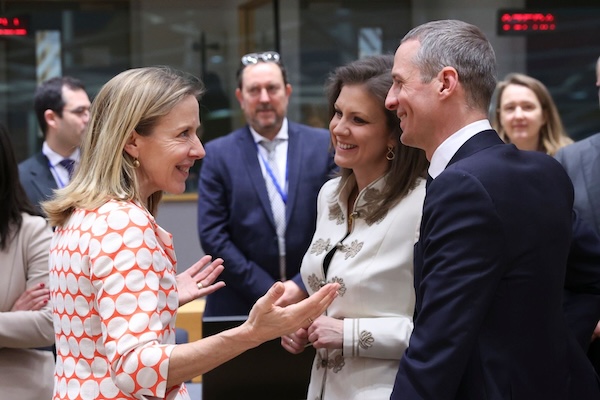
 (right) Serge Wilmes, Luxembourg’s Minister of the Environment, Climate and Biodiversity;
Credit: © Union européenne
(right) Serge Wilmes, Luxembourg’s Minister of the Environment, Climate and Biodiversity;
Credit: © Union européenne
Luxembourg’s Ministry of the Environment, Climate and Biodiversity has reported that Minister Serge Wilmes stressed the need to advance competitiveness and decarbonisation together, while accelerating the transition towards a more electrified economy based on renewable energy, during a recent EU Environment Council meeting.
Following the meeting of the European Union (EU) Environment Council held in Brussels on Tuesday 17 March 2026, Luxembourg’s Minister of the Environment, Climate and Biodiversity, Serge Wilmes, took part in discussions covering the revision of CO₂ emission standards for cars and vans, the EU bioeconomy strategy, post-2030 climate action and international environmental diplomacy.
According to the ministry, EU environment ministers held a policy debate on proposed amendments to CO₂ emission standards for cars and vans. The European Commission’s proposal of December 2025 includes reducing current targets for the automotive industry for 2030 and 2035 (from 100% to 90%), as well as introducing a range of flexibilities and technological options for manufacturers, including incentives to use low-carbon steel produced in the EU.
Minister Wilmes also referred to the current crisis in the Near and Middle East, highlighting Europe’s vulnerability and dependence on fossil fuel imports. He emphasised the importance of progressing competitiveness and decarbonisation in parallel and accelerating the climate transition, in particular through the electrification of the economy based on renewable energy, as a key strategy for resilience and economic independence.
He added that hesitant or contradictory approaches in current EU policy risk creating uncertainty and could shift investment related to the transition outside Europe, potentially slowing the EU in the global race for electric mobility.
Despite divergent positions within the Council, the minister stated that Luxembourg remains ready to engage constructively in finding a compromise, provided it remains consistent with EU climate objectives. According to the ministry, he acknowledged the potential added value of proposed flexibilities, including certificates for low-carbon steel and incentives for small electric vehicles. While reserving his position on the “made in EU” component pending further analysis, he expressed interest in the approach and called for it to be properly discussed during negotiations. He also welcomed the proposal to update vehicle labelling to better reflect developments in the zero-emission vehicle market, stressing the importance of clear and transparent information for consumers and the functioning of the internal market.
Ministers responsible for climate also exchanged views on the key elements of the future legislative framework to implement the EU’s 2040 climate target.
In this context, Minister Wilmes stressed that the post-2030 framework must be incentive-based, provide visibility for businesses and ensure a socially fair transition. The EU Emissions Trading System (ETS) will remain the cornerstone but should be adapted to ensure fair competition and better support the modernisation and decarbonisation of industry.
Regarding flexibilities to be included in future proposals, the minister emphasised that EU climate policies should be aligned with a 90% net emissions reduction target: “Flexibilities must primarily facilitate cost-effective emission reductions within the EU, so that Member States are not necessarily required to rely on international credits.”
Luxembourg thus joined the group of Member States advocating for a framework that supports competitiveness while maintaining strong climate ambition, the ministry noted.
Ministers also adopted Council conclusions on the EU’s new bioeconomy strategy.
While acknowledging that the bioeconomy offers opportunities to reduce dependence on fossil fuels and strengthen both autonomy and competitiveness, Minister Wilmes stressed the importance of integrating ecological limits to ensure the credibility and success of the strategy.
During negotiations, Luxembourg highlighted the need to address growing competition for sustainable biomass more directly and to ensure optimal allocation between different uses (cascade use principle), while taking into account biodiversity and nature restoration requirements.
The minister also underlined the importance of clear and consistent sustainability criteria, as well as recognition of the role of forests as carbon sinks and providers of essential ecosystem services, the ministry added.
During discussions on strategic cooperation between the EU and its Member States in global environmental diplomacy, Minister Wilmes reaffirmed the importance of science and its conclusions, which are increasingly being challenged. He called for proactive and systematic diplomacy based on clear and robust narratives to build strong alliances capable of influencing international negotiations.
He also highlighted the key role of the United Nations Environment Programme as a pillar of environmental multilateralism and a guarantor of scientific credibility within the UN system. In this context, he described the “UN80” reform as a major opportunity to strengthen the effectiveness, coherence and impact of the United Nations, while keeping climate action and environmental protection at the core of its priorities.