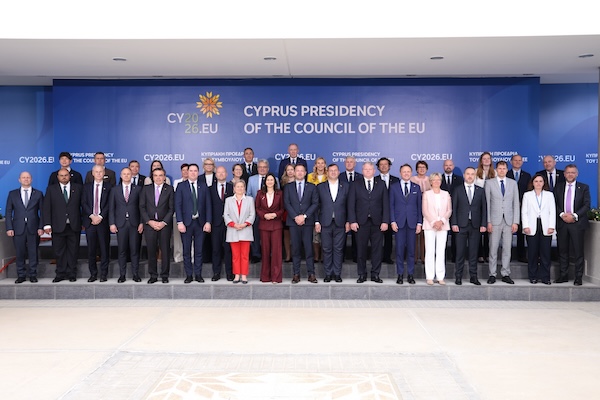
 Group photo from the informal “Agriculture and Fisheries” meeting;
Credit: EU
Group photo from the informal “Agriculture and Fisheries” meeting;
Credit: EU
On Monday 5 May 2026, Luxembourg’s Ministry of Agriculture, Food and Viticulture announced that Luxembourg participated in the informal European Union (EU) “Agriculture and Fisheries” meeting, represented by Martine Hansen, Luxembourg’s Minister of Agriculture, Food and Viticulture.
Taking place from Sunday 4 to Monday 5 May 2026 in Nicosia, Cyprus the meeting brought together ministers of Agriculture, the European Commission, the European Parliament (EP) and professional organisations from the agricultural sector at European level. It allowed decision-makers to exchange views on risk management tools to strengthen in order to make the agricultural and agri-food sectors more resilient, noted the ministry.
Asked which instruments of the Common Agricultural Policy (CAP) have proven effective and which should be prioritised, Martine Hansen, highlighted the effectiveness of the insurance system against natural disasters in the agricultural sector in Luxembourg: “Luxembourg has established an insurance system financed by national funds. This scheme now constitutes an essential element of the resilience of our agricultural sector. More than 50% of agricultural and viticultural holdings have taken out crop loss insurance, covering more than 42% of agricultural and viticultural land and placing Luxembourg well above the European average.”
Furthermore, Minister Hansen underlined the importance of insurance against animal diseases to strengthen the sector’s resilience: “The past three years have been marked by bluetongue and lumpy skin disease. Thanks to our awareness efforts, the number of insurance contracts taken out against animal diseases has tripled.” In this context, Minister Hansen called for state aid rules to be maintained in order to continue the current system, the ministry said.
Regarding future measures, according to the ministry, the functioning of the new crisis reserve remains a key issue. Minister Hansen called for clarification on its role and methods of use to ensure a coherent, effective and rapid response to future crises.
In addition, ministers analysed which additional measures could be taken to address systemic agricultural risks.
Minister Hansen underlined: “The CAP alone cannot cover all systemic risks, as its budget will be reduced beyond 2027. Other sources of funding must therefore be mobilised, in particular those linked to the Competitiveness Fund.” According to her, greater investment will be needed in research, innovation and the fight against transmissible animal diseases.
Moreover, Minister Hansen also welcomed the development of national preparedness and response plans for food security, while warning against increasing the administrative burden.