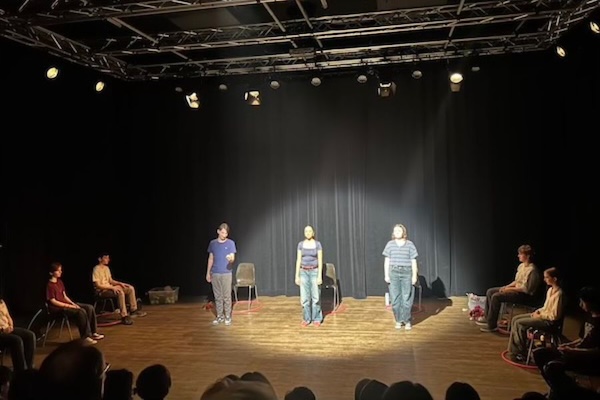
 A scene from the play “Chaos” by the International School of Luxembourg;
Credit: Elza Osmane, Chronicle.lu
A scene from the play “Chaos” by the International School of Luxembourg;
Credit: Elza Osmane, Chronicle.lu
On Friday 27 February 2026, the Festival of English-Language School Theatre (FEST) officially opened its fifth edition with the play “Chaos” by Laura Lomas at the Rotondes Black Box Studio in Luxembourg-Bonnevoie.
Before the official part, Joanne Olivier, British Ambassador to Luxembourg, in her opening speech thanked the audience for their presence and support. “By being here, you help to nurture confidence and encourage the talent of the next generation”, she said.
The FEST Director, Tony Kingston, then took the floor to wish all its performers a memorable experience and highlighted the ability of students to perform in a non-native language. He outlined: “I’m going to say that again for people of English language background, like myself. The idea when I was at school that I would do anything in any other language is actually just as ridiculous now as it was then. And yet here you have eleven, twelve year olds, thirteen year olds coming out on stage…performing in English.”
One of the students, Caitlyn, addressed the audience reflecting on common perceptions of school theatre. “School theatre is sometimes stereotyped as dramatic, strange or slightly out of touch with reality. Speaking as someone who joined school drama at fourteen, I can confirm that we are indeed dramatic and occasionally strange. But it is also a wonderfully imaginative world,” she explained.
The official part took place in the auditorium, which was filled to capacity with an audience of around 200 people. Directed by Jason Hudson, the production explored how individuals search for meaning in an unstable world and how a single incident can transform life and personal relationships.
A cast consisted of nine performers from the International School of Luxembourg: Laura Baichikova; Julia Davis; Ezra Ojeda Debuf; Benjamin Ganter; Rewa Jain; Artem Polovinkin; Madeline Saarnio; Andrew Shepro; and Shawn Yu.
Moving through separate yet connected scenes, the story relied on metaphors to create visual symbolism throughout the performance.
The staging throughout remained minimal. The actors were dressed casually and did not assign personal names to their characters, which placed main emphasis on their confident acting skills, clear vocal delivery and emotional expression rather than superb scenography.
The limited use of simple objects, which included chairs, tennis balls, artificial flowers, water bottles and hula hoops, highlighted the play’s experimental style, with the scene transitions being mainly supported by the lighting and musical accompaniment.
Themes of heartbreak, existential crisis and inner emotional conflict shaped the narrative, reflecting on relationships and vulnerability that many people may experience.