 Credit: © SIP / Emmanuel Claude
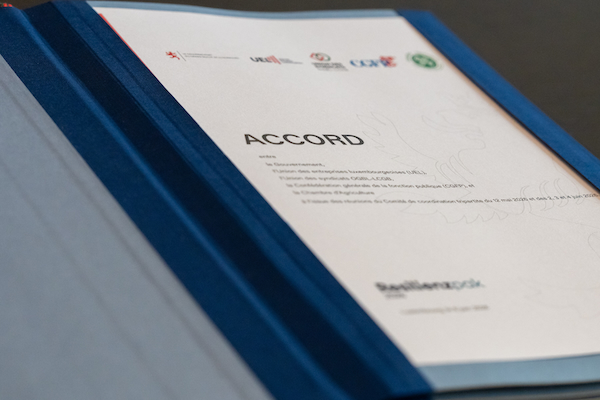
On Monday 8 June 2026, Luxembourg’s Ministry of State announced that the Luxembourg Government, the Union of Trade Unions, the General Confederation of Public Service, the Union of Luxembourg Businesses and the Chamber of Agriculture had reached a tripartite agreement to mitigate the economic and social effects of the international energy crisis.
In its press release, the parties noted that since February 2026, the geopolitical situation in the Middle East, in particular the interruption of maritime traffic through the Strait of Hormuz, has caused significant disruption to international supply chains and energy markets, characterised by a substantial increase in energy prices, particularly oil and its derivatives.
According to the various scenarios prepared by Luxembourg’s statistics institute, STATEC, the macroeconomic situation risks deteriorating further, marked by slower growth, higher inflation and an increase in unemployment. In particular, more pronounced inflation could lead to a loss of household purchasing power and increased costs for businesses.
In light of these developments, the Government decided to convene the Tripartite Coordination Committee in order to examine the principal economic and social challenges facing Luxembourg. The meetings of the Committee were held on Tuesday 12 May 2026 and on Tuesday 2, Wednesday 3 and Thursday 4 June 2026 in the presence of the Government, the Union of Luxembourg Enterprises (UEL), the OGBL-LCGB Trade Union Confederation, the General Confederation of the Civil Service (CGFP), and the Chamber of Agriculture.
During these meetings, a consensus emerged on the need to introduce measures immediately in order to:
• protect employment and economic prospects;
• avoid an inflationary shock and strengthen gains in household purchasing power;
• support households and businesses through a series of targeted measures; and
• promote resilience by accelerating the energy transition, whilst remaining conscious of budgetary constraints and the need to ensure energy supply from different sources.
Accordingly, the Government and the social partners,
• considering the deterioration of the geopolitical situation in the Middle East and its economic and social consequences for Luxembourg;
• reaffirming the fundamental importance of social and tripartite dialogue for Luxembourg’s economic and social model;
• taking into account economic forecasts, particularly inflation developments, as well as trends in job creation and unemployment in recent years;
• emphasising the determination of the Government and the social partners to support households and businesses in the face of rising energy prices and broader inflationary pressures;
• considering the increased exposure of certain economic sectors, particularly agriculture and road transport, to the deterioration of the international environment;
• considering the temporary State aid framework established by the European Commission;
• considering that housing costs weigh heavily on both residents’ purchasing power and the country’s social cohesion and economic attractiveness;
• reaffirming the shared objective of accelerating the transition to renewable energy and energy-efficient renovation; and
• recalling that the social partners note that the present package of measures entails a significant structural cost for public finances and acknowledge that this financial effort serves objectives of solidarity, social cohesion and economic stability;
have agreed on a set of decisions designed to mitigate the effects of the international energy crisis whilst strengthening the country’s resilience against possible future shocks.
This package consists of three complementary pillars:
Pillar I: Strengthening Purchasing Power and Curbing Inflation
1. Limiting increases in Diesel and Petrol Prices: the Government will temporarily absorb part of the additional cost arising from increases in diesel and petrol prices by reducing prices by €0.05 per litre, inclusive of all taxes, from 1 July until 31 December 2026.
2. Electricity Price Subsidy for Households: the Government will temporarily introduce a subsidy of €0.04 per kWh, inclusive of all taxes, on the integrated electricity price from 1 August 2026 until 31 December 2026 for all residential customers with annual consumption below 25,000 kWh.
3. Subsidy for Heating Oil Used by Households: the Government will introduce financial compensation of €0.15 per litre, inclusive of all taxes, for heating oil used as fuel, applicable from 1 August to 31 December 2026.
4. Gas Price Subsidy for Households: the Government will introduce financial compensation of €0.15 per cubic metre of gas, inclusive of all taxes, from 1 August to 31 December 2026. The measure applies to all customers with meters having a maximum hourly flow rate below 65 cubic metres.
5. Introduction of an Economic Conditions Tax Credit: the Government will introduce, from 1 June 2026 until 31 December 2026, an economic conditions tax credit equivalent to the adjustment of the income tax scale for inflation by one index tranche. This tax credit will be integrated into the tax scale from 1 January 2027.
6. Increase in the Social Minimum Wage: In order to support employees paid the social minimum wage whilst limiting the impact on business costs, particularly for small and medium-sized enterprises, the Government intends to increase the net social minimum wage by approximately €200 in several stages as follows: a structural increase of approximately 3.8% (€105) in the social minimum wage pursuant to Article L. 222-2 of the Labour Code from 1 January 2027, as decided by the Government Council at its meeting of 27 March 2026; an increase in the Social Minimum Wage Tax Credit (CISSM) from €81 to €179 from 1 January 2027; and a further increase in the CISSM from €179 to €200 from 1 July 2027. It should also be noted that, given its tapering nature, the increase in the CISSM will also benefit employees earning salaries of up to €3,600.
Pillar II: Protecting Employment and the Economy
7. Structured Exchanges on Housing: the Government and the social partners agree to establish a Housing Monitoring Committee whose mission will be:
• to monitor developments in the housing market on the basis of objective analysis and a shared assessment;
• to ensure regular monitoring of policies and measures implemented;
• to identify persistent obstacles and opportunities for improvement that may strengthen the effectiveness of public action;
• where appropriate, to formulate proposals aimed at supplementing or adapting existing instruments in order to address structural challenges relating both to housing supply and housing affordability; and
• to strengthen coordination and cooperation among the various stakeholders concerned.
8. Doubling of the Maximum Refund Available Under the Super-Reduced VAT Rate: subject to approval by the European Commission, the Government undertakes to double the maximum refund available under the super-reduced rate of Value Added Tax (VAT) from €50,000 to €100,000 in order to adjust this amount to reflect price developments since it was last revised.
9. Improving the Tax Attractiveness of Home Savings Contracts: the Government will abolish the age limit of 40 years currently applicable to the doubling of deductible contributions under home savings contracts.
10. Decisions Concerning Labour and Employment: The Government and the social partners reaffirm their commitment to continuing dialogue within the framework of the Permanent Committee on Labour and Employment (CPTE) and undertake to participate constructively. Should one or more economic sectors face a serious crisis, significant restructuring or job losses likely to have a major impact on employment, the Government and the social partners agree to examine the situation without delay within the Tripartite Monitoring Committee.
11. Targeted State Aid for Particularly Exposed Businesses: In the context of the crisis in the Middle East, which is creating a highly uncertain situation in energy markets over the coming months, the Government will implement temporary State aid frameworks adopted by the European Commission in order to support businesses particularly exposed to the effects of this crisis and, consequently, the economy as a whole.
12. Targeted Aid for the Agricultural Sector: In view of the specific adverse effects on the agricultural sector, particularly in relation to fertilisers, and in order to safeguard Luxembourg's food sovereignty, the Government and the social partners have agreed a number of targeted measures to support farmers, namely:
• implementation of financial assistance to compensate for additional fertiliser costs incurred in 2026, in accordance with the provisions of the European temporary State aid framework;
• an assessment of the inclusion of agricultural businesses within the scope of the Mutual Guarantee Fund in order to facilitate access to financing;
• an assessment concerning advance payment of direct aid under the European Union's Common Agricultural Policy, whilst respecting European regulatory provisions;
• expansion of the promotion of regional food products in collective catering services operated by State organisations or bodies under State supervision;
• strengthening public support for biogas production facilities, including an examination of simplified authorisation procedures, in order to achieve the objectives established in the National Energy and Climate Plan (PNEC); and
• a reduction in the sale price of diesel used exclusively for agricultural, viticultural and horticultural work, aquaculture and forestry, as defined under Measure 3.
Pillar III: Promoting the Energy Transition
13. Temporary Increase in Financial Aid for Heat Pumps: the Government will implement a further temporary increase in financial assistance for heat pumps installed in existing residential buildings, from 1 January 2026 to 30 June 2027, of approximately €2,000, in order to provide additional encouragement for the replacement of fossil-fuel heating systems.
14. Temporary Increase in Financial Aid for Energy Advice: the Government will implement a temporary increase in support for energy advisory services of €300 for a single-family house and up to €500 for a multi-unit residential building, from 1 January 2026 to 30 June 2027.
15. Temporary Increase in Financial Aid for Energy Renovation: the Government will increase financial support for energy renovation measures from 15% to 20% for the period from 1 January 2026 to 30 June 2027.
16. Early Introduction of Social Leasing: the social leasing scheme for electric vehicles, based on long-term contracts with reduced monthly payments and specifically intended for vulnerable households, will enter into force on 1 January 2027.
17. Awareness-Raising Campaign: through Klima-Agence, the Government will launch an awareness campaign aimed at informing, encouraging and supporting households, businesses and public-sector stakeholders in reducing their energy consumption through the adoption of more energy-efficient behaviours, whilst also reducing dependence on fossil fuels through investment in renewable energy.
18. Assessment of Batteries Installed in Co-Location with Photovoltaic Installations: the Government will examine, in addition to the "Einfach. Séier. Erneierbar." process (see Measure 19) and the strategy relating to battery storage systems, the economic viability of batteries installed alongside small and medium-sized photovoltaic installations, operated for example by farmers.
19. Implementation of the "Einfach. Séier. Erneierbar." Package of Measures: the Government reaffirms its commitment to the package of measures entitled "Einfach. Séier. Erneierbar.", designed to promote the transition to wind and solar energy, and undertakes to ensure its full and rapid implementation.
Final Provisions
20. Monitoring of the Measures Adopted Under This Agreement: In view of the volatility of the international situation, the Government and the social partners agree to establish a Tripartite Monitoring Committee tasked with:
• assessing progress in the implementation of the various measures provided for under this Agreement and identifying difficulties that may compromise their implementation;
• analysing developments in the economic, social and employment situation, together with their impact on households and businesses;
• examining circumstances and determining whether sectoral redeployment and retraining units should be established, in accordance with Measure 10; and
• examining any significant developments that may require adaptation of the measures adopted under this Agreement.
The Government has said it will convene the Tripartite Monitoring Committee on a quarterly basis, with the first meeting to take place no later than October 2026, and additionally whenever there is a significant deterioration in the economic or social situation.