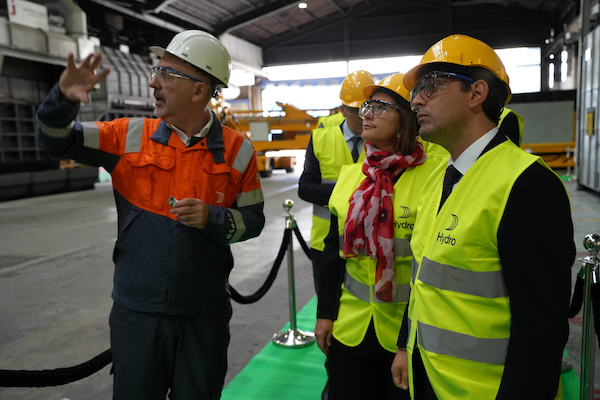
 (L–R) Ludovic Dardinier, Plant Manager, Hydro Clervaux; Yuriko Backes, Minister of Mobility and Public Works; Stéphane Séjourné, Executive Vice-President of the European Commission for Prosperity and Industrial Strategy, Industry, SMEs & the Single Market;
Credit: MMTP
(L–R) Ludovic Dardinier, Plant Manager, Hydro Clervaux; Yuriko Backes, Minister of Mobility and Public Works; Stéphane Séjourné, Executive Vice-President of the European Commission for Prosperity and Industrial Strategy, Industry, SMEs & the Single Market;
Credit: MMTP
On Friday 25 September 2026, Luxembourg’s Ministry of the Economy, Ministry of State and Ministry of Mobility and Public Works reported on the working visit of Stéphane Séjourné, Executive Vice-President of the European Commission responsible for Prosperity and Industrial Strategy, Industry, SMEs and the Single Market, to Luxembourg.
The day's programme, which focused on strengthening Europe's industrial competitiveness, began with a visit to Hydro Aluminium in Clervaux, accompanied by Yuriko Backes, Minister for Mobility and Public Works.
As Hydro's largest aluminium remelting facility in Europe, the Clervaux site processes more than 100,000 tonnes of aluminium waste each year into new products intended in particular for the construction and industrial sectors. Through the increasing use of post-consumer recycled materials, the company is helping to significantly reduce the carbon footprint of aluminium production while strengthening European industrial autonomy in a raw material considered strategic.
The visit to the Hydro Aluminium site in Clervaux highlighted a concrete example of the contribution of European industry to the green transition and the strengthening of Europe's economic resilience. Discussions focused in particular on the challenges facing Europe's aluminium industry, including energy costs, access to secondary raw materials and the need to maintain competitive industrial recycling capacity within the European Union. Stéphane Séjourné reaffirmed his determination to propose an appropriate European regulatory framework that will enable industry to achieve these objectives.
“Today's visit demonstrates that local innovation and the circular economy enable industry and sustainability to thrive together. In the face of geopolitical crises, securing our critical materials is the cornerstone of our collective resilience. Luxembourg stands ready, alongside Europe, to turn these energy challenges into opportunities to build a profoundly resilient, sovereign and sustainable future,” said Minister Backes following the visit.
Stéphane Séjourné then held a bilateral meeting with Lex Delles, Minister of the Economy, SMEs, Energy and Tourism. Discussions focused on the main levers for strengthening Europe's industrial competitiveness in an international context marked by increased competition and growing geopolitical tensions. Among other things, they discussed the Industrial Accelerator Act and the unprecedented introduction of European preference, deepening the Single Market through harmonisation and the removal of the most persistent barriers, reducing the administrative burden on businesses, and modernising the European public procurement framework.
They also stressed the importance of having a simple, predictable and investment-friendly regulatory framework in order to sustainably support the competitiveness of the European economy and the development of SMEs across the European Single Market. Moreover, Minister Delles stressed the importance of banning, at European level, territorial supply restrictions that prevent companies from sourcing from suppliers of their choice.
Following the meeting, they held a joint press conference devoted to European priorities in the areas of industrial competitiveness and economic sovereignty. On this occasion, Minister Delles said: “To sustainably strengthen the competitiveness of European industry, we must act on several fronts at the same time: support innovation and investment, ensure competitive energy, simplify our regulatory framework and complete the Single Market. Our industry needs a predictable framework and a Europe that facilitates business activity rather than making it more complicated. Companies such as Hydro demonstrate that European industry can be innovative, sustainable and create value at the same time.”
For his part, Stéphane Séjourné stressed that strengthening Europe's industrial base is an essential condition for preserving the prosperity, resilience and strategic autonomy of the European Union. He said: “Together with the Member States, we are continuing to develop a new European industrial doctrine based on sovereignty, reciprocity with our partners, decarbonisation, innovation and integration of the internal market. We can count on Luxembourg to defend ambitious objectives for the legislation currently under discussion at European level: the Industrial Accelerator, the reform of public procurement and our strategy for the Single Market.”
The afternoon continued with a meeting with Luxembourg Prime Minister Luc Frieden, focused on Europe's competitiveness. The meeting reaffirmed the high priority Luxembourg attaches to the Single Market, a strategic asset in a context marked by growing political, economic and trade tensions. However, this shield still has weaknesses. In the face of these challenges, the Prime Minister stressed the need to accelerate reforms to strengthen it and thereby safeguard European competitiveness.
The visit concluded with an audience between the Executive Vice-President and Grand Duke Guillaume at the Grand Ducal Palace.