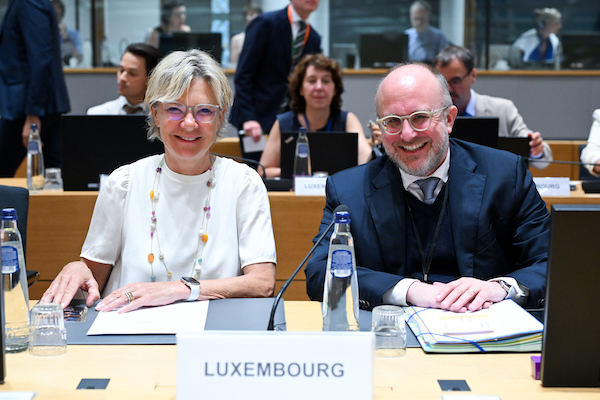
 (L-R) Martine Hansen, Luxembourg Minister of Agriculture, Food and Viticulture; Fabien Raum, Deputy Permanent Representative of the Grand Duchy of Luxembourg to the European Union;
Credit: EU
(L-R) Martine Hansen, Luxembourg Minister of Agriculture, Food and Viticulture; Fabien Raum, Deputy Permanent Representative of the Grand Duchy of Luxembourg to the European Union;
Credit: EU
On Monday 13 July 2026, Luxembourg’s Minister of Agriculture, Food and Viticulture, Martine Hansen, participated in the European Union’s “Agriculture and Fisheries” Council in Brussels, Belgium.
According to the Ministry of Agriculture, Food and Viticulture, the Agriculture Ministers heard the Irish Presidency’s presentation on its priorities for the second half of 2026. They also discussed the European strategy on livestock farming, the protein plan, the role of women in agriculture, as well as several issues related to agricultural trade.
During the debate on the European strategy for livestock farming and the protein plan, Minister Hansen highlighted the importance of a resilient, sustainable and competitive livestock sector in order to guarantee food security and the European Union’s strategic autonomy. She recalled that grassland-based livestock systems play an essential role, particularly in Luxembourg, and that they must be able to continue developing within a balanced regulatory framework. She also advocated better use of organic fertilisers, strengthened prevention of animal diseases and appropriate support for processing sectors in order to increase the resilience of the sector.
The ministry reported that during discussions on agricultural trade, Minister Hansen stressed the importance of geographical indications as a means of promoting European products. She called for their protection to be strengthened in European Union trade agreements, for registration procedures to be simplified and for their promotion among both producers and consumers to be improved. Minister Hansen also advocated the development of a European Union origin label to better distinguish European products from imported products and highlight the efforts of European producers.
Moreover, during the debate on women in agriculture, Minister Hansen recalled that women play an essential role in the development and long-term sustainability of family farms. She highlighted the importance of strengthening their visibility and recognition within the sector, while ensuring a better balance between family life and professional activity. In this regard, she stressed the importance of having reliable replacement solutions available on farms, particularly during maternity leave, parental leave or in cases of illness.