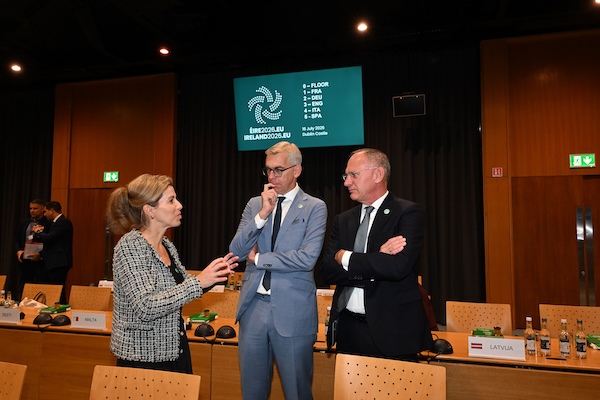
 (L-R) Gilles Roth, Luxembourg Minister of Finance; Claude Meisch, Luxembourg Minister for Housing and Spatial Planning;
Credit: MFIN
(L-R) Gilles Roth, Luxembourg Minister of Finance; Claude Meisch, Luxembourg Minister for Housing and Spatial Planning;
Credit: MFIN
On Thursday 16 July 2026, Luxembourg’s Minister for Housing and Spatial Planning, Claude Meisch, and Minister of Finance, Gilles Roth, presented the government’s new "Booster fir de Wunnengsbau" (“Housing construction stimulus”) package of measures.
According to the government, this initiative aims to provide a lasting boost to residential construction, support access to home ownership, and increase the supply of affordable housing in Luxembourg.
Built around the slogan "Méi bauen. Méi erschwénglech. Méi Wunnengen." ("Build More. More Affordable. More Homes."), the package addresses financing, investment and construction simultaneously in order to provide practical and lasting solutions to citizens' primary concern: housing.
Minister Meisch stated: "For the first time, tax measures relating to housing are being made conditional on social criteria. They will encourage the creation of more rental housing at affordable rents. By also strengthening the interest subsidy, we are supporting young people and young families in their plans to become homeowners. These measures open up new opportunities and represent a concrete investment in the future of our country."
Minister Roth added: "Housing is the foremost concern of our citizens. It is also an absolute priority for the government and for me personally. With this 'Booster fir de Wunnengsbau', we are implementing a coherent package of measures combining tax relief, investment incentives and the mobilisation of private savings, enabling more people to access housing."
The seven measures of the "Booster fir de Wunnengsbau"
1. Exemption from Registration and Transcription Duties on the Construction Element of a Home Intended as a Principal Residence, Where Construction Is No More Than 80% Complete
A temporary exemption from registration and transcription duties will be introduced for individuals purchasing a property as their principal residence. Where construction is no more than 80% complete at the time of purchase, duties will only be payable on the value of the land. The measure applies to off-plan purchases (VEFA) concluded from 16 July 2026 and for a period of three years.
Purchasers whose deeds are signed between the announcement of the measure and the entry into force of the legislation will be able to benefit from the exemption by submitting an application to the Registration, Estates and VAT Administration.
2. Increase in the "Bëllegen Akt" tax credit to €45,000
The "Bëllegen Akt" tax credit will increase from €40,000 to €45,000 per individual for purchases intended as a principal residence. The new ceiling allows the acquisition of a property worth approximately €640,000 without registration duties.
The measure applies from 16 July 2026. Purchasers whose deeds are signed between the announcement of the measure and the entry into force of the legislation will be able to benefit from the increase by submitting an application to the Registration, Estates and VAT Administration.
3. Reduced 8% VAT for social rental housing
A reduced VAT rate of 8% will be introduced for the creation of social rental housing.
To qualify, properties must meet several conditions:
• Maximum floor area of 120 m²;
• Sale price per square metre at or below the median price published by the Housing Observatory for the relevant region and dwelling size;
• Rental return limited to 4% of the net capital invested;
• Let for at least ten years; and
• Rented to a tenant certified as eligible by the Ministry of Housing and Spatial Planning.
The measure will apply from the date the legislation enters into force and will not apply retrospectively.
4. New accelerated depreciation scheme of 6% for six years
A new accelerated depreciation scheme based on the principle of "three times six" will be introduced to improve the profitability of residential property investment.
It provides for depreciation of 6% over six years where the depreciable base does not exceed €600,000 per property.
Where the €600,000 threshold is exceeded, a depreciation rate of 2% will apply to the entire depreciable base without any time limit.
Acquisitions made during 2026 may, at the taxpayer's option, benefit either from the current scheme or the new scheme.
From 1 January 2027, the new scheme will apply to all new acquisitions. Previous schemes will continue to apply until their expiry.
5. Housing bond
Following the success of the Defence Bond, a new €250 million retail bond will be launched to support the financing of affordable housing.
Interest earned on the bond will be exempt from the 20% withholding tax.
The bond is expected to be launched at the beginning of 2027.
6. Changes to individual housing assistance
6.1 Enhanced interest subsidy for first-time young buyers
To make home ownership more accessible for young people, the maximum loan amount eligible for the interest subsidy calculation will increase by €100,000 to €300,000 where at least one borrower is aged 35 or under.
The measure will reduce monthly mortgage repayments and make it easier for young households to purchase their first home.
Enhanced Support for All Households
In addition to the targeted measure for young first-time buyers, the government is strengthening the general housing assistance scheme by increasing the maximum subsidised loan from €200,000 to €250,000.
The additional allowance for each dependent child will increase from €20,000 to €30,000, representing an increase of €10,000 per child.
The maximum subsidised loan ceiling will therefore rise to €370,000.
These improvements will benefit both new applicants and those whose applications are already being processed.
6.2 Home ownership grant extended to young buyers of affordable housing
To help more young people become homeowners, future purchasers of affordable or lower-cost housing will now be eligible for the home ownership grant, as well as the housing savings grant, where at least one future owner is aged 35 or under at the time of purchase.
Previously, these grants were reserved for buyers purchasing on the private market.
The measure will help young households build the personal contribution required to obtain a mortgage and take another step towards purchasing their first home.
7. Continued roll-out of the VEFA acquisition programme
The State is investing an additional €300 million and expanding its off-plan (VEFA) acquisition programme.
The first affordable housing acquisition programme confirmed the effectiveness of this approach. Through an initial budget of €480 million, the State acquired or reserved 830 affordable homes.
To build on this momentum and further increase the supply of affordable housing, the government is allocating an additional €300 million.
Several adjustments have also been made to improve the scheme's effectiveness and better reflect market conditions.
Greater Flexibility Through Partial Acquisition of Developments
The Luxembourg State is moving towards a model of partial acquisition, allowing it to purchase only part of a housing development.
By committing at the start of sales, the State acts as an anchor purchaser, securing part of the sales and increasing confidence among private buyers.
Most importantly, this commitment enables more developments to reach the pre-sale thresholds required by banks, unlocking financing for developers and allowing construction work to begin more quickly.
With the same budget, partial acquisition increases the number of projects that can proceed and benefits all future purchasers, whose homes can only be built once construction starts.
Land Acquisition Criteria Adapted to Market Conditions
Housing acquisitions will be based on the new regionalised Maximum Eligible Amount (MME) model.
Municipalities are now divided into six categories.
This new classification allows acquisition ceilings to better reflect regional and local market conditions and will now serve as the reference framework for the State's VEFA programme.
Examples of interest subsidy calculations
• New "young purchaser" ceiling: A household with one dependent child and a net income of €79,000, receiving an interest subsidy of 1.5%, can now benefit from a monthly subsidy of up to €400.31, thanks to the new ceiling of €330,000, representing an increase of €133.43 per month.
• New "young purchaser" ceiling: A household with four dependent children, a net income of €80,000 and receiving an interest subsidy of 3.5%, can now benefit from a monthly subsidy of up to €1,193.58, thanks to the new ceiling of €420,000, representing an increase of €397.86 per month.
• New ceiling: A household with one dependent child and a net income of €79,000, receiving an interest subsidy of 1.5%, can now benefit from a monthly subsidy of up to €339.66, thanks to the new ceiling of €280,000, representing an increase of €72.78 per month.
• New ceiling: A household with four dependent children, a net income of €80,000 and receiving an interest subsidy of 3.5%, can now benefit from a monthly subsidy of up to €1,051.48, thanks to the new ceiling of €370,000, representing an increase of €255.76 per month.