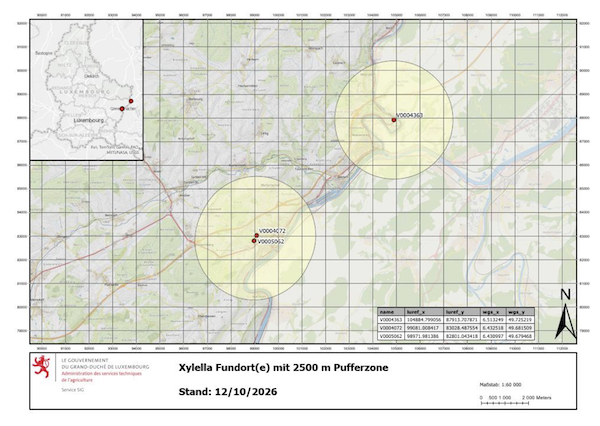
 Confirmed Xylella Fastidiosa detection sites in Luxembourg's Moselle region and the surrounding 2.5km buffer zones;
Credit: ASTA
Confirmed Xylella Fastidiosa detection sites in Luxembourg's Moselle region and the surrounding 2.5km buffer zones;
Credit: ASTA
On Tuesday 13 October 2026, Luxembourg's Ministry of Agriculture, Food and Viticulture announced that the bacterium Xylella fastidiosa had been detected at three sites in the country's Moselle wine-growing region.
According to the ministry, the authorities received three positive test results on Monday 12 October 2026 from specialised laboratories, confirming the presence of the bacterium in samples collected at separate locations in the municipalities of Mertert and Grevenmacher.
The ministry stressed that the bacterium cannot be transmitted to humans or animals and that its detection does not affect the safety of Luxembourg wines.
Xylella fastidiosa affects various plant species, including grapevines, by disrupting the flow of sap, which can cause plants to dry out and die. The bacterium spreads mainly through sap-feeding insects and the movement of infected plants. There is currently no treatment available to cure infected plants.
The bacterium has previously been detected in several countries within the European Union (EU), including Italy, France, Spain and Portugal, although some outbreaks have been successfully eradicated.
Following the confirmed detections, Luxembourg's authorities established infected zones extending 50 metres around each affected plant, alongside buffer zones covering a radius of 2.5 kilometres around each infected zone.
The infected areas cover a total of 2.35 hectares. Within these zones, authorities are identifying and removing infected or suspected plants, as well as plants of the same species, even if they show no symptoms. All grapevines covered by these measures must be uprooted and destroyed.
The buffer zones extend across parts of Rosport-Mompach, Mertert, Manternach, Grevenmacher, Biwer and Wormeldange, where authorities will carry out additional sampling and testing.
Measures to control insects that spread the bacterium will also be introduced, while the movement of potentially affected plants intended for planting will be prohibited or strictly regulated.
German authorities will implement similar measures in the affected areas on their side of the border.
The ministry confirmed that affected winegrowers will receive compensation for damage resulting from the mandatory plant health measures, with further details to follow.
Residents, businesses and agricultural operators in the affected areas have been urged not to transport potentially infected plants outside the designated zones, to report any suspected infections and to follow instructions from the authorities.
Winegrowers seeking information or suspecting an infection can contact the Institut Viti-Vinicole (IVV) by tel: 23-612-1 or by email at viticulture@ivv.etat.lu.
Suspected infections can also be reported to the Plant Protection Service of the Administration of Agricultural Technical Services (ASTA) at pest.alert@asta.etat.lu.
Further information about the bacterium is available on the ministries website.