 Credit: Ievgenii Karanov, Chronicle.lu
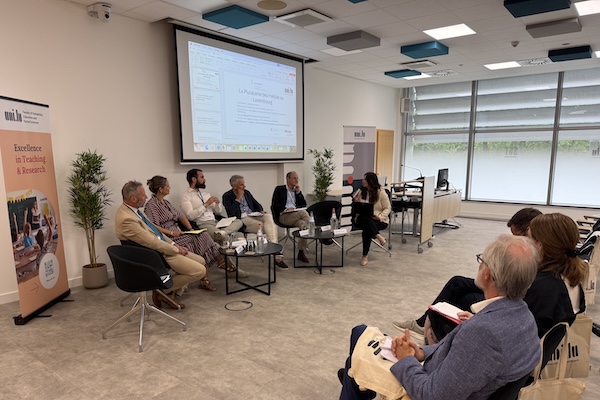
On Tuesday 7 July 2026, the University of Luxembourg hosted a Media Pluralism Conference at its Kirchberg Campus, bringing together around 40 representatives from academia, public institutions, the media sector and European organisations to discuss the state of media pluralism in Luxembourg.
Luxembourg's Minister Delegate to the Prime Minister for Media and Connectivity, Elisabeth Margue, opened the conference. The programme also included presentations on the findings of the Luxembourg Media Pluralism Monitor, the role of influencers in Luxembourg and abroad, and a panel discussion featuring representatives of the University of Luxembourg, the European Commission Representation in Luxembourg, the Luxembourg Press Council, ALIA and public broadcaster Radio 100.7.
Presenting the findings of the 2026 Luxembourg Media Pluralism Monitor, Dr Stéphanie Lukasik and Dr Raphaël Kies said Luxembourg ranked tenth among the 32 countries assessed in terms of risks to media pluralism. While the country recorded a low risk for political independence (33%) and a medium-low risk for social inclusiveness (44%), market pluralism remained the main area of concern, receiving a high-risk score of 68%. They attributed this primarily to the concentration of media ownership, with CLT-UFA dominating the audiovisual sector and Editpress and Mediahuis the print media market. They also warned that growing reliance on generative artificial intelligence and social media for access to information increasingly threatens both media pluralism and the integrity of information.
They also identified several areas requiring further attention, including greater transparency of media ownership across all media sectors, stronger safeguards against commercial influence on editorial content and the publication of independent audience data. They also questioned whether Luxembourg's Independent Audiovisual Authority (ALIA) currently has sufficient resources to fulfil its expanding responsibilities under the European Media Freedom Act (EMFA), including tackling disinformation and foreign interference. Other priorities highlighted included strengthening media literacy and journalism education, improving the representation of minorities and women in senior media positions and ensuring continued support for smaller media outlets to promote a more diverse media landscape.
The focus then shifted to the traditional media landscape to the growing role of digital content creators and social media in shaping public opinion. PhD student Yifei Ding of the University of Luxembourg presented preliminary findings from his research on influencers and their role in Luxembourg's information ecosystem. He noted that professional media remain the main source of news, although around four in ten respondents encounter news-related influencer content at least occasionally, with younger people significantly more exposed than older generations. While only 8.8% said they actively seek political information from influencers, political messages often appear through broader lifestyle and societal content.
The survey also found that respondents generally trust professional media more than influencers, despite 78% reporting that they encounter misleading or false information from influencers at least occasionally. Although only 11.9% of respondents said influencers had affected their political opinions at least sometimes, Ding argued that this remains relevant for democratic debate and highlighted the need for greater transparency around influencer activity, political advertising and sponsorship.
In a pre-recorded presentation, Professor Dr Mark D. Cole of the University of Luxembourg stressed that safeguarding media pluralism requires continuous efforts rather than one-off legislative measures. Referring to the European Media Freedom Act (EMFA), he argued that independent and diverse media are essential for democratic discourse, particularly at a time when online platforms, disinformation campaigns and artificial intelligence are reshaping the information landscape. He added that strengthening trusted professional media would be key to countering unreliable online content and ensuring citizens continue to have access to reliable information.
The conference concluded with a panel discussion, in which speakers commented on the findings of the Media Pluralism Monitor and shared their views on the challenges and opportunities facing Luxembourg's media landscape.
Misch Pautsch, President of the Press Council, described the Media Pluralism Monitor results as "a small win", noting that Luxembourg remained one of only four countries whose overall score had remained stable while many others had deteriorated. He welcomed improvements in indicators related to professional journalism, political independence and cultural diversity, but said market pluralism remained "the one problem that we need to tackle", while also expressing concern about experienced journalists leaving the profession before becoming specialists.
Jean-Lou Siweck, Chief Executive Officer of Radio 100.7, argued that Luxembourg had "a number of players" employing professional journalists, but that ownership was concentrated among relatively few media groups. He said the economic model for daily newspapers had weakened significantly over the past two decades, leading to smaller newsrooms, and added that the country's international population remained underserved by Luxembourg-focused journalism.
Dennis Wernerus, Deputy Head of the European Commission Representation in Luxembourg, noted that Luxembourg consistently ranked among Europe's strongest performers for media freedom and pluralism. However, he stressed that legislation alone would not be enough to address future challenges, arguing that "legislation will never be as fast as technological developments" and calling for continued investment in journalist training and media literacy.
Cindy Bauwens, Director of ALIA, said she preferred to describe Luxembourg's media pluralism as "difficult to assess" rather than simply good or bad. While welcoming developments such as DAB+ and the forthcoming launch of the country's first African radio station, she confirmed that ALIA was working on a national media ownership database, expected in early 2027, adding: "If you cannot measure pluralism, you cannot protect it."
Carsten Ullrich, Research Scientist at the University of Luxembourg, highlighted the specific challenge of ensuring market pluralism in a small multilingual country where media outlets must remain economically viable despite a limited audience. He added that Luxembourg nevertheless faced the same digital risks as the rest of Europe, particularly the growing concentration of online platforms.
The conference concluded with a networking session, giving participants an opportunity to continue discussions and exchange views in an informal setting.