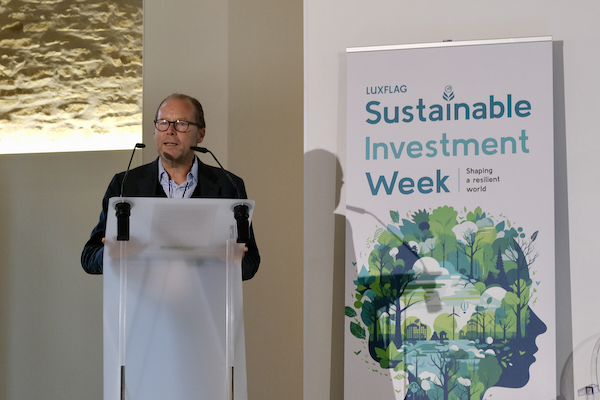
 Herman Beythan, Chairman LuxFLAG;
Credit: Steven Miller, Chronicle.lu
On Wednesday 21 October 2026, the first day of the eighth edition of LuxFLAG Sustainable Investment Week took place at the Centre Culturel Schéiss in Luxembourg-Belair.
The two-afternoon event, organised by the Luxembourg Finance Labelling Agency (LuxFLAG), was moderated by Adriano Scarampi, Partnerships and Business Development at LuxFLAG, and began with opening remarks from Herman Beythan, Chairman LuxFLAG, who began by stating: “This is an interesting moment for our industry. Sustainable finance has moved firmly into the mainstream, but with that comes progress, comes as well greater scrutiny.”
Herman Beythan spoke of how the original emphasis towards building frameworks, defining classifications and creating disclosure requirements has now shifted to the question of, “are they delivering what we need? Are they contributing to transparency and trust?” and highlighted how these questions would be some of the driving themes for the conference.
In closing, he remarked: “This conference is an opportunity to bring different perspectives together, from asset managers and investors to regulators, advisers, technology providers and researchers. And to discuss not only what is working, but just as importantly, what is not working and what needs to be done that it will be working. Because ultimately the question is not simply how sustainable finance continues to evolve. But how we ensure that the framework, products and initiatives we develop serve their fundamental purpose. Helping to direct capital towards a more sustainable economy.”
The first guest speaker of the conference, Thomas Schoos, Director-General for International, European and Internal Affairs - Ministry of the Environment, Climate and Biodiversity, was then welcomed to the stage. He spoke of the societal and environmental challenges being experienced across the world and cited the ongoing conflict in Iran as an example of “the quagmire that comes from trying to blindly sustain a model that is coming to an end.”
Emphasising a positive outlook, Thomas Schoos added: “The transition is happening, we are all working for the transition, in some way, shape or form, together. So I am much more positive, despite all the negativity that surrounds us. I am much more a believer of just steadying the course of the progress that we are making, even though it might not always feel like that.”
He spoke of the three priority pillars for Luxembourg’s Ministry of the Environment, Climate and Biodiversity: the effect of climate change on livelihoods and communities; the conservation and restoration of nature; and finding economic viability while safeguarding environmental integrity.
Thomas Schoos then detailed Rio Changemakers - a global, AI-powered investment marketplace co-developed by the Government of Luxembourg and the Global Landscapes Forum (GLF), with LuxFLAG serving as its certifying partner - which aims to connect investors and financial institutions with locally led projects that address climate change, biodiversity loss and nature conservation.
“We have our role, finance has its role, science has its role, and technology has another one. The value of this nexus approach and the value of Rio lies in bringing these communities together around this objective of speeding up investments and increasing the size of the cake that is reserved for impact finance, and we believe we can do that here from Luxembourg,” said Thomas Schoos.
There then followed a panel discussion on the subject of how AI can help connect locally led solutions with sustainable finance, moderated by Marina Brunale, Sustainable Finance Programme Manager at Global Landscapes Forum, and member of the Landscape Alliance; Jasmin Metzler, Senior Advisor, International Climate Finance and Sustainable Finance for Luxembourg’s Ministry of the Environment, Climate and Biodiversity; Ludwig Liagre, Founder and Managing Director at Rio Impact, and Finance Advisor at GLF Sustainable; and Alexandre Gaudin, Sustainability Operations Officer at LuxFLAG.
Each member of the panel was presented with a different question by Marina Brunale. On the subject of the feasibility of AI to meet this requirement, Jasmin Metzler answered: “AI, for us, can help reduce friction in climate and nature times, but we need to be aware, we need to be inclusive, responsible, we need to have the necessary safeguards in place in order to have these positive aspects. It is also of utmost importance to have like the locally led organisations and the local partners to be an active participant in the whole process, to have leadership. We need scientific integrity to be as a very strong pillar… AI can help support human decision making but it cannot replace it.”
On the question of what is the biggest disconnect between the world of investors and developers in the field of sustainable investment and finance, Ludwig Liagre noted that both the scale of the projects and the physical distances between the projects and investors creates problems. Additionally, differences in data requirements and what is communicated also create additional barriers.
He remarked: “Some of these project developers, they are not used to work with this kind of information, and to format them in a way that are relevant for investors. So, that is where also the exchange makers could help, thanks to AI, to format more rapidly and to work in a way that we can plug in a number of data sets and databases… It is very challenging because every time an investor or fund comes, it is a new process, it is a different questionnaire and it takes time. With AI… we can do it in a way that we are going to learn from the best practices, and those projects will be accelerated, thanks to this.”
And on the question of what role organisations like LuxFLAG play in maintaining trust within the sustainable ecosystem, Alexandre Gaudin responded: “We look at the fund ecosystem, how the governance is structured, who are the experts, how the technical assistance is performed, how the employees’ knowledge is maintained over time. And, of course, we have the investment pipeline… to make sure that the targeted companies and projects can deliver the impact promised.”
He added: “We are trying to make the flow of capital from investors to locally led projects faster and better. AI could help us in this process. We will be able to connect databases to identify assets, local risks, whether they are climate risks, very significant risks, and even social risks, to make sure that, for instance, smallholder farmers' communities are not left aside, they also have a part, a share of the cake… AI can help money to move faster and better, and verification is about making sure it moves in the right direction for the long term.”
The event then continued with presentations on SFDR 2.0 regulations, navigating ethical AI risks, a panel discussion on sustainable finance trends in private markets, trust in technology, ethical finance and sustainable investment products.
The second day of the LuxFLAG Sustainable Investment Week will feature contributions from representatives at LuxFLAG, PWC Luxembourg, Cranfield University, Linklaters, Foyer Group and others.
The full programme can be viewed at https://lsiw.luxflag.org/2026/.
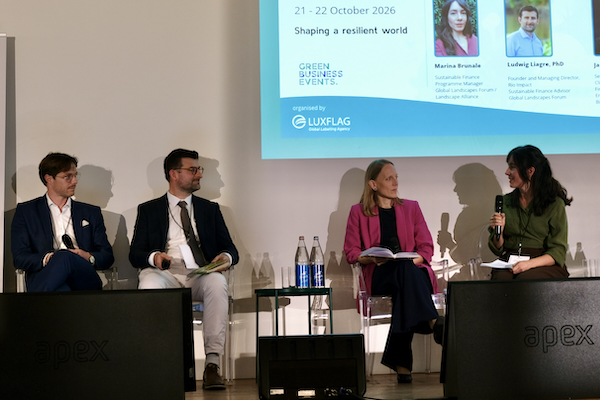 Caption: (L-R) Alexandre Gaudin, LuxFLAG; Ludwig Liagre, Rio Impact; Jasmin Metzler, Luxembourg Ministry of the Environment, Climate and Biodiversity; Marina Brunale, Global Landscapes Forum/Landscape Alliance
Credit: Steven Miller, Chronicle.lu