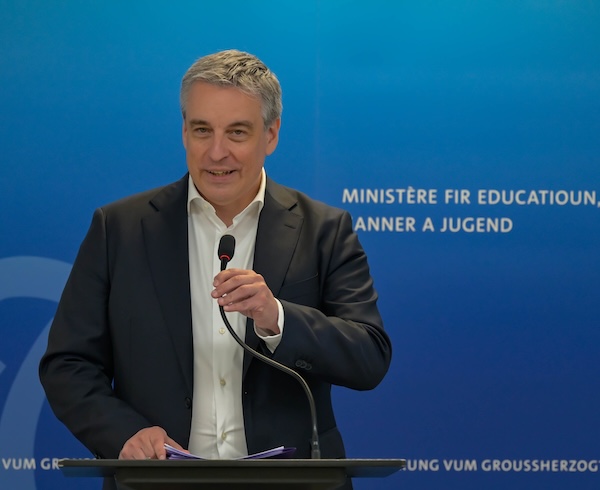
 Claude Meisch, Luxembourg’s Minister of Education, Children and Youth;
Credit: MENEJ
Claude Meisch, Luxembourg’s Minister of Education, Children and Youth;
Credit: MENEJ
On Friday 5 June 2026, Luxembourg’s Minister of Education, Children and Youth, Claude Meisch, presented measures to expand language pathways in secondary education and vocational training for the 2026/2027 school year.
In Luxembourg’s multicultural and multilingual context, the diversification of educational pathways and languages of instruction aims to better reflect the varied profiles of pupils and improve their chances of academic success. Alongside the development of public international schools, the ministry has expanded language options within primary and secondary schools, following the national curriculum.
At primary school level, this diversification is reflected in the ALPHA - “zesumme wuessen” reform, which will introduce, from the 2026/2027 school year, a choice of literacy language (German or French) for all pupils. At secondary school level, French language provision is being expanded in both lower and upper classes to reflect the growing diversity of the school population, said the ministry.
“By offering French language classes alongside German language classes across all levels of education, we are enabling more pupils to follow their educational pathway in the language in which they learn best. Expanding the availability of French language classes therefore helps to strengthen equal opportunities and social cohesion while preserving the multilingual advantage that characterises Luxembourg’s education system,” said Minister Meisch.
According to the ministry, the language in which a pupil feels most comfortable plays an important role in their academic success, considering that more than two-thirds of pupils do not speak Luxembourgish or German at home nowadays.
In the lower classes of classical secondary education (Years 7 to 5), general secondary education (Years 7 to 1) and vocational training (Years 4 to 1), German has traditionally been the language of instruction for most subjects, except mathematics, French, English and certain specialised subjects, added the ministry, noting that French language classes have gradually been introduced in recent years. Intended for pupils who attended primary school in Luxembourg.
The objectives and requirements of language subjects such as German, French and English remain unchanged compared with German language classes, while French language provision will be expanded further in both lower and upper secondary education.
Before 2020, French language classes mainly served newly arrived pupils. The first French language Year 7 classes for pupils coming from Luxembourg’s primary schools were introduced in the 2021/2022 school year. Since then, the offer has gradually expanded across different educational pathways.
The expansion will see the number of schools offering French language Year 7 classes increase from one to four in classical secondary education, from six to seventeen in general secondary education and from two to ten in the preparatory pathway. The French language offer in general secondary education will also expand at upper secondary level, with five of the twelve sections available from Year 4 onwards and nine of the twenty sections available from Year 2 onwards offered in French. Pupils will be able to choose between German and French language streams regardless of the language of instruction followed in lower secondary education.
To further expand language options, the ministry is also considering the introduction of German language sections in upper classical secondary education (Years 4 to 1), where French has traditionally been the language of instruction. A pilot project is planned for the 2027/2028 school year at the Lycée classique de Diekirch, Lycée de garçons de Luxembourg and Lycée Hubert Clément in Esch-sur-Alzette. All three schools will also begin offering French language Year 7 classes from the 2026/2027 school year.
The ministry also announced plans to further expand language options in vocational training. For the 2026/2027 school year, nine additional Diploma of Vocational Aptitude (DAP) programmes will be offered in French, bringing the total number of French language DAP programmes to 40. Of the 23 programmes leading to a Technician Diploma (DT), five are also available in French, while programmes leading to a Certificate of Professional Competence (CCP) may be taught in either German or French depending on pupils' needs. The English language vocational training offer will also expand, with eight DAP programmes and three DT programmes available in English from the start of the new school year.