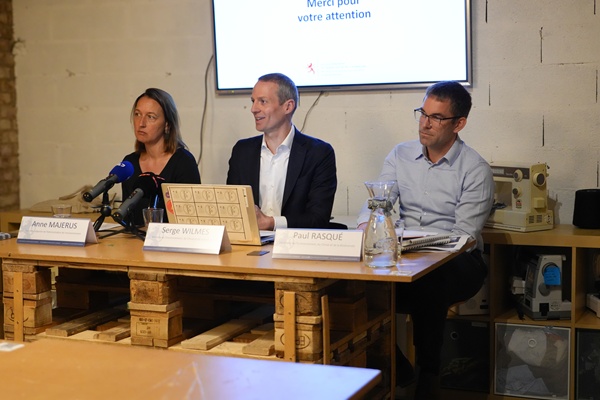
 (L-R) Anne Majerus, Deputy Director of the Environment Agency; Serge Wilmes, Luxembourg's Minister of the Environment, Climate and Biodiversity; Paul Rasque, Ministry of the Environment, Climate and Biodiversity;
Credit: MECB
(L-R) Anne Majerus, Deputy Director of the Environment Agency; Serge Wilmes, Luxembourg's Minister of the Environment, Climate and Biodiversity; Paul Rasque, Ministry of the Environment, Climate and Biodiversity;
Credit: MECB
At a press conference on Friday 24 April 2026, Luxembourg's Ministry of the Environment, Climate and Biodiversity, together with the Environment Agency, presented the new national waste and resource management plan.
The ministry noted that the Government Council (cabinet) approved the third revision of this plan on Wednesday 15 April 2026.
The revised plan sets out the main guidelines for national policy on waste prevention and sustainable resource management up to 2030 and forms part of the transition to a circular economy.
Serge Wilmes, Luxembourg's Minister of the Environment, Climate and Biodiversity, described the plan as "the main tool for supporting the transition from waste management to resource management by adopting a structured and pragmatic approach." He added that the plan "puts the principles of prevention, reuse and responsibility at the heart of our actions."
Since 2000, the national waste and resource management plan has served as an essential framework for waste prevention and management in Luxembourg, according to the ministry.
The 2025 plan:
- analyses the current state of waste and resource management to identify concrete avenues for improvement;
- defines 86 strategic objectives and 328 operational measures to be implemented by 2030 to strengthen waste prevention and ensure sustainable resource management in Luxembourg;
- assesses progress in the transition to a circular economy and a "zero waste" future.
The revised plan is the result of an extensive participatory process. It is based on a comprehensive assessment and in-depth analyses conducted by experts across various resource streams, as well as municipalities, inter-municipal associations, relevant economic actors and stakeholders in the circular economy.
The draft plan was refined based on contributions from a public consultation held from 11 June to 1 October 2025 via the national public consultation portal and the "Zesumme vereinfachen" platform. A total of 46 opinions were submitted, generating 260 comments, which were incorporated into the final version.
The plan is based on fundamental principles that structure all planned measures, including:
- the waste hierarchy, prioritising prevention, monitoring reuse, repurposing, recycling and recovery before disposal;
- the protection of human health and the environment;
- the polluter-pays principle, according to which waste producers bear the cost of waste management;
- extended producer responsibility, giving producers financial responsibility for the end-of-life management of their products.
The plan pays particular attention to waste management infrastructure to ensure its sustainability, resilience and integration into a circular economy. This includes:
- landfills;
- incineration and co-incineration plants;
- composting facilities;
- biomethanisation plants;
- resource centres.
The plan identifies 22 types of waste or areas of action, organised by management method or the nature of the waste and pollutants involved.
For the first time, the national waste management plan includes a chapter dedicated to textile waste and waste containing persistent organic pollutants (POPs). It also strengthens cross-cutting actions promoting reuse, repair and end-of-waste status.
Key targets for 2030 include:
- municipal household waste: at least 60% recycling by weight and an end to landfilling municipal waste;
- biowaste and food waste: full national coverage through separate collection and nutrient recovery, and reduced food waste across the value chain;
- construction and demolition waste: prevention of excavated soil, promotion of material reuse and end-of-waste management;
- packaging waste: at least 70% recycling and reduced single-use plastic packaging;
- littering: reduced litter, strengthened producer responsibility and improved monitoring;
- waste electrical and electronic equipment (WEEE): collection rate of at least 65%, with stronger prevention and promotion of (and preparation) for reuse;
- textile waste: introduction of an extended producer responsibility scheme, improved separate collection and monitoring of textile flows, and promotion of reuse;
- reuse: stronger structuring and promotion of reuse and repurposing, supported by reliable reuse databases.
To achieve these objectives, the plan includes measures such as:
- strengthening separate collection of household waste;
- promoting separate collection of biowaste, targeted awareness campaigns and action plans against food waste;
- developing construction waste recovery channels, promoting selective deconstruction, the reuse of materials, and the end of waste status;
- environmental agreements and stronger campaigns to prevent and combat littering;
- developing a regulatory framework for textile waste, as well as an analysis of textile flows and their potential for recovery;
- establishing platforms and networks dedicated to reuse, their integration into resource centres and their promotion through the Climate Pact.