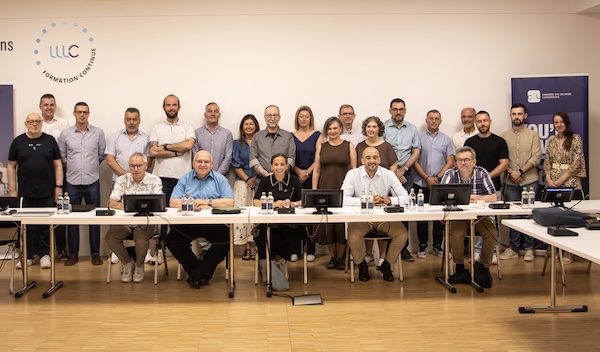
 Members of the Union of Trade Unions (l’Union des syndicats);
Credit: USD
Members of the Union of Trade Unions (l’Union des syndicats);
Credit: USD
On Tuesday 30 June 2026, the OGBL-LCGB Union of Trade Unions (l’Union des syndicats) announced the publication of the activity report covering its first year of operation.
The Union of Trade Unions was officially founded on 20 June 2025 through the shared initiative of the OGBL and the LCGB, with the aim of strengthening trade union action in response to increasing attacks on workers’ rights and the erosion of social dialogue and with the defence of the Luxembourg social model as its objective.
Following the constitutive meeting on 4 July 2025 which set up the organisation, the Executive Bureau has met on a bi-weekly basis throughout its first year to ensure political follow-up on the many ongoing files.
The union noted that the joint meeting of the OGBL National Committee and the LCGB Central Committee, held in June 2026, marked a further step in strengthening cooperation between the two organisations, and said that this first year was not devoted solely to building a new structure - it was above all a year of building a genuine trade union balance of power.
In its report, the union highlighted a number of events in which it was involved in the past year. These included its participation in the three “Sozialronnen” meetings organised during the summer of 2025, following which it issued a clear assessment of the state of social dialogue in Luxembourg and announced a boycott of several consultation bodies, including the Permanent Committee for Labour and Employment (CPTE), while affirming its intention to continue discussions only within bilateral meetings capable of producing concrete results.
The year also included ongoing dialogue with the authorities, political parties and social partners on key policy areas including labour law, working time organisation, professional redeployment, challenges linked to artificial intelligence, new forms of work and platform workers. Several meetings were also held with Luxembourg’s Minister of Finance, Giles Roth, on tax reform, as well as with the Minister for Family Affairs, Max Hahn, in the context of developing the National Plan to Combat Poverty.
The union also organised a protest picket against the extension of shop opening hours, actively participated in the Women’s Strike on 8 March and put forward union demands on 1 May, as well as campaigning for a €300 increase in the minimum wage. The union noted that these actions pursued the same objective: creating the necessary balance of power to achieve results.
In it the report the union also highlighted that it had carried out continuous work on all major social policy files, including the defence of the healthcare system, launched the idea of a “KI-Dësch” to frame technological developments, particularly artificial intelligence (AI) and ensure worker protection and respect for social dialogue at all levels and was strongly engaged in the issue of platform workers, such as delivery workers.
Moreover, the union said its actions throughout the year helped create the conditions for a resumption of social dialogue between the government and social partners as part of the tripartite negotiations. The union remarked that the tripartite agreement demonstrated that no major progress is achieved without mobilisation. It is the direct result of the balance of power gradually built since—and through—the creation of the Union of Trade Unions.
In conclusion, the union said: “In just one year of existence, the Union of Trade Unions has established itself as the only force capable of defending the Luxembourg social model. It has demonstrated that trade union unity is a powerful lever for defending workers’ interests, whether in negotiations with public authorities, mobilisation on the ground, or policy proposals on major economic and social challenges. However, this first year is only a stage. Many challenges remain. Building on the experience gained and the balance of power created with workers, the union will continue its commitment to strengthening social justice, social dialogue, and the rights of workers, pensioners and their families.”