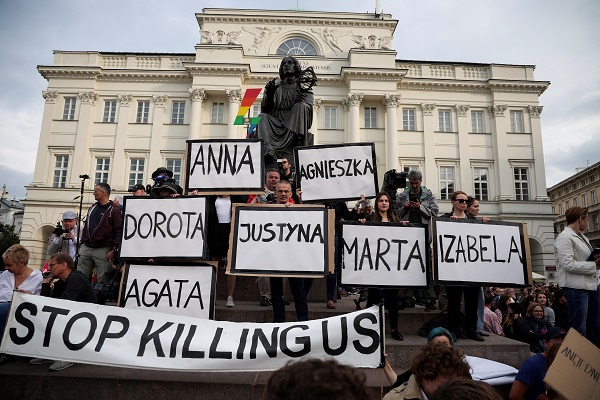
 People take part in a protest, after a pregnant woman died in hospital in an incident campaigners say is the fault of Poland's laws on abortion, which are some of the most restrictive in Europe, in Warsaw, Poland, 14 June 2023;
Credit: Reuters/Kacper Pempel/File Photo
People take part in a protest, after a pregnant woman died in hospital in an incident campaigners say is the fault of Poland's laws on abortion, which are some of the most restrictive in Europe, in Warsaw, Poland, 14 June 2023;
Credit: Reuters/Kacper Pempel/File Photo
PARIS (Reuters) - On Wednesday 17 December 2025, the European Parliament will vote on a scheme that would enable women from nations restricting abortion to terminate pregnancies in another EU member state free of charge.
The "My Voice, My Choice" citizens' initiative proposes a fund from the EU budget to cover procedures for people from nations with near-total bans such as Malta and Poland or places where abortion is hard to access like Italy and Croatia.
While the trend in Europe has been towards more accessibility for abortions, with the UK decriminalising it and France making it a constitutional freedom, there has been a surge in support for far-right parties, many of which oppose abortion.
Proponents of the initiative, including abortion rights campaigners and some members of European Parliament (MEPs) from the left to centre-right, say it should reduce unsafe practices and help women lacking funds for a procedure abroad.
"It would place us on equal grounds as other European citizens," said Isabel Stabile, a doctor who campaigned for signatures in Malta.
Critics, including far-right and some centre-right MEPs, say the proposal interferes in national laws and traditional Christian values.
Lobbying networks
The vote is due around midday at the European Parliament in Strasbourg and analysts expect it to pass.
The European Commission will then have until March 2026 to decide whether to adopt the proposal, though other citizens' initiatives have not been successful until now.
In the lead-up, opponents held events with anti-abortion rights federation One of Us and the European Centre for Law and Justice, an offshoot of the American Center for Law and Justice, which litigates on abortion cases, including the US Supreme Court’s 2022 overturning of the landmark Roe v Wade case.
The groups organised two conferences at the European Parliament criticising the proposal and pushing for the European Commission to offer more support for maternity and not abortion.
"Sending women to countries that are more liberal is an attack on national order," said Elisabeth Dieringer of the far-right Patriots for Europe group, in a parliamentary debate on the eve of the vote. "This ideological abuse of power is something that we're not going to accept at EU level."