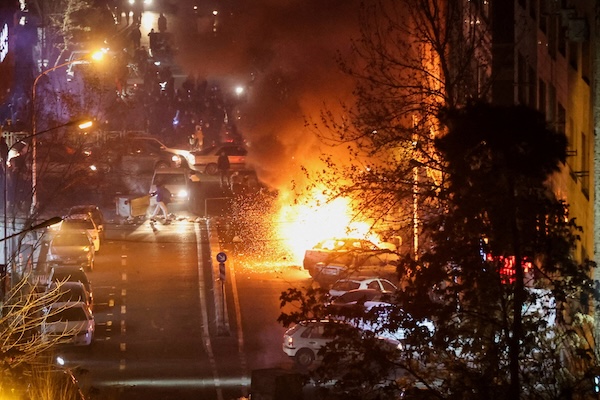
 Cars burn in a street during a protest over the collapse of the currency's value, in Tehran, Iran, Thursday 8 January 2026;
Credit: REUTERS/Stringer/WANA
Cars burn in a street during a protest over the collapse of the currency's value, in Tehran, Iran, Thursday 8 January 2026;
Credit: REUTERS/Stringer/WANA
DUBAI (Reuters) - The death toll from protests in Iran has reached 2,571, the US-based HRANA rights group said on Wednesday 14 January 2026, as the Islamic Republic's clerical rulers try to quash the biggest wave of dissent in years, sparking threats of US intervention.
A renewed confrontation between Washington and Tehran, following an Israeli and US bombing campaign against Iran last year targeting its nuclear programme, would further unsettle the Middle East - already battered by the two-year war in Gaza.
US President Donald Trump urged Iranians on Tuesday 13 January to keep protesting, promising help is on the way.
Iranian officials, however, have accused US and Israel of fuelling violence in the country and blamed the deaths on "terrorist operatives" receiving foreign guidance to instigate.
HRANA said it had so far verified the deaths of 2,403 protesters, 147 government-affiliated individuals, twelve people aged under eighteen and nine non-protest civilians.
An Iranian official said on Tuesday 13 January about 2,000 people had been killed, the first time authorities have given an overall death toll from more than two weeks of nationwide unrest.
‘Help on the way'
Asked what he meant by "help is on its way", Trump told reporters they would have to figure that out. Trump has said military action is among the options he is weighing to punish Iran over the crackdown.
Trump had already announced 25% import tariffs on products from any country doing business with Iran - a major oil exporter. China, which buys much of Iran's oil exports, swiftly criticised the move.
In a phone call on Saturday 10 January, Israeli Prime Minister Benjamin Netanyahu and US Secretary of State Marco Rubio discussed the possibility of US intervention in Iran, according to an Israeli source present for the conversation.
Iran vowed to retaliate against any attack by targeting Israel and US bases and ships.
The unrest, sparked by dire economic conditions, has posed the biggest internal challenge to Iran's rulers for at least three years and has come at a time of intensifying international pressure on Iran over its nuclear and ballistic missiles programmes.
Trump said he cancelled all meetings with Iranian officials until the "senseless killing" of protesters stopped and in a later comment told Iranians to "save the name of the killers and the abusers ... because they'll pay a very big price."
Iran's diplomatic efforts
Iranian officials have intensified diplomatic contacts in the region in the past few days, holding calls with Qatar, Turkish, and Iraqi officials.
Iranian Foreign Minister Abbas Araqchi had spoken with his counterpart in the United Arab Emirates, the Iranian foreign ministry said on Wednesday. The Arab Gulf country is one of Iran's big trading partner, but also a close ally to both the US and Israel.
Araqchi told Sheikh Abdullah bin Zayed al-Nahyan that "calm has prevailed (in Iran) thanks to the vigilance of the people and law enforcement forces" and Iranians are determined to defend their national sovereignty and security against any foreign interference, said the Iranian foreign ministry.
Araqchi spoke on Tuesday 13 January with France's Foreign Minister Jean-Noel Barrot and called on him to condemn "foreign interventionist in the internal affairs" of Iran.
France had summoned the Iranian ambassador over the "unbearable and inhumane" crackdown by Iranian authorities to quell protests across the country.
The protests began on 28 December 2025 over the fall in value of Iran's rial currency and have grown into wider demonstrations and calls for the fall of the clerical establishment.
So far there are no signs of fracture in the security elite that could bring down the clerical system in power since a 1979 Islamic Revolution.
Iran's authorities have taken a dual approach, cracking down while also calling protests over economic problems legitimate.
Iran's chief justice Gholamhossein Mohseni Ejei said on Wednesday, during a visit to one of Tehran prisons where people arrested in protests are being held, that speed in punishing those "who beheaded or burned people" was critical to ensure that such events would not take place again.