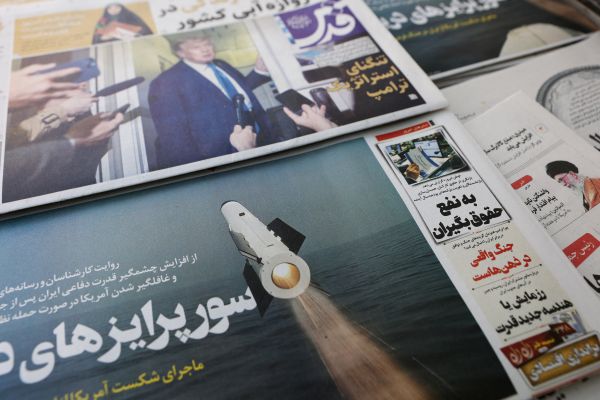
 An Iranian newspaper with a cover photo of an Iranian missile, in Tehran, Iran, 19 February 2026;
Credit: Majid Asgaripour/WANA (West Asia News Agency) via Reuters
An Iranian newspaper with a cover photo of an Iranian missile, in Tehran, Iran, 19 February 2026;
Credit: Majid Asgaripour/WANA (West Asia News Agency) via Reuters
WASHINGTON (Reuters) - President Donald Trump warned Iran on Thursday 19 February 2026 that it must make a deal over its nuclear programme or "really bad things" will happen, and set a deadline of ten to fifteen days, drawing a threat from Tehran to retaliate against US bases in the region if attacked.
Amid a massive US military buildup in the Middle East that has fueled fears of a wider war, Trump said negotiations with Iran to end the tense standoff were going well but demanded that Tehran reach a "meaningful" agreement.
"Otherwise bad things happen," Trump, who has repeatedly threatened to attack Iran, told the first meeting of his Board of Peace in Washington.
Trump spoke of the US airstrikes carried out in June 2025, saying Iran's nuclear potential had been "decimated," adding "we may have to take it a step further or we may not."
"You’ll be finding out over the next probably ten days," he said. Asked later to elaborate, he told reporters aboard Air Force One: "I would think that would be enough time, ten, fifteen days, pretty much maximum.”
But he declined to be specific, except to warn again of "really bad things" and insist that Iran would have to make a deal one way or another.
In a letter to UN Secretary-General Antonio Guterres, Tehran said it would not start any war but that "in the event that it is subjected to military aggression, Iran will respond decisively and proportionately" in its exercise of the right of self-defence.
"All bases, facilities and assets of the hostile force in the region would constitute legitimate targets," the letter said. "The United States would bear full and direct responsibility for any unpredictable and uncontrolled consequences."
"Good Talks": Trump
Trump's threats to bomb Iran, with the two sides far apart in talks on Tehran's nuclear programme, have pushed up oil prices, and a Russian corvette warship on Thursday joined planned Iranian naval drills in the Gulf of Oman, a vital sea route for global energy.
Iranian and US negotiators met on Tuesday 17 February 2026 and Iranian Foreign Minister Abbas Araqchi said they had agreed on "guiding principles." White House press secretary Karoline Leavitt said on Wednesday 18 February 2026, however, that the two sides remained apart on some issues.
Trump said "good talks are being had," and a senior US official said Iran would make a written proposal on how to address US concerns.
Trump called on Tehran to join the US on the "path to peace."
"They can't have a nuclear weapon, it's very simple," he said. "You can't have peace in the Middle East if they have a nuclear weapon."
Iran has resisted making major concessions on its nuclear programme, though insisting it is for peaceful purposes. The US and Israel in the past have accused Tehran of trying to develop a nuclear bomb.
Trump's latest saber-rattling came as he talked himself up as a man of peace in a long, meandering speech while hosting world leaders at the launch of his Board of Peace. He proposed the body in September 2025 when he announced his plan to end Israel's war against Hamas in Gaza. He later expanded the board's remit to tackle conflicts worldwide, prompting many key Western allies to stay away.
Earlier on Thursday, Russia warned against an "unprecedented escalation of tension" around Iran on Thursday and urged restraint amid the US military buildup in the region, which a senior American official said should be complete by mid-March.
Threat of War
Trump has sent aircraft carriers, warships and jets to the region, raising the prospect of another attack on the Islamic Republic.
The United States and Israel bombed Iran's nuclear facilities and some military sites last June. US Secretary of State Marco Rubio will meet Israeli Prime Minister Benjamin Netanyahu to discuss Iran on Saturday 28 February 2026, the senior US official said.
Washington wants Iran to entirely give up uranium enrichment, a process used to create fuel for atomic power plants but that can also provide material for a warhead.
The US and ally Israel also want Iran to give up long-range ballistic missiles, stop supporting groups around the Middle East and stop using force to quell internal protests.
Iran says it refuses to discuss issues beyond the atomic file, calling efforts to limit its missile arsenal a red line.
Satellite pictures have tracked both Iranian work to repair and fortify sites since last summer, showing work at both nuclear and missile sites, as well as preparations at US bases across the Middle East over the past month.
Iran's joint exercise with Russia came days into an extended series of Iranian naval drills in the Gulf of Oman, with Iranian state television showing special forces units deployed on helicopters and ships.
In a sign of growing concern over the increased tensions, Poland on Thursday became the latest European country to urge its citizens to leave Iran, with Prime Minister Donald Tusk saying Poles may only have hours to evacuate.
Trump began threatening strikes on Iran again in January 2026, as Iranian authorities crushed widespread protests with deadly violence that left thousands dead across the country.