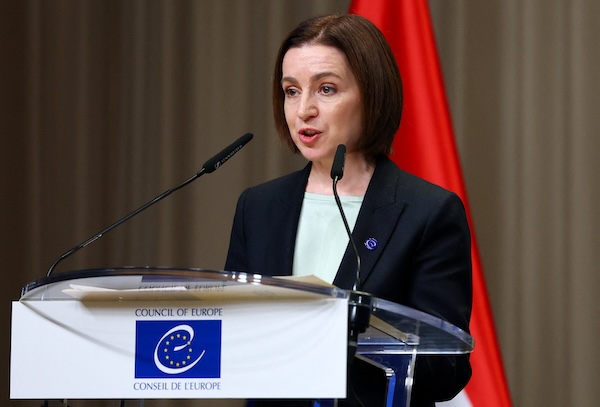
 Moldovan President Maia Sandu speaks at a Council of Europe conference to launch the International Claims Commission for Ukraine, aimed at handling compensation claims related to Russia's war in Ukraine, in The Hague, Netherlands, 16 December 2025;
Credit: Reuters/Piroschka van de Wouw
Moldovan President Maia Sandu speaks at a Council of Europe conference to launch the International Claims Commission for Ukraine, aimed at handling compensation claims related to Russia's war in Ukraine, in The Hague, Netherlands, 16 December 2025;
Credit: Reuters/Piroschka van de Wouw
CHISINAU (Reuters) - On Monday 16 March 2026, A Russian attack on a hydroelectric plant in southern Ukraine triggered an oil spill and polluted water systems in neighbouring Moldova, with supplies cut completely in the country's second-largest city, officials said.
President Maia Sandu, who wants to bring Moldova, one of Europe's poorest countries, into the European Union by the end of the decade, said she held Russia responsible for the pollution in the Dniestr River.
Moldova's Environment Ministry said the spill prompted the cut-off in Balti, a city of 90,000, and in three other towns and would remain in effect for at least a further twelve hours into Tuesday 17 March 2026.
Schools were ordered closed and students told to work online.
Moldova declared a fifteen-day environmental alert on Sunday 15 March 2026 as the extent of the pollution became apparent.
"We declared environmental alert and are acting to protect our people," Sandu said in a statement on social media, referring to the on 7 March attack on the Novodnistrovsk hydro station. "Russia bears full responsibility."
Moldova's foreign ministry summoned Russia's ambassador to the country over the attack on the station.
"The Republic of Moldova strongly condemns this attack, which caused an oil spill in the Nistru River, posing major risks to the environment and the security of the Republic of Moldova's water supply," it said in a statement, using the Romanian name for the Dniestr River.
Sandu has repeatedly denounced Russia's 2022 invasion of Ukraine and accused Moscow of trying to unseat her government. Moscow accuses her of fomenting Russophobia.
The EU has provided considerable financial support for Moldova since Sandu's 2020 election and Marta Kos, the EU Commissioner for Enlargement, said the bloc was prepared to help tackle the pollution.
"This is a reminder that Russia's war does not stop at Ukraine's borders," she wrote on X. "We stand in solidarity with the Republic of Moldova."