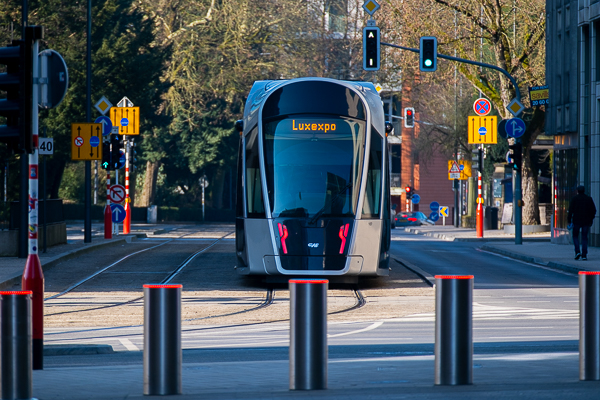
 Credit: Ali Sahib, Chronicle.lu
Luxembourg is the only country in the world to offer free public transport at the point of use to anyone who wishes to use it. As straightforward a statement as that it is, it is actually a description which encapsulates an incredibly radical, forward-thinking idea which many in the Grand Duchy overlook or simply take for granted.
Since 1 March 2020, travelling second class on trains, buses and trams within the borders of Luxembourg has been free at the point of use. Passengers only need to buy a ticket if they want to travel first class or board a cross-border train.
This is a service which is not exclusive to residents and extends to tourists and cross-border workers. Yet, after six years, responses on social media to any news about the success, ongoing expansion or redevelopment of Luxembourg’s public transport system regularly suggest it is not free or beneficial. At worst, the rise in physical and verbal abuse suffered by public transport employees hints that some believe because it is free it is not even worthy of basic respect.
The roots of free public transport policy
An idea originally put forward by the young socialists prior to the July 2018 national congress meeting of the LSAP (Luxembourg Socialist Workers' Party), the introduction of free public transport was agreed as part of the 2018 government coalition agreement between the Democratic Party (DP), LASP and The Greens. The policy was intended to increase social mobility, with additional benefits including a reduction in traffic congestion and a transition towards a transport system which was less damaging to the environment. Six years on it has fulfilled some of its ambitions but undeniably failed in others.
Passenger numbers have steadily risen year-on-year. Luxembourg's national railway company, the CFL, announced in February that 31.4 million passengers took the train in 2025, a small rise of 0.57% but enough to break the record number of train passengers recorded in 2024.
According to Luxembourg’s Ministry of Mobility, approximately 70,000 passengers a month use the tram stop at Luxembourg Airport just one year after the line was extended from Kirchberg to Findel. MICE Travel Advisor reported that the tram network serves 120,000 passengers per day, while the bus network serves around 140,000 each weekday. These are considerable numbers for a country whose population is only 690,000 and whose capital city has around 138,000 residents, albeit these figures are bolstered by cross-border workers who utilise the system.
Benefit or burden
Yet, traffic congestion has continued to increase. This can be put down to several factors, including Luxembourg being a high-income country, relatively inexpensive fuel prices, cross-border train links that are only subsidised up to the Luxembourg border and park-and-ride facilities remaining limited (although this is improving). With an ongoing energy crisis worldwide, there is unsurprisingly little appetite for the authorities to artificially raise fuel prices to reduce consumption and encourage people to take advantage of free public transport.
Multimodal is often a term used by the Luxembourg government to market the public transport system, encouraging a hop-on hop-off mentality where travellers can go from bus to train to tram fluidly on the way to their destination. Unfortunately, despite the excellent Mobiliteit and CFL Mobile apps and websites, which will create a multi-mode travel itinerary based on point of departure and destination, the results often do not line up with reality.
Despite improvements, there are still issues with delays on the rail and bus networks which serve as a considerable spanner in the works of the concept of modality. One small delay perpetuates quickly when you’re following an itinerary which requires rigid adherence but is combined with a structuring of services which often seems misaligned. Ongoing works on the rail network, road maintenance, vehicle reliability and the aforementioned congestion also contribute to gumming up what could be a world-class system of public transport. However, the fact it is free is not the problem.
On the issue of cost, even before public transport in Luxembourg became free, the system was heavily subsidised. Ticket revenue previously covered only about 8% of total costs, which is why removing fares had a relatively small fiscal impact compared with the overall transport budget. The public transport system is funded by the Luxembourg State and the budget (set in 2025) was €1.1 billion per year. This breaks down to €366 million for rail, €420 million for buses and €18 million for tram services.
The public transport budget when the system became free in 2020 was €590 million and rose to €905 million by 2024, a considerable increase in a relatively short period of time. However, it should be noted that these operating costs factor in upgrades to each transport network. An aging bus network has been hugely improved over the past fifteen years with newer, hybrid and electric vehicles now operating across the network and ongoing plans to ensure Luxembourg meets EU requirements that city buses have to be zero-emission by 2035. According to T&E projects, Luxembourg is already well ahead of schedule and this milestone will be reached in 2027. There are also considerable rail developments underway across the country and multiple extension underway and scheduled for the capital’s popular tram network.
The problem with 'free’
This is where we reach the psychological problem of something being free. The zero-price effect is where something is priced at zero but is not evaluated using standard cost-benefit logic. Mentally, we reduce its value regardless of its real worth. In the case of public transport, we complain about services being overcrowded and unreliable, facilities being unclean, passengers being disrespectful and then imagine that it was somehow better, safer and more reliable when you had to pay for it.
Let us be clear. It was not. Luxembourg’s public transport system has improved immeasurably over the past three decades and never faster than in the last five years. The level of investment in improving rolling stock, infrastructure and support services is a result of the service being used more and it is being used more because it is free.
If we were to follow the logic that charging for the services would remove the negative opinions, I present to you Exhibit One: the UK’s privatised rail system. A system so broken by private control that it is cheaper and easier to fly from one city to another instead of taking the train. Luxembourg’s decision to take control and create viable partnerships with the country’s transport operators should be widely applauded.
Sadly, the ever-increasing number of attacks on staff across the public transport network shows this is not happening.
In 2025 Luxembourg’s Ministry of Mobility and Public Works presented safety statistics for 2024 and noted a 15% increase in reported incidents (across all modes of transport and all types of assaults) compared to 2023. One-third of these incidents were related to inappropriate behaviour. The rail sector (trains and stations) reported incidents increased by 11.5%, reaching a total of 2,741. During the same period, passenger numbers rose by 8.98%.
Physical attacks against public transport staff on trains and at stations also increased, particularly in terms of threats, spitting and non-injuring blows. Attacks against third parties (including insults, spitting, threats involving objects and both psychological and sexual harassment) on trains and at stations also rose. The same observation was made regarding attacks (both physical and verbal) on staff and third parties on buses and trams.
Just recently, Luxembourg trade union the LCGB issued a statement calling for urgent and concrete action to improve safety in public transport and welcomed the announcement by Luxembourg’s Ministry of Mobility that it is examining the possibility of deploying security staff on lines of the national RGTR network (General Road Transport System). A recent response from Mobility Minister Yuriko Backes to a parliamentary question revealed that 548 assaults occurred in 2025, targeting CFL, AVL, RGTR, Luxtram and Tice employees.
While it is impossible to say that incidents such as these would not occur if the system was not free, should we not appreciate that the system is free to use and as a consequence should respect those that operate it for us?
What needs to change?
The public transport system is not absorbing huge amounts of additional tax income because it is free. It is a system which is undergoing continual upgrades to improve its functionality. It has improved mobility for many and reduced travel costs for hundreds of thousands of people but, as a daily user of the network, I am well aware that it is not perfect.
A recent study from Eurostat revealed that one in five residents use public transport daily in Luxembourg. For all the investment in the network, 20% is a surprisingly low figure. Undeniably, the existing system is very capital-centric and reliability seems to decline in direct correlation with distance from the capital. This needs to improve, particularly when more rural locations require the much championed idea of Luxembourg’s multimodal system. More people live outside of Luxembourg City than in it and this needs to be reflected in the level of service.
Although the CFL and the City of Luxembourg (VdL) publish details of upcoming disruptions to train services and bus routes caused by network maintenance, the problem of “ghost” buses, which randomly disappear from the electronic information boards, and train services which seem to be cancelled at a whim need to be addressed. The excellent Mobiliteit app certainly suffers from this phenomenon. The app often tells me my service is running on time, only for me to arrive at the train station or bus stop to find out it is running significantly late or cancelled altogether.
Attacks and abuse of staff need to be dealt with more severely. Putting a protective booth around a bus driver is a solution but it is choosing to accept the problem instead of attempting to solve it. The underlying cause of such attacks are more likely based in wider societal problems but they are manifesting on the public transport network. We cannot realistically expect security personnel on every bus, train or tram but some form of regular presence can make a difference. Anyone using the train network at night will have noticed the increased security presence. Unfortunately, I suspect that most of the aggressive behaviour recorded against those working on public transport is not on the late night services which have this increased security presence.
We need to encourage respect for the fantastic yet occasionally frustrating one-of-a-kind public transport system we have in Luxembourg and appreciate the people who operate it. If we do not, it will become exactly what the naysayers currently say it is and the chances of encouraging more people to make use of it will diminish. If that happens, it will never achieve what it was intended for and it is only then that we will pay a cost.