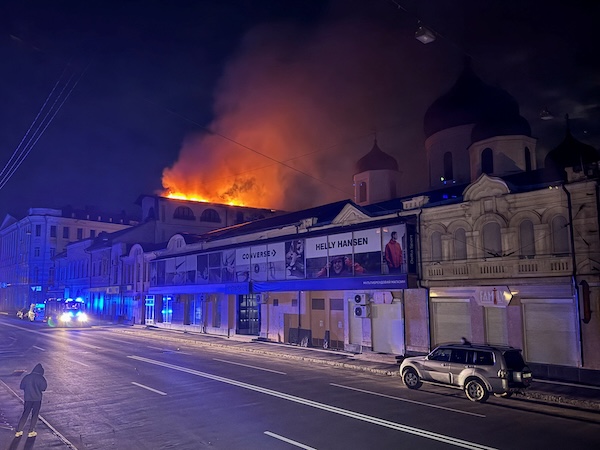
 A building burns after being hit by a Russian drone strike, amid Russia's attack on Ukraine, in central Kharkiv, Ukraine Thursday 2 April 2026. Picture taken with a mobile phone;
Credit: Reuters/Vitalii Hnidyi
A building burns after being hit by a Russian drone strike, amid Russia's attack on Ukraine, in central Kharkiv, Ukraine Thursday 2 April 2026. Picture taken with a mobile phone;
Credit: Reuters/Vitalii Hnidyi
KYIV (Reuters) - On Friday 3 April 2026, Ukraine's air force said that Russia is conducting a rolling aerial attack on Ukraine since Thursday 2 April evening, adding that a large number of enemy drones were in Ukrainian airspace.
The bombardment is the second time this week Russia has followed a overnight drone barrage with heavy daytime attacks, a new tactic as Moscow probes ways to penetrate Ukraine's air defences.
"We can see that the enemy is using new routes, new drones which they are constantly modernising, and new tactics," air force spokesman Yurii Ihnat said on state television.
He added that Russia had launched more than 400 long-range drones in the past 24 hours, as well as ten ballistic missiles that primarily targeted areas near the frontline.
Ihnat said the bombardment was similar to an attack on Tuesday 31 March 2026, which killed at least four people, when an overnight barrage of over 300 drones was followed by another of similar size in the middle of the day.
Large-scale Russian bombardments cause disruption across Ukraine, as many government institutions, public transport services and businesses close during the attack, which can last many hours.
"The enemy is exerting (pressure) on our population, paralysing the work of certain public institutions, as well as learning institutions," Ihnat said.
In the eastern region of Kharkiv, one person was killed and 25 others injured by missile, bomb and drone attacks over the past 24 hours, governor Oleh Synehubov said on social media.
That included four ballisitic missiles that struck the regional capital, also called Kharkiv, overnight. Authorities only reported one injury from that strike.