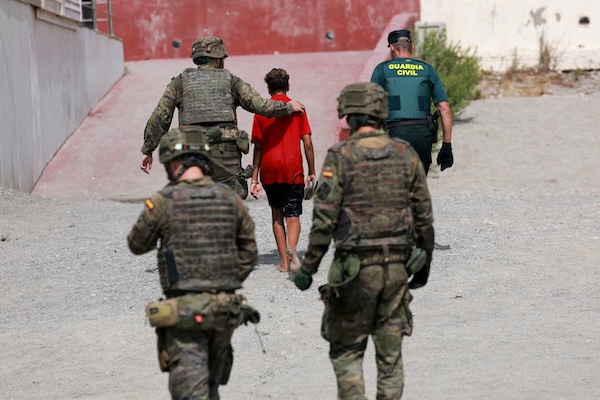
 A migrant minor from Morocco is escorted by Spanish security forces after attempting to cross into Ceuta by sea amid recent mass crossings of migrants on foot and by sea from Morocco into Spanish territory, in Ceuta, Spain, 1 August 2026;
Credit: Reuters/Violeta Santos Moura
A migrant minor from Morocco is escorted by Spanish security forces after attempting to cross into Ceuta by sea amid recent mass crossings of migrants on foot and by sea from Morocco into Spanish territory, in Ceuta, Spain, 1 August 2026;
Credit: Reuters/Violeta Santos Moura
CEUTA (Reuters) - Spain's Ceuta, still reeling from a rush of 72,000 migrants arriving on its shores in one week, is seeking the transfer of hundreds of unaccompanied minors still in the enclave to mainland Spain, local leaders said on Wednesday 5 August 2026.
Though the vast majority of migrants have since returned to Morocco, roughly 1,100 unaccompanied minors who arrived before and during the influx – and cannot be summarily deported – remain, according to the local government.
Many are being housed in makeshift accommodation in warehouses, while others are sleeping on the streets because Ceuta's reception centres are full.
Charities and residents' groups said they were trying to help children sleeping rough, along with pregnant women.
Hamza Sitouni Moreno, a 40-year-old local, said he had taken children to the authorities but been turned away, so he had a young girl sleeping in his car for safety, and had built makeshift shelters for other children and provided them with food and blankets.
"So many people arrived ... the authorities cannot handle this," he said.
'Crying out for help'
About 75 people died during last week's border rush across one of the European Union's two land borders with Africa, which triggered alarm across the bloc and revived memories of its 2015-16 migration crisis, in which more than one million people arrived, mostly from the Middle East.
While regional governments are obliged to assist overstretched territories in emergencies, it remains unclear if Spain's conservative People's Party and far-right Vox – which jointly run four regions – would accept migrant minors.
On Wednesday, all four of their regional coalition governments indicated they would challenge any such order, with Vox's leader saying "not one euro" of Spanish money should go to the migrant minors.
Even if regions accept them, experts warn that the process of identification and relocation could take months, requiring individual interviews, reports and contact with countries of origin to rule out returning them to their families.
A lawyer representing humanitarian charities in Ceuta, who declined to be named because they were not authorised to speak to the media, said the authorities and police were currently focused on registering minors under fifteen, but that there could be thousands more young people still to be identified in the city.
"We are crying out for help and assistance," Ceuta's local government head, Juan Jesus Vivas, told Spanish broadcaster RTVE on Wednesday.
Migration emergency
Under a reform to Spanish immigration law implemented in 2025, after a surge of migration overwhelmed reception centres in the Canary Islands, unaccompanied minors must be redistributed from overstretched territories within fifteen days of their case file being completed.
Disagreements on the policy prompted Vox to abandon five regional coalition governments it ran with the PP in 2024 after the latter backed a Socialist government plan to relocate 400 minors from the Canary Islands to the peninsula.
Since the reform, 719 minors have been transferred from the Canary Islands to mainland Spain, according to government data released in April 2026, and more than 400 minors arriving in Ceuta have been relocated.
The issue could also further strain Spain's relationship with conservative-run European countries such as Italy, which suspended passport-free Schengen travel arrangements with Spain for a month after the Ceuta border rush.
After initially stating that migrants should all be sent back, the PP's Alma Ezcurra told Spanish radio station Onda Cero on Wednesday that due process must first be followed to identify those suspected to be minors.
However, Isabel Diaz Ayuso, the PP president of the Madrid regional government, said the young migrants should be sent home. "I can't see Spain abandoning its children to their fate in another country," she posted on X. "It's inhuman, every country should take responsibility for its own children and citizens."
The Spanish government approved €25 million in funding for Ceuta to support the unaccompanied minors.
"Inter-territorial solidarity is necessary so these minors end up in other locations where they will be better off," said Miguel Angel Perez, government’s representative in Ceuta, on Wednesday. "The law must be upheld."