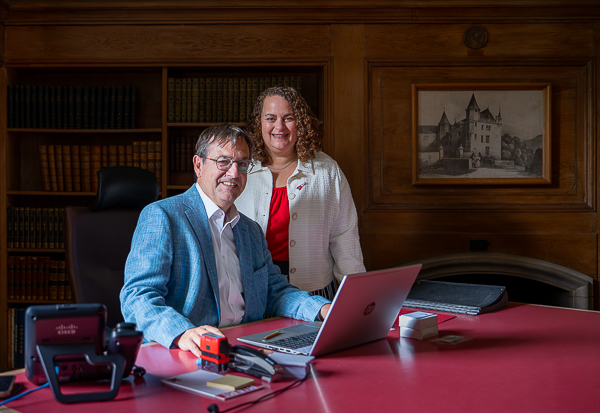
 (L-R) Raymond Manes; Stephanie Shaheen;
Credit: Ali Sahib, Chronicle.lu
(L-R) Raymond Manes; Stephanie Shaheen;
Credit: Ali Sahib, Chronicle.lu
After 24 years at the Miami University Dolibois European Center (MUDEC) in Differdange, Executive Director Raymond Manes is preparing to retire at the end of June 2026, marking a leadership transition for Miami University's European campus in Luxembourg.
MUDEC was established and opened in 1968 as a campus for the Miami University in Oxford, Ohio, United States (US); almost 30 years ago it moved to its current location at the Differdange Chateau. It welcomes over one hundred students each semester, some of whom reside with host families, and others in student accommodation, while in the Grand Duchy.
A Luxembourg native, Raymond Manes joined MUDEC in 2002 as Assistant Director for Administration and has served as Executive Director (the first Luxembourgish director) since 2020. During his tenure, he guided the centre through the COVID-19 pandemic, oversaw the expansion of student accommodation options and helped reverse a decline in enrolment. Last month, Miami University recognised his contributions with several honours, including the Presidential Medal of Honor.
His successor, Stephanie Shaheen, who has worked at MUDEC for nearly five years and currently serves as Director of Academic Programmes, will become the centre's next Executive Director.
Chronicle.lu spoke with both leaders about MUDEC's evolution, the challenges facing international education and the future of the institution.
Chronicle.lu: Coming from an academic and teaching background, how different was the approach to education at MUDEC from that at Prolingua?
Raymond Manes: My career in education in Luxembourg began in secondary education, first as a French teacher and later in adult education. One of the biggest differences I observed was that adult learners usually have a clear sense of purpose and can immediately apply what they learn in their professional lives.
However, the most striking contrast was not necessarily linked to age, but rather to the American concept of campus life. In the United States, universities are much more than places of academic instruction. Students develop social, leadership, artistic and athletic skills alongside their studies. This creates a strong sense of belonging that often continues long after graduation through active alumni engagement.
At the same time, the high cost of higher education has changed the relationship between universities, students and parents. Because education represents a major investment, students and families increasingly view themselves as clients, which has influenced expectations around academic performance and support.
Chronicle.lu: What were the major challenges and achievements during your time as Executive Director?
Raymond Manes: One of the biggest challenges was responding to declining enrolment. Through surveys and discussions with students, faculty and administrators, we realised that students increasingly wanted programmes that were more flexible, career-oriented and aligned with current economic realities.
In response, we introduced greater academic flexibility by allowing students to take online courses from their home departments while studying in Luxembourg and by creating internship opportunities with local partners.
Housing was another major challenge. The traditional host-family model had become increasingly difficult to sustain, both because of a shortage of host families and changing student preferences. We therefore expanded apartment accommodation, which helped support future growth.
Chronicle.lu: How did you cope during the COVID-19 pandemic?
Raymond Manes: The pandemic required us to react almost overnight. In March 2020, our students had to return urgently to the United States following border closure announcements.
The immediate priority was ensuring students could complete their studies online. However, the larger challenge was safeguarding the future of the centre itself. With enrollment falling and uncertainty surrounding international travel, there was a genuine risk that the programme could close.
Working closely with Miami University leadership and Luxembourg authorities, we secured authorisation for students and faculty to enter Luxembourg despite restrictions. We also reorganised the Château de Differdange, implemented health measures and maintained in-person learning. As a result, we were able to continue offering an immersive educational experience throughout the pandemic.
Chronicle.lu: What are your plans after retirement?
Raymond Manes: I plan to take the summer to recharge and spend time with my growing family. Beyond that, I expect to remain connected to both education and Miami University.
I would like to help strengthen Miami University's visibility in Luxembourg and across Europe, support student recruitment and reinforce alumni connections throughout the continent. I see many opportunities to continue building bridges between Luxembourg, Europe and the United States.
Chronicle.lu: What advice would you give to your successor?
Raymond Manes: I have worked closely with Stephanie for nearly five years and I am convinced she is the right person for the role. She understands the history of the centre, the reasons behind many of our traditions and what it takes to ensure the programme continues to succeed.
She will need patience because not everyone can always keep up with her pace, but she knows people on both sides of the Atlantic and has the relationships necessary to help MUDEC move forward. I have no doubt that she will do an excellent job.
As MUDEC prepares for its next chapter, incoming Executive Director Stephanie Shaheen said she hopes to build on the institution's legacy while expanding opportunities for students and strengthening connections between the university and Luxembourg.
Chronicle.lu: You have been at MUDEC for almost five years. What were the biggest changes from your previous role at the US Embassy?
Stephanie Shaheen: One of the biggest changes was moving from promoting American culture and education to Luxembourgers to introducing Luxembourgish and European culture to American students.
In many ways, however, there are similarities. Both organisations have a larger parent institution in the United States and require balancing local realities with expectations from abroad. I have also been fortunate to continue working with many educational partners I first collaborated with during my time at the Embassy.
Chronicle.lu: What are the major milestones you hope to achieve as Executive Director?
Stephanie Shaheen: I want to continue welcoming as many Miami students as possible so they can benefit from the same life-changing experiences that more than 14,000 students have already enjoyed in Luxembourg.
In 2027, we will celebrate the 30th anniversary of MUDEC at the Château de Differdange, and in 2028 we will mark 60 years of Miami University's presence in Luxembourg. I would also like to strengthen connections between alumni, current students and the local community, creating more opportunities for networking, mentoring and professional exchanges.
Chronicle.lu: What challenges do you expect to face during your first years in the role?
Stephanie Shaheen: One challenge will be replacing the institutional knowledge and experience that Raymond brings. Many things that are second nature to him will involve a learning process for me and the team.
Another challenge will be responding to the changing expectations of American students. They are eager to travel throughout Europe, and one of our goals is to encourage them to spend more time exploring Luxembourg itself. We have even created a "MUDEC Luxembourg Bucket List" to help students discover different parts of the country.
Chronicle.lu: How do you think artificial intelligence will affect higher education and MUDEC?
Stephanie Shaheen: Artificial intelligence (AI) is already having an impact on higher education. Students use it for applications, assignments, presentations and travel planning.
Our role is to help students understand that AI should be a tool rather than a substitute for critical thinking. Research, writing and reflection remain essential learning experiences. Like other technological developments before it, AI presents challenges, but it also offers opportunities. I am confident that education will adapt and emerge with valuable new tools.