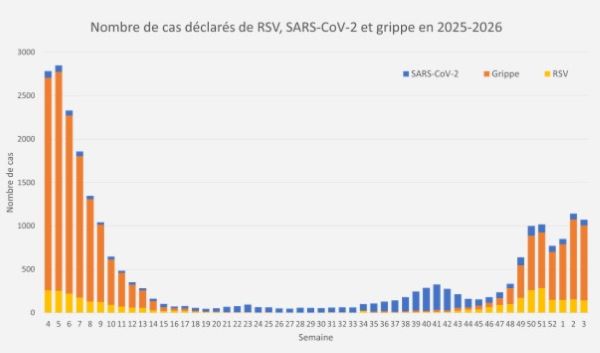
 Number of reported cases of RSV, COVID-19 and flu in 2025-2026, Week 3;
Credit: MSSS
Number of reported cases of RSV, COVID-19 and flu in 2025-2026, Week 3;
Credit: MSSS
On Thursday 22 January 2026, the Health Directorate of Luxembourg's Ministry of Health and Social Security published its weekly overview on the development of major acute respiratory infections, including COVID-19, influenza (flu) and respiratory syncytial virus (RSV), for the week of Monday 12 to Sunday 18 January 2026 (week 3).
Slight decrease in COVID-19 / SARS-CoV-2 cases
During week 3, the number of positive COVID-19 cases decreased from 69 to 65, representing a 6% decrease compared to the previous week. On the other hand, the viral concentration detected in wastewater showed an increase. The latest available sequencing data reveal that the XFG variant (45.5%), its sub-variant XFG.3 (26.7%) and the NB.1.8.1 variant (18.2%) are predominant.
Flu cases decrease
The number of flu cases reported by laboratories fell by 6%, from 922 to 863 cases, over one week. Influenza A accounted for 99.6% of the typed results and influenza B for 0.4%.
The Ministry of Health and Social Security recalled that vaccination remains available and primarily targets people aged 65 and over, who face a higher risk of complications from influenza. The ministry noted that vaccination is the most reliable way to prevent seasonal flu and reduce the risk of related complications.
Decrease in RSV cases
The number of RSV cases reported by laboratories saw a 7% decrease, with 143 confirmed cases compared to 153 the previous week. Since October 2025, 60% of infections have occurred in children under the age of ten, indicating that the virus mainly affects younger age groups.
The ministry reminded the public of preventative measures to help limit the spread of viruses. These include:
• washing hands regularly with soap and water for at least 30 seconds, thoroughly rubbing palms, fingers, the backs of hands and under the nails;
• covering the mouth and nose with a tissue when coughing or sneezing or using the crook of the elbow if no tissue is available;
• disposing of used tissues immediately in a bin and washing hands afterwards;
• avoiding physical contact such as hugs, kisses and handshakes;
• avoiding crowds and gatherings during the epidemic season;
• staying at home when ill to avoid infecting others;
• ventilating rooms regularly, at least three to four times a day for ten minutes.