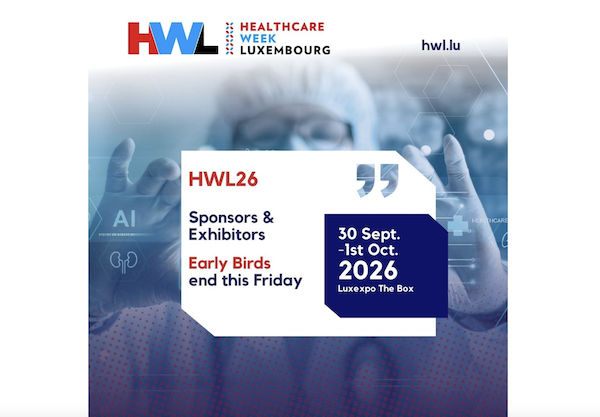
The fourth edition of Healthcare Week Luxembourg (HWL) will take place on Wednesday 30 September and Thursday 1 October 2026 at Luxexpo The Box in Luxembourg-Kirchberg.
This year’s conference, titled “Resilience of Tomorrow’s Healthcare: From Preparedness to Antifragility”, will focus on the role of people, systems and artificial intelligence (AI) in building sustainable healthcare systems and developing a multidimensional framework to support the future of healthcare professions, facilities and practices.
HWL targets decision-makers in healthcare, research, education and industries, executives, entrepreneurs and startups as well as institutional representatives from governments, ministries and academia. The event is organised by the Fédération des Hôpitaux Luxembourgeois (FHL) in partnership with the event agency Quinze Mai (QM).
As reported by the organisers, the conference will host presentations and panels featuring international speakers. It will serve as a platform for experts to engage in discussions, roundtables, feedback sessions and demonstrations. Participants will also have the opportunity to explore more than 100 exhibits from a wide range of specialisations in the healthcare sector.
Registration will open via the official website, where the detailed and regularly updated programme will also be available: https://www.hwl.lu
“We are delighted to host Healthcare Week Luxembourg again and build on the remarkable success of last year’s edition, which attracted more than 3,000 visitors,” said Martine Goergen, General Director of Centre Hospitalier de Luxembourg and Chair of the Scientific Committee of HWL. “This year’s fourth edition will focus on the question of how our healthcare systems can not only become more resilient but even stronger in times of crisis, as suggested by the term ‘antifragile’. AI applications and agents are certainly important tools, but we will also look closely at another driver of systemic change: people. By placing citizens, professionals, and patients at the centre of our endeavours, we want to move from a model which is merely prepared for crises to one in which health systems not only absorb shocks but also adapt, learn, and demonstrate sustainable progress over time.”