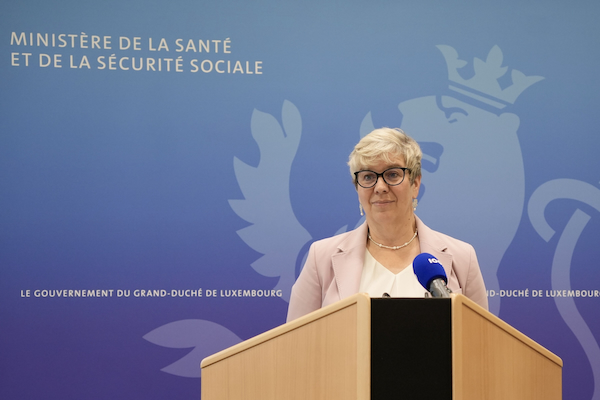
 Martine Deprez, Luxembourg Minister of Health and Social Security;
Credit: M3S
Martine Deprez, Luxembourg Minister of Health and Social Security;
Credit: M3S
On Wednesday 10 June 2026, Luxembourg’s Minister of Health and Social Security, Martine Deprez, presented the draft law amending the Social Security Code and the amended Law of 8 March 2018 relating to hospitals and hospital planning.
According to the Ministry of Health and Social Security, this draft law aims to implement the 2023–2028 coalition agreement, which provides that the Government will seek to fully exploit the potential of outpatient care and significantly increase its role within the healthcare system.
The ministry said the implementation of this policy direction forms part of a gradual approach and, following an initial phase dedicated in particular to the development of decentralised hospital satellite units for certain minor procedures, the draft law represents a further step towards a broader strategy for the development of outpatient care. The objective is to adapt the legal framework to contemporary developments within the healthcare system, particularly the growing expansion of outpatient treatment.
A legal framework for outpatient care facilities
According to the ministry, the draft law is intended to broaden the scope of the hospital law by incorporating outpatient care facilities.
These facilities are separate from hospitals and may be operated, in particular, by medical associations or medical companies. Their purpose will be to provide outpatient healthcare services in several fields, including dialysis, non-surgical day hospital care, oncology, as well as certain minor procedures in ophthalmology, dermatology, abdominal wall and proctological surgery and urology.
“With this draft law, we want to make better use of the potential of outpatient care within our healthcare system. The objective is clear: to bring care closer to patients, speed up treatment, make the system more efficient and enhance the attractiveness of professional practice for healthcare professionals,” remarked Minister Deprez.
Quality, safety and continuity of care
The introduction of these facilities will be accompanied by a prior authorisation regime. Every outpatient care facility will be required to obtain an operating licence issued by the competent minister on the basis of an institutional project and a compliance dossier.
To ensure continuity and safety of care, each facility will also be required to conclude an agreement with a hospital. This agreement will govern, in particular, patient referral and transfer arrangements, as well as access to hospital resources.
Outpatient care facilities will also be incorporated into the national health map in order to ensure a comprehensive overview of healthcare provision and the optimal allocation of available resources across the country.
Financial and organisational support
The draft law provides that outpatient care facilities may, subject to certain conditions, benefit from State contributions towards investment costs or infrastructure rental costs. Lump-sum funding will also be extended to these new facilities in order to cover their operating expenses.
Other measures included in the draft law
In addition to the development of outpatient care, the draft law provides for the establishment of new competence networks aimed at improving the management of complex conditions requiring a multidisciplinary and coordinated approach, including long COVID, endometriosis, myalgic encephalomyelitis, menopause and neurodevelopmental disorders in children and young people.
The draft law also clarifies that every hospital must have the necessary expertise in infectious diseases and infection prevention and control, including through the designation of an infectious disease specialist.
The ministry emphasised that, ultimately the draft law seeks to modernise and strengthen the legal framework applicable to Luxembourg’s healthcare system while ensuring a high level of quality, safety and accessibility of care for the benefit of patients.