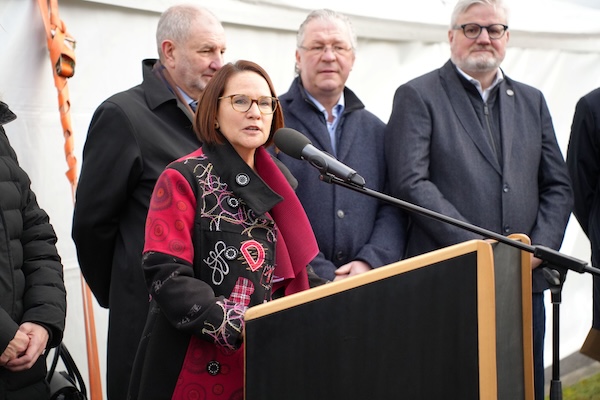
 (L-R) Maurice Groben, Mayor of the commune of Weiler-la-Tour; Jean-Theis, Alderman of the commune of Hesperange; Jean Feipel, 1st Alderman of the municipality of Weiler-la-Tour; Yuriko Backes, Luxembourg Minister of Mobility and Public Works;
Credit: MMTP
(L-R) Maurice Groben, Mayor of the commune of Weiler-la-Tour; Jean-Theis, Alderman of the commune of Hesperange; Jean Feipel, 1st Alderman of the municipality of Weiler-la-Tour; Yuriko Backes, Luxembourg Minister of Mobility and Public Works;
Credit: MMTP
On Monday 23 February 2026, Luxembourg Minister for Mobility and Public Works, Yuriko Backes, ceremoniously turned the first sod for the PC11 cycle path between Alzingen and Hassel.
According to the Luxembourg Ministry of Mobility and Public Works, the event, which took place in the presence of Diane Adehm, Mayor of the Municipality of Hesperange, and Maurice Groben, Mayor of the Municipality of Weiler-la-Tour, represented a new milestone in Luxembourg’s cycle network.
The project, intended to improve cycling infrastructure in the localities of Alzingen, Syren and Hassel, forms part of the ministry’s drive to encourage cycling and to provide sustainable, comfortable and safe travel alternatives. Tailored to road safety requirements and to the needs of users, the project follows the red cycle lanes inaugurated in 2025 in Esch-sur-Alzette and Howald.
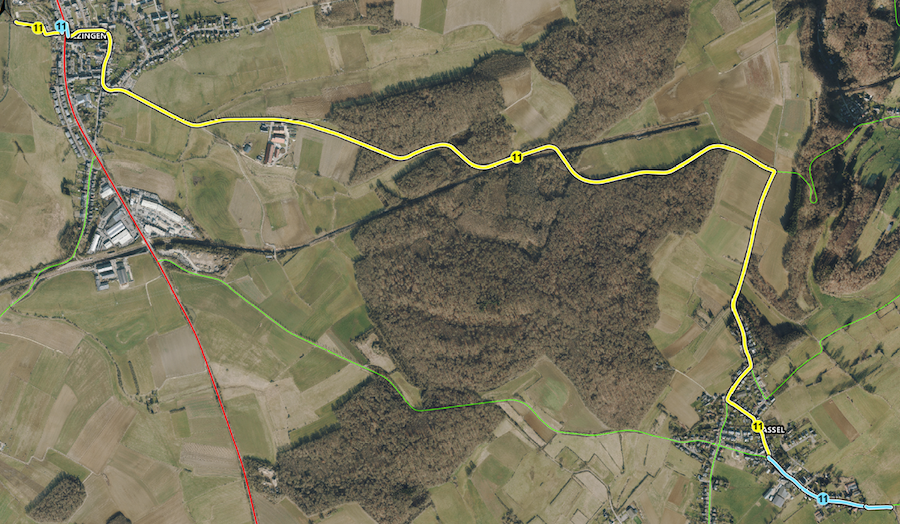
This ministry noted that the project fills an existing gap in the cycle network by connecting PC11 to PC1 and PC3, and the linking section to PC1 between Hesperange-Parc and Hassel provides a continuous inter-municipal connection between the south-east of the country and the surrounding areas of Luxembourg City. Until now, the Centre cycle route (PC1) ended in Hesperange for cyclists wishing to avoid motorised traffic. This limit will now be removed through the complete redevelopment of PC11 and the construction of a coloured asphalt section on the CR154 and, together, will provide a continuous and clearer route, improving daily journeys for users, both by bicycle and by car.
Minister Backes said: “Each new cycle section is an invitation to rethink the way we travel and to move forward together towards reliable and more harmonious mobility in a public space where everyone can travel with peace of mind, whatever their mode of transport. With this new innovative cycling project, we are taking another step towards a network that is accessible and adapted to the challenges and expectations of our time. It embodies a resolutely forward-looking vision, where smooth traffic flow and safety come together to bring about lasting change in the way we travel.”
With this first phase of the project, the planned works will include:
• the creation of a 130m section along the CR162, on the southern side, to provide a seamless link between the exit from Hassel and the existing cycle path. This addition removes a major discontinuity and significantly improves cyclists’ comfort;
• the construction of two twelve-metre speed tables to enhance safety by calming traffic and providing greater protection for vulnerable users;
• the introduction of advisory cycle lanes on the CR154, ensuring better legibility of the road space and more harmonious coexistence between all modes of transport;
• the creation of a combined crossing (“shared path”) at the exit from Hassel, together with the upgrading of bus stops to PRM (persons with reduced mobility) standards;
• the securing of the combined crossing at the N3 junction, at the junctions with Rue du Camping and Rue de Syren, transforming this key intersection into a safer and better organised space;
• the installation of 1.5m advisory cycle lanes on each side of the carriageway, providing clearly identifiable space for cyclists and encouraging more harmonious coexistence with motorised traffic;
• the installation of four targeted traffic-calming measures to ensure compliance with the 50 km/h speed limit and to provide lasting safety along the entire route;
• the narrowing of the central carriageway, a deliberate measure to calm traffic and encourage more cautious driving;
• the laying of 3.4 km of red “mexphalte rouge” (EB11 R2) surfacing, a coloured asphalt specifically designed to enhance the visibility of cycle lanes.
The ministry highlighted that the use of coloured surfacing improves the visibility and immediate recognition of cycle routes, while enhancing user safety.
According to the ministry, the works began on Monday 16 February 2026 and are planned to be completed by June 2027. The total project cost is €4,029,701 (including VAT) and is managed by the Roads and Bridges Administration, Luxembourg Roads Division.
Credit: MMTP