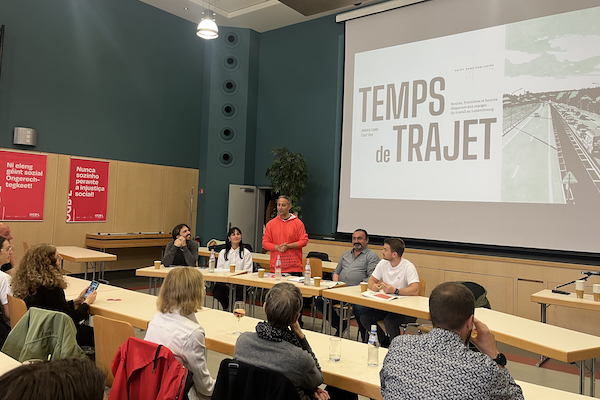
 Attendess at a round table event on travel conditions for commuters, at the Maison du Peuple in Esch-sur-Alzette;
Credit: Transition Minett
Attendess at a round table event on travel conditions for commuters, at the Maison du Peuple in Esch-sur-Alzette;
Credit: Transition Minett
On Wednesday 6 May 2026, a round table discussion dedicated to the issue of travel times and their social and climate impacts took place at the Maison du Peuple in Esch-sur-Alzette.
Organised by Transition Minett and the OGBL, the event brought together representatives of social and environmental movements, including Antonio Veneziani, President of the Esch section of the OGBL and Alexandre Couderc from Haus vum Vëlo, alongside the authors of the illustrated book Temps de trajet, Jessica Lopes and Charl Vinz. The discussion was moderated by Eric Lavillunière from Transition Minett.
Transition Minett reported that the debate began with a simple yet fundamental question: do we really have a choice in our means of transport? In their book Temps de trajet, authors Jessica Lopes and Charl Vinz examined the time spent travelling to work. Their book highlights different realities depending on professions, gender and housing situations, where some people benefit from flexibility or remote working, while others face rigid schedules, long journeys and overcrowded transport. In some cases, up to three hours per day can be lost in traffic jams or train delays.
The speakers recalled that, in theory, a 24-hour day is logically divided into eight hours of work, eight hours of sleep and eight hours of free time. However, inequalities caused by work are increasingly disrupting this balance.
They noted that loss of time directly affected quality of life: fatigue, stress, lack of sleep, tension on public transport and difficulties maintaining a balanced family or social life. As highlighted during the discussion, time is both a collective and precious resource and discussing travel times means questioning the organisation of society as a whole: housing, mobility, regional planning, work organisation and access to public transport.
Among the ideas discussed, the authors of the book and Antonio Veneziani raised the issue of gradually reducing working hours as a possible way to better distribute life balance and allow citizens to devote more time to their loved ones, their health or their commitments.
Alexandre Couderc highlighted more sustainable mobility solutions that are also beneficial to health, particularly cycling, as well as diversifying means of transport. Car sharing and less polluting vehicles were also mentioned as positive developments, especially with rising fuel prices.
Transition Minett detailed that discussions with the event’s audience highlighted the shortcomings of Luxembourg’s infrastructure in the face of the constant increase in the number of commuters and cross-border workers. Examples from abroad were also discussed, particularly in Switzerland, where some companies allow time spent travelling to count as working time when employees are able to work during their journeys.
The participants also noted that Luxembourg would need to adapt both its infrastructure and attitudes in order to preserve its attractiveness and respond to current social and climate challenges.
Transition Minett said one of the key conclusions of the evening was the need to create more collective spaces for dialogue around issues of mobility and work-life balance in order to imagine solutions developed together with citizens, workers, employers and political decision-makers.