 Credit: lux-Airport
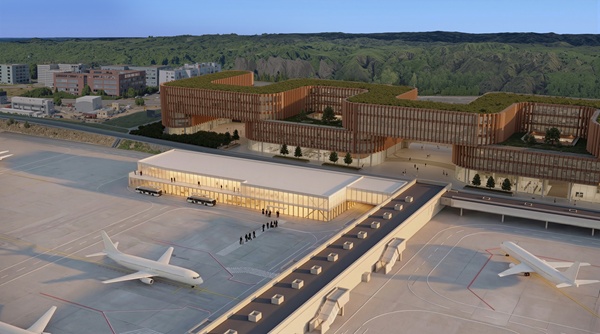
On Thursday 16 April 2026, Luxembourg's Ministry of Mobility and Public Works and lux-Airport unveiled the Luxembourg Airport "Masterplan", a strategy aimed at developing airport infrastructure to 2050.
For the first time, the authorities have drawn up a strategic planning document for the development of airport infrastructure in Luxembourg. The masterplan provides an overview and identifies potential projects with a clear concept and structure for the organisation of the airport site. This strategic document presents a vision to 2050 but does not constitute a definitive construction plan. The projects mentioned will need to be developed and analysed in detail, particularly from a technical and budgetary perspective, before any implementation decisions are made. It therefore serves as a framework for structuring planning and discussions regarding the future development of the airport, the authorities noted.
"Luxembourg Airport is much more than a transport infrastructure: it is a catalyst for growth, connectivity and prosperity for the country. My responsibility is to anticipate future needs, ensure that the necessary investments are made, and guarantee that the airport continues to sustainably support the Luxembourg economy. A structured and coherent vision within a comprehensive concept has proven essential. The masterplan is a first; it is a strategic roadmap, the expression of a strong political will: it creates a clear, rational, and sustainable framework, and it methodically anticipates the needs and opportunities of tomorrow," stated Luxembourg's Minister for Mobility and Public Works, Yuriko Backes.
The strategic importance of Luxembourg Airport extends beyond its role in connectivity. Independent economic studies have confirmed its central role in the economic development of the country and the Greater Region. With an estimated economic impact of €9.2 billion, representing nearly 13% of Luxembourg's gross domestic product (GDP), the airport supports approximately 90,000 jobs across the Greater Region, including 55,000 in Luxembourg itself. These figures illustrate the airport's key role as a regional economic driver, whose capacity and performance directly influence the competitiveness, attractiveness and resilience of the Luxembourg economy, according to the authorities.
Over the past eighteen months, the Luxembourg government has taken several decisions to support the airport's development. An investment plan has been defined for the next seven years, until 2032, which includes over €1 billion in investments. The State is contributing over €200 million to this plan, with the remainder financed by lux-Airport.
Through this structured and progressive planning, the airport infrastructure is resolutely focused on the future, the authorities said. By anticipating traffic growth, modernising its infrastructure and enhancing service quality, Luxembourg Airport is set to consolidate its role as a strategic European hub.
Sustainability and environmental considerations are described as essential pillars of the development strategy, balancing growth, operational performance and environmental responsibility. The airport's development is being carried out using an integrated approach aimed at optimising land and resource use, strengthening public transport services and promoting sustainable multimodal mobility solutions.
Furthermore, lux-Airport intends to establish a lasting presence in its local environment by fully embracing its role as a responsible institutional actor, working closely with neighboring municipalities and all stakeholders to contribute to balanced and harmonious territorial development.
The authorities added that traffic forecasts are a central element of lux-Airport's strategic planning. They allow the airport to anticipate long-term demand trends and determine the timing, scope and prioritisation of infrastructure investments, ensuring a sustainable balance between capacity and actual needs. Current forecasts project 10.6 million passengers (+100% compared to 2025) and 1.25 million tonnes of freight (+50%) by 2050, as well as a total of 107,000 commercial aircraft movements (+42%). The joint objective of the airport operator and the government, specifically the Ministry of Mobility and Public Works, is to optimise the future use of the limited space at the Findel site.
The planning process adopted in the master plan allows for a gradual, coherent and sustainable deployment of investments.
Among the priority areas of the master plan are:
- expansion and modernisation of Terminals A and B;
- extension of apron areas and reconfiguration of taxiways;
- modernisation and development of cargo facilities;
- new onboard catering facilities;
- maintenance, repair and overhaul (MRO) activities;
- dedicated drone facilities;
- creation of de-icing and engine testing areas;
- construction of a new business aviation centre and a new VIP lounge.
In this context, the authorities described the construction of a new hybrid control tower as essential to ensuring the continuity of safe, efficient and future-proof air navigation services.
The first phase of the master plan, extending to 2032, aims to address the most pressing capacity challenges in the terminals and on the airside, while also modernising existing infrastructure.
Terminal A expansion (2028)
This first phase includes:
- the installation of a modern, centralised security screening facility equipped with newly certified, state-of-the-art technology;
- improvements to check-in and baggage drop-off processes to enhance the operational efficiency of boarding.
Terminal B expansion (2028)
The expansion of Terminal B will create approximately six additional boarding gates, accessible by bus. The works, scheduled for completion by 2028, are expected to help alleviate congestion in Terminal A and improve passenger comfort. The project also includes a new retail area, aimed at enhancing the overall passenger experience.
Terminal A extension (2032)
This second phase aims to further optimise passenger journeys, notably through the implementation of a new baggage handling system, significantly increasing processing capacity and overall efficiency. The extension is also expected to create seamless, covered access between the tram platform and the terminal.
Furthermore, a reconfiguration of the main aircraft parking area is planned, increasing overall capacity and creating additional parking positions with direct access to the terminal.
Air traffic control - hybrid control tower
According to the authorities, modernising air traffic control is a key driver of development and resilience for airport infrastructure. To this end, the plan includes the construction of a new hybrid air traffic control tower (ATC Tower), integrated near the future VIP lounge and combined with the establishment of a digital control and training centre. This infrastructure upgrade aims to integrate cutting-edge technologies, improve operational resilience, optimise airspace management and support future operational needs in the interest of enhanced safety.
Cargo area
The cargo area and its associated infrastructure will also undergo targeted modernisations to support future growth in cargo activities and improve the efficiency of logistics operations.
The capacity of aircraft parking aprons will be increased to meet the growing demand from air traffic. This expansion will accommodate a larger number of aircraft, while also taking fleet evolution into account.
Fuel farm
Under the laws of 7 August 2023 and 17 December 2025, construction of a new, modern fuel depot began on 2 October 2025, aimed at ensuring greater security of supply. It will include up to six storage tanks, each with a capacity of 5,000 m³, and represents a major step forward in the modernisation of the airport's infrastructure. The works will be completed in 2028.
New VIP lounge
A new VIP lounge ("salon d'honneur") for official delegations will be built, reflecting the need for prestigious facilities that meet today's standards.
The ministry and lux-Airport concluded that all of these improvements will contribute to enhancing the overall operational performance and resilience of the airport infrastructure.