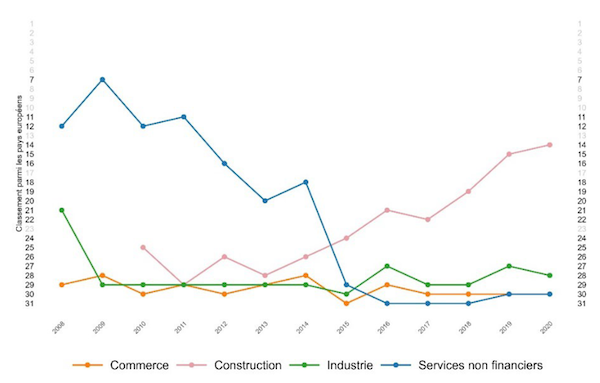
 Luxembourg's ranking by EBITDA margin among European countries;
Credit: EUROSTAT SBS data
Luxembourg's ranking by EBITDA margin among European countries;
Credit: EUROSTAT SBS data
On Thursday 7 May 2026, STATEC, Luxembourg’s national statistical office, published a study examining the determinants of business profitability in Luxembourg.
According to data, Luxembourg ranks among the least profitable European economies when profitability is measured by the gross operating surplus (GOS) rate.
The GOS rate is “strongly” influenced by the large share of trading activities, such as international trade, subcontracting and distribution activities in turnover, STATEC explained, adding that overall, trading has a negative effect on the GOS rate in European countries, with a stronger impact in Luxembourg than in other countries.
In absolute value, Luxembourg’s gross operating surplus increased by more than 50% between 2008 and 2020, indicating that the economy generates substantial profits. The study also highlights that the measurement of profitability should not rely on a single indicator for large aggregates. In particular, the use of the margin rate instead of the GOS rate improves Luxembourg’s relative position.
Furthermore, according to data, Luxembourg shows a high operating surplus but a low level of profitability. The GOS rate is a business profitability indicator generally used at aggregate level. It measures the share of gross operating surplus in total turnover. GOS is defined as the surplus generated after covering labour costs.
According to this indicator, Luxembourg consistently ranks among the least profitable economies in Europe. This finding, reported by STATEC and confirmed by Eurostat data, has raised concerns regarding the competitiveness and performance of Luxembourg’s non-financial businesses.
However, this ranking does not mean that Luxembourg companies generate low profits in absolute value. On the contrary, GOS increased strongly over time, rising by around 55% between 2008 and 2020. During the same period, the GOS rate fluctuated moderately, varying between 5.5% and 7%.
The data show that the share of trading in total company turnover in Luxembourg has consistently ranked among the highest in Europe. Although this share decreased from more than 60% in 2008 to around 50% in 2020, Luxembourg still recorded the second highest share of trading in Europe in that year.
Comparative data show that a higher level of trading is associated with lower profitability as measured by the GOS rate. This relationship is observed across all countries considered, with the exception of Germany.
The analysis based on Luxembourg-specific data shows that the negative relationship between trading and profitability is particularly pronounced in sectors such as wholesale and retail trade, as well as energy production and distribution activities (electricity and gas), which are characterised by high turnover compared with added value.
In addition, data shows that the company size plays a significant role. Large companies, defined as those employing 250 people or more, contribute strongly to total gross operating surplus, but generally show lower profitability ratios than small companies with fewer than ten employees. STATEC explained it by turnover growing faster than profits for large companies.
In both international and national analyses, labour productivity shows a consistent and positive association with profitability. Although STATEC said it does not demonstrate a direct causal relationship, the result is consistent with theoretical predictions according to which more productive companies are better able to generate an operating surplus.
The study proposes the use of the margin rate as an alternative profitability indicator, as it reflects the distribution of added value between labour compensation and the operating surplus of capital. According to STATEC, using the margin rate “GOS/added value” instead of the “GOS/turnover” changes the assessment of Luxembourg’s profitability: the country ranks better in several sectors, and this indicator is less influenced by trading.