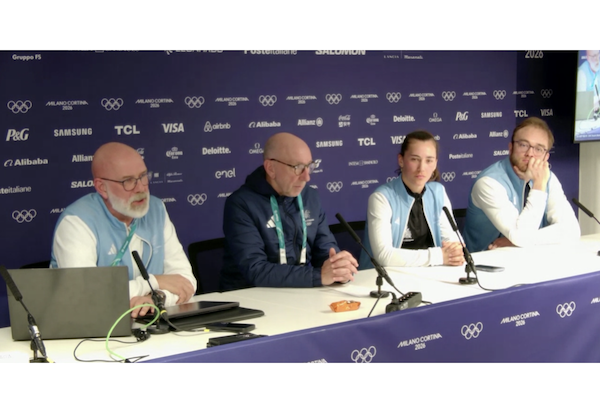
 (L-R) Raymond Conzemius, COSL Technical Director; Michel Knepper, COSL President; Gwyneth Ten Raa, Luxembourg's Alpine skier; Matthieu Osch, Luxembourg's Alpine skier;;
On Wednesday 18 February 2026, Team Lëtzebuerg concluded their participation in the Milano Cortina 2026 Winter Olympic Games with Gwyneth Ten Raa competing in the women’s slalom in alpine skiing, where she did not finish the first run.
In her first event on Sunday 15 February 2026, the giant slalom, at her second Olympic Games, the 20-year-old skier from the Grand Duchy recorded her best result to date, finishing 30th out of 76 competitors with a time of 1:06.60. This was 3.37 seconds behind Italy’s Federica Brignone, who took the win.
Speaking at a press conference organised by the Luxembourg Olympic and Sporting Committee (COSL) after the race, Gwyneth Ten Raa said she had approached the slalom with full commitment, noting that in this discipline athletes must give “100%” despite the inherent risk of not finishing. She explained that she preferred to take that risk rather than ski conservatively, emphasising that success at this level comes from pushing to the limit, not from holding back.
The second member of Team Lëtzebuerg, Matthieu Osch, also competed in the same alpine skiing events and matched his best-ever Olympic result. In the slalom on Monday 16 February 2026, the 26-year-old skier, who did not finish in this discipline at the Pyeongchang 2018 and Beijing 2022 Winter Olympic Games, secured 28th place in Milano Cortina with a time of 1:04.22, finishing 8.5 seconds behind gold medallist Loïc Meillard of Switzerland.
In the giant slalom on Saturday 14 February 2026, Matthieu Osch had placed 28th four years ago and finished 46th in Milano Cortina with a time of 1:25.06, just over eight seconds behind Brazil’s Lucas Pinheiro Braathen, who claimed gold.
Speaking after the competition, Matthieu Osch also reflected on his performance. He described the slalom as a discipline decided by “millimetres”, where the margin for error is extremely small. He acknowledged that taking significant risks is unavoidable at this level and that such an approach can lead to mistakes or disqualification, but stressed that pushing hard is essential in order to compete at the highest level.
Michel Knepper, President of the Luxembourg Olympic and Sporting Committee (COSL), also underlined the broader significance of Luxembourg’s participation. He noted that alpine skiing is no longer limited to traditional Alpine nations and that an increasing number of so-called non-traditional countries are now represented at the highest level. According to Michel Knepper, this reflects the growing inclusivity and international development of the sport, with smaller nations such as Luxembourg steadily strengthening their presence on the Olympic stage.