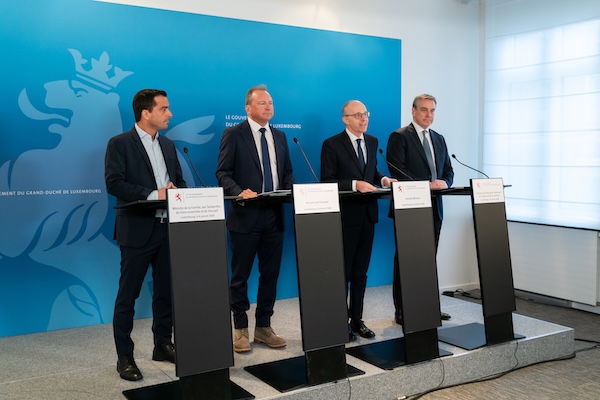
 (L-R) Max Hahn, Minister for Family, Solidarity, Community Life and Reception; Gilles Roth, Minister of Finance; Luc Frieden, Prime Minister of Luxembourg; Claude Meisch, Minister of National Education, Children and Youth;
Credit: SIP / Emmanuel Claude
(L-R) Max Hahn, Minister for Family, Solidarity, Community Life and Reception; Gilles Roth, Minister of Finance; Luc Frieden, Prime Minister of Luxembourg; Claude Meisch, Minister of National Education, Children and Youth;
Credit: SIP / Emmanuel Claude
On Tuesday 6 January 2026, the Luxembourg Government unveiled a new package of measures for families in Luxembourg, including the introduction of a single tax class, the reform of the childcare voucher system and adjustments to the family allowance.
The new measures, titled “Mateneen. Fir all Famill. Fir all Kand.” (“Together. For every family. For every child.”) were officially announced by Luxembourg Prime Minister Luc Frieden at a press conference at the Hôtel Saint-Augustin in Luxembourg-Ville.
The press conference, which also featured speeches from Minister of Finance Gilles Roth, Minister of National Education, Children and Youth Claude Meisch, and Minister of Family, Solidarity, Living Together and Reception Max Hahn, outlined a series of new measures, some of which form part of the national action plan for the prevention of and fight against poverty first outlined on 9 December 2025.
The new measures include the introduction of a single tax class as of 1 January 2028, an increase of the tax-free allowance to €26,650 (compared with the current level of €13,230 for tax class 1), the introduction of an “early childhood allowance” - a tax reduction amounting to €5,400 per year and per child under the age of three - an increase to the amount of the single-parent tax credit to €4,008 (compared with the current rate of €3,504) and 20 hours of free childcare per week for children aged one to four.
In introducing the measures, Prime Minister Frieden said: “The fight against poverty is a point we have always insisted on since the beginning of our legislature because there is a risk that children will fall into poverty. That is why we need strong support for children. We think it is important and this is reflected in these proposals.”
He added: “Like other countries in Europe, Luxembourg has evolved a lot in the last 20 years. We need to achieve social justice regardless of family composition. Everyone must be treated the same way and better than in the past.”
Minister Roth described the reforms as “a modern concept that corresponds to everyone's circumstances” and stated: “It is simpler, more transparent, more equitable for everyone, no one loses anything and it is a relief for the working middle class.”
Proposed tax reforms:
⁃ as of 1 January 2028, all new taxpayers, as well as those currently belonging to tax classes 1 and 1a, will be taxed under the new tax class. Taxpayers who were jointly taxed before 1 January 2028 will be able to continue benefiting from the rate of the former tax class 2 for 25 years;
⁃ in the event of death or divorce during the transitional period, the benefit of the former tax class 2 rate will be maintained for five years (instead of current period of three years);
⁃ introduction of an “early childhood allowance,” amounting to €5,400 per year and per child under the age of three;
⁃ single-parent tax credit to be increased to €4,008;
⁃ the allowance for children who are not part of the taxpayer’s household will increase from €5,424 to €5,928;
⁃ the ceiling for the deductibility of debit interest as well as insurance premiums and contributions paid by taxpayers will be set at €900 instead of the current level of €672;
⁃ the annual deductible amount for contributions paid under a home-savings contract will increase from €1,344 to €1,500 for persons aged 18 to 40 inclusive and from €672 to €900 in other cases;
⁃ the flat-rate allowance for household help costs, assistance and care costs due to dependency, as well as childcare costs, will be set at €6,000 (€5,400 currently).
As part of the tax reforms, the government has also proposed introducing an indexation mechanism for the tax scale following three index brackets. This is intended as a correction to the increased tax burden resulting from monetary erosion due to rising prices.
The government also announced the restructuring of the childcare voucher scheme (CSA) around four main pillars: financial relief for parents; a guarantee of a childcare place for every child by 2030; improved service quality; and strengthened governance.
To ensure fairer billing adapted to actual needs, new billing rules will apply. A uniform tariff will be applied across all education and care services. Billing will be based on the child’s registered hours rather than on a fixed hourly package imposed on parents. Parents will also be able to adjust their childcare needs on a monthly basis.
To further reduce child poverty, households with an income less than or equal to 3.5 times the social minimum wage will benefit from targeted financial relief and children aged one to four cared for by childminders will benefit from 20 hours of free childcare per week.
The government said it reaffirmed its objective of guaranteeing, by 2030, a childcare place for every child who needs one and will invest in a targeted manner in service quality and added that new governance rules will strengthen transparency and ensure that investments in non-formal education effectively benefit children.
The government said another of its key priorities is to strengthen support for families, particularly households with children, and it announced several adjustments will be made to benefits administered by the Children’s Future Fund:
⁃ structural increase in family allowances of €45 for children up to the age of twelve and €60 for children over the age of twelve;
⁃ the introduction of targeted financial aid for low-income households with school-age children, amounting to up to €3,000 per child per year;
⁃ an increase in the back-to-school allowance by €60 for children aged six to eleven and by €90 for children over the age of twelve;
⁃ automatic indexation of the back-to-school allowance, the supplementary special allowance and birth grants.
Minister of Family, Solidarity, Living Together and Reception Max Hahn remarked: “In the context of this major societal change, it is essential for us to place families at the centre. The objective is to allow every child to grow up under the best possible conditions and to ensure that their needs are met, regardless of the parents’ situation.”
Minister of National Education, Children and Youth, Claude Meisch, added: “The system will become more transparent and accessible. We will strengthen the chances of these children in view of their future. These changes also allow parents to go to work. Parents can have a restful mind by going to work knowing that their children will be well cared for. This also represents an increase in purchasing power if the second partner goes to work. This is what the government wants, more net income than gross income.”
Minister Roth emphasised: “We are at the beginning of a legislative process. Adaptations will still be necessary. We hope that this reform will be voted on by the end of the year.”
In closing, Prime Minister Frieden stated: “You can see that the government is starting the year on a high note with an ambitious policy […] We have several goals that emanate from the coalition agreement. It is an investment for the contributors, a reinforcement of purchasing power and an increase of social cohesion in favour of those who have are experiencing difficulties.”