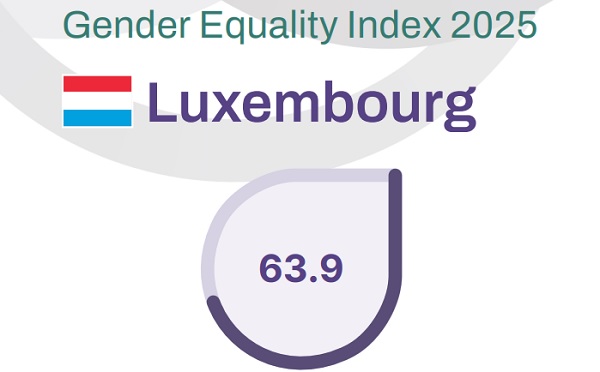
 Gender Equality Index 2025 - Luxembourg;
Credit: European Institute for Gender Equality
Gender Equality Index 2025 - Luxembourg;
Credit: European Institute for Gender Equality
Luxembourg has secured 9th place in the European Union's (EU) Gender Equality Index for 2025.
The Grand Duchy achieved an overall score of 63.9 out of 100 - slightly above the EU-27 average of 63.4.
Since 2015, Luxembourg has improved its score by 10.1 points, making it one of the fastest-advancing Member States over the past decade. The report, issued by the European Institute for Gender Equality (EIGE), highlighted that Ireland, Spain and Malta recorded the strongest progress (an increase of about 13 points), followed by Luxembourg and Belgium (about 10 points each). Between 2020 and 2025, the Grand Duchy gained 4.6 points.
Over the past five years, Luxembourg has made progress in most domains, with the exception of health, where a slight decline was noted. The country improved its scores in work (+4 points), money (+2.6), knowledge (+1.5) and power (+9.7), but fell by 0.4 points in health. Due to a lack of data, progress since 2020 was not recorded for any Member State in the domain of time.
Luxembourg's Ministry of Gender Equality and Diversity highlighted that long-term analysis since 2015 reveals a positive trend even in the health domain, with an overall improvement and reduced inequalities between women and men.
Progress in the work domain was particularly notable. Luxembourg, along with Malta, saw "considerable growth" in women's employment, the length of their working lives and the share of women managers. However, Luxembourg was also the EU Member State with the highest share of women in low-paid jobs (38%). Overall, there is room for improvement in this domain, where Luxembourg ranks 19th.
The EIGE report also showed that 22% of employed women living in single-adult households struggled to meet basic needs - one of the highest rates in the EU.
The ministry described gender income and pension gaps as "particularly noteworthy". In Luxembourg, women in couples earn 80% of their partner's annual salary, while men earn 33% more than their partners. These gaps have narrowed over the past decade. The difference in income ratios is particularly pronounced among couples where at least one partner is highly qualified and among couples with children. The pension gap stands at 33% in Luxembourg, compared to 25% at EU level. Overall, Luxembourg ranked 19th in the money domain, with a score of 73.7 points.
The report found Luxembourg to be among the Member States with the highest percentage of women with higher education. Women are more likely than men to complete higher education (70% of women aged 30 to 34 compared to 62% of men). The share of women in ICT-related professions has also increased by 3% since 2015, reaching 17%, although this remains below the EU average. Overall, knowledge is one Luxembourg's strongest areas, where it ranks 5th.
In the care sector, women continue to shoulder the majority of domestic tasks and caregiving responsibilities, devoting more time than men to childcare and housework. Among parents of children up to the age of eleven, 24% of women spend more than five hours a day on these tasks, compared to 11% of men. 38% of women reported carrying out household chores, such as cooking, cleaning and laundry, compared to 21% of men.
Growth in the power domain since 2020 is largely due to improvements in the sub-domains of economic and social power. However, women remain underrepresented in political roles. Luxembourg's score in this area stands at 37.3 points, placing it 12th in the EU.
In the health domain, Luxembourg has improved its score by 5.5 points since 2015, despite the small decline since 2020.
This year's Gender Equality Index is based on a revised methodology - the first major update since 2013. The update reflects a constantly evolving context in which policy priorities are shifting, placing greater emphasis on the impact of digitalisation on daily life and society and the importance of work-life balance. It also introduces updated indicators, new data sources and increased attention to individual data (not just household data).
The EU-wide score for 2025 stands at 63.4 points, representing an increase of 10.5 points since 2010 and by 7.4 points since 2015. At the current rate of progress - an increase of around 0.7 points per year - EIGE estimates it will take at least 50 years to achieve full gender equality in the EU.
Yuriko Backes, Luxembourg's Minister for Gender Equality and Diversity, expressed the belief that "while the progress our country has made on gender equality is encouraging, it must in no way lead us to relax our efforts to build a fairer society. The National Action Plan for Gender Equality, presented in March 2025, coordinates 55 measures and 109 concrete actions structured around six objectives closely linked to the Gender Equality Index areas requiring improvement."
For the full report, visit https://eige.europa.eu/publications-resources/publications/gender-equality-index-2025-sharper-data-changing-world