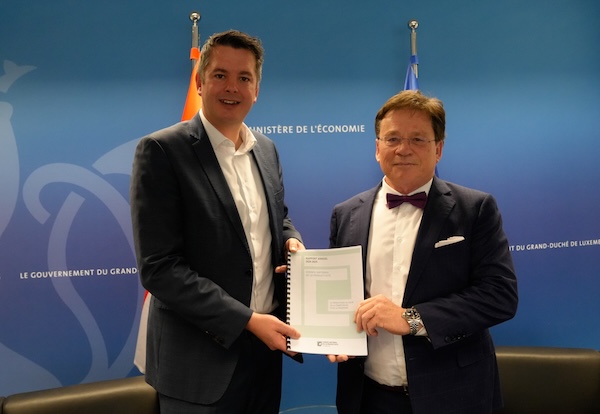
 (L-R) Lex Delles, Minister of Economy, SMEs, Energy and Tourism; Serge Allegrezza, President of the National Productivity Council (CNP);
Credit: MECO
(L-R) Lex Delles, Minister of Economy, SMEs, Energy and Tourism; Serge Allegrezza, President of the National Productivity Council (CNP);
Credit: MECO
On Tuesday 10 February 2026, Luxembourg’s Ministry of the Economy reported that the National Productivity Council (CNP) had submitted its 2024–2025 annual report to the Minister for the Economy, SMEs, Energy and Tourism, Lex Delles.
According to the ministry, the report was submitted on Friday 6 February and highlights the essential role of productivity for businesses, in advancing real wages, ensuring the sustainability of the socio‑economic model and achieving the ecological transition.
The annual report, entitled Revitalising Productivity – Elements for an Action Plan, draws attention to the stagnation of labour productivity in Luxembourg over more than a decade. The ministry said this trend masked significant disparities between economic sectors. The CNP also evaluated resource and energy productivity to assess, from a sustainable development perspective, the value created for each unit of resource or energy used in production.
The report detailed that based on data from the past ten years, Luxembourg has not yet managed to decouple its consumption of raw materials from its economic growth. In contrast, energy productivity has improved. For the first time, 25% of the electricity consumed in Luxembourg was generated domestically from renewable energy sources. However, despite a gradual decline, the report noted that the country maintained a high level of greenhouse gas emissions largely due to fuel sales.
As part of its reporting, the CNP issued a list of recommendations to revive productivity growth in Luxembourg. These cover various areas including innovation, corporate policy and artificial intelligence. The latest edition of the report tracked the implementation of these recommendations and analysed the measures the government had taken since the publication of the previous annual report.
The ministry detailed that as in previous years, the CNP’s report also included applied research studies on productivity. The first study, conducted by the CNP Secretariat, examined the impact of Luxembourg’s economic structure, characterised by a strong financial presence, on the level and evolution of productivity. The results showed that this structure contributes to a high but stagnant level of productivity.
The second study, carried out by Luxembourg's national statistical institute STATEC, illustrated the evolution of total factor productivity (TFP) based on the latest update of the LuxKLEMS project. Luxembourg recorded modest TFP growth, largely driven by the service industries. The report indicated the slowdown was linked to the effects of technological change. Moreover, the study examined the relationship between TFP evolution and investment in information and communication technology (ICT) capital across different economic sectors.
The third study, also conducted by STATEC, investigated the link between investment in intangible capital and TFP growth. The findings indicated that investment in intangible capital, primarily in branding, organisational capital and training, can lead to TFP growth.
Serge Allegrezza, President of the CNP, said: “Productivity lies at the heart of our country’s competitiveness.”
The CNP’s 2024–2025 annual report will be submitted to the European Commission and forwarded to the Economic and Social Council for opinion.
The report can be consulted at https://productivite.public.lu/en.html.