On Friday 6 March 2026, the Luxembourg Sustainable Finance Initiative (LSFI) published the Luxembourg Women in Finance (WiF) Charter 2025 Progress Report providing an overview of women’s representation across seniority levels within signatory organisations, including the targets set and the concrete initiatives undertaken.
The report was prepared together with the WiF Charter Founders using data collected in 2025. It covers 85 signatory organisations representing nearly 31,000 employees, approximately 42% of Luxembourg’s financial sector workforce. The report shows gradual progress alongside persistent structural challenges and notes that women represent one-third of senior managerial roles among Luxembourg WiF Charter signatories.
“Gender balance in finance is a business imperative. Initiatives such as the WiF Charter in Luxembourg play a critical role in turning commitment into measurable action by setting clear standards, accountability and visibility around progress. Transparency is equally essential: when organisations openly track and report gender metrics, they build trust, accelerate change and ensure momentum does not stall. While commitment across Luxembourg’s financial sector remains, with an increased number of signatories and progress, accelerating this progress in the highest leadership positions is the next critical step to ensure the targets are met in line with the timeline set,” noted Nicoletta Centofanti, LSFI CEO and Luxembourg WiF Charter Data Partner.
The number of signatories increased from 78 in 2024 to 85 as of 31 December 2025, including seven new organisations that joined the initiative during the year. According to the data, banks remained the largest subsector represented, with their number rising from 34 to 38. Among the signatories, 41% were small firms, 25% were medium firms and 34% were large firms.
Workforce distribution showed that women accounted for 47.1% of the total workforce across the signatory organisations, a figure that remained stable compared to the previous year. However, part-time work remained disproportionately female, with more than seven out of every ten part-time positions held by women.
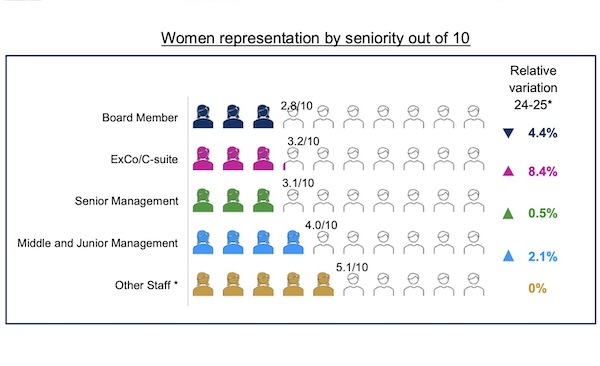
The data also showed that women’s representation at the most senior levels has increased slightly. The share of women in ExCo and C-suite roles rose from 29.9% in 2024 to 32.4% in 2025. At the board level, however, representation declined from 29.8% to 28.5%, moving further away from the average target of 34.4% set by signatories. Overall, men remain more represented in the most senior leadership positions and are roughly twice as likely as women to hold top leadership roles.
Women’s representation across seniority levels showed gradual progress, although gaps remain at several managerial levels. The variation presented in the report considers the year over year evolution of the 2024 signatories, which includes 75 organisations and is reflected in the percentage change. However, the current representation reflects the situation of the 2025 workforce across 85 signatory organisations.
Target setting among signatories also strengthened. According to the report, 79 signatories had targets for senior management representation, up from 68 in the previous year. In addition, 69 organisations had targets for board representation, compared to 63 previously, while 53 had targets for ExCo and C-suite levels, up from 50.
Despite this progress, women’s representation remained below the average targets set for all managerial levels, with variations across subsectors. The report noted that most deadlines set by signatories fell between 2025 and 2028, meaning further progress toward these targets will become clearer in future reporting periods.
Women’s representation increased slightly in most seniority levels between 2024 and 2025, rising to 39.6% in middle and junior management, 31.1% in senior management and 32.4% in ExCo and C-suite roles, while board representation declined to 28.5%.
WiF Charter signatories introduced a range of initiatives to promote gender balance, including inclusive leadership practices, flexible working models and measures to address the gender pay gap through audits and remuneration governance. Organisations also reported efforts to improve recruitment and promotion practices through gender-neutral job language, diverse interview panels and unconscious bias training, alongside leadership development initiatives such as mentorship and training programmes.
Despite gradual progress in executive and senior management representation, the report noted that declining board-level figures and persistent sector gaps show that achieving gender balance at the highest leadership levels remains a challenge.